Best Stainless Steel Mixing Bowl Sets
What's inside
As an Amazon Associate I earn from qualifying purchases. This post may contain affiliate links at no extra cost to you.
Our Top Picks
 Umite Chef Mixing Bowls with Airtight Lids Set5, 4, 3.5, 2, 1.5QT2 x 2 x 2 inches0.8 poundsCheck on Amazon


Best Stainless Steel Mixing Bowl Sets
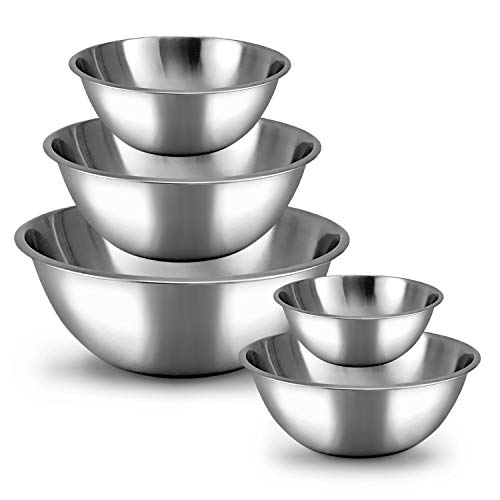
The best stainless steel mixing bowl set for most kitchens is a nesting set with four or five bowls, capacities from roughly 1.5 to 5 quarts, a thick enough body to resist denting, and nonslip bases on the bowls you use most often. Lids are useful for storage, but they should not outweigh stability, useful size spacing, and easy cleaning.
Quick comparison: what you get at different price levels
| Set type | Typical capacities | Typical steel and gauge | Best for | Expected price range |
|---|---|---|---|---|
| Basic nesting set | 1.5, 2, 3, 4, and 5 qt | 430 stainless steel, approximately 24–22 gauge | Occasional baking and everyday prep | $20–$40 |
| Heavy-duty kitchen set | 1, 2, 3, 4, and 5–6 qt | 18/8 or 18/10 stainless steel, approximately 22–20 gauge | Frequent cooking and batch preparation | $40–$90 |
| Professional-style set | 1, 2, 3, 5, 8, and 13 qt | Heavy 18/8 stainless steel, often around 20–18 gauge | Large batches, dough, catering, and food prep | $70–$160 |
| Premium storage set | 1.5, 2.5, 3.5, 4.5, and 5.5 qt | 18/8 or 18/10 steel with coated bases or silicone rings | Regular use where storage and stability matter | $60–$130 |
Gauge numbers can be confusing: a lower gauge generally indicates thicker metal. Manufacturers do not always publish gauge, and some use rolled rims or shaped bases to make relatively thin steel feel more rigid. Treat gauge as a useful clue, not a complete quality measurement.
As an Amazon Associate we earn from qualifying purchases at no extra cost to you.


Our picks by kitchen situation
Best all-around choice: five-piece nesting set with nonslip bases
For most households, choose five bowls between 1.5 and 5 quarts. A set with a small bowl for whisking dressings, two medium bowls for ingredients, and a 4- or 5-quart bowl for batter covers more tasks than a six-piece set with several nearly identical sizes. OXO Good Grips stainless steel bowls are a well-known example of this design approach, with broad bases and nonslip support intended to keep the bowl steady during mixing.
Look for a base that grips the counter without permanently trapping food or water. A silicone or rubber ring should be securely fitted, not loosely glued to the underside. Nonslip bases are particularly valuable when creaming butter, kneading a small amount of dough, or mixing thick cookie batter.
Best for frequent cooking: heavy-gauge professional-style bowls
If you prepare food several times a week, prioritize wall rigidity and rim construction over extra accessories. Vollrath stainless steel mixing bowls are commonly sold in commercial-style sizes, including large capacities that are useful for salad, bread, and bulk preparation. Heavy bowls tolerate repeated handling better and are less likely to flex when scraping dense mixtures.
The trade-off is storage. A professional set may include an 8- or 13-quart bowl that occupies considerable cabinet space, while its smallest bowl may still be too large for a single serving of dressing. Buy this style when you routinely make large quantities, not simply because the metal appears more substantial.
Best for storage: bowls with fitted lids
A set with plastic lids turns mixing bowls into refrigerator containers. This is useful for marinating, chilling dough, storing chopped vegetables, or saving leftovers without transferring food to another vessel. Cuisinart and KitchenAid both sell stainless steel bowl sets in configurations that may include lids, depending on the specific collection and market.
Check whether the lids are airtight, leak-resistant, or merely dust covers. Most bowl lids are not suitable for shaking liquids or transporting soup. They can also warp, retain odors, or become difficult to fit after dishwasher cleaning if the care instructions are ignored. A lid is a bonus; it should not justify buying a bowl set with poor sizes or unstable bases.
What to compare before buying
Capacities and spacing
A useful set separates sizes enough to give each bowl a purpose. Five bowls at 1, 1.25, 1.5, 1.75, and 2 quarts technically offer variety but waste cabinet space. A better household progression is approximately 1.5, 2, 3, 4, and 5 quarts.
For baking, a 4- or 5-quart bowl is usually large enough for a standard cake or cookie recipe while leaving room for stirring without splashing. A 6-quart bowl is more comfortable for double batches. For bread or large salads, 8 quarts or more is preferable. Remember that stated capacity is filled to the rim; practical working capacity is often about 70% to 80% of that figure.
Steel grade and resistance to stains
18/8 and 18/10 stainless steel contain chromium and nickel and are common choices for food-preparation bowls. They resist rust and staining well under normal kitchen use. 430 stainless steel is also widely used and can be perfectly serviceable, although it generally contains less nickel and may show discoloration or surface marks sooner in harsh conditions.
Stainless steel can develop rainbow heat tint, water spots, or residue from acidic foods. These are usually cosmetic rather than signs that the bowl has failed. A paste of baking soda and water or a stainless-steel cleaner can remove many marks. Do not use chlorine bleach, steel wool, or abrasive powders that leave deep scratches.
Resistance to dents
Thin bowls are light and inexpensive but can dent if dropped, pressed against a sink, or stacked carelessly. Dents around the rim are especially troublesome because they can prevent lids from sealing and make nesting uneven. A rolled rim and a reinforced bottom improve stiffness. If a bowl feels flexible when you press its side with moderate finger pressure, expect more visible wear over time.
Nonslip bases
A silicone base is most valuable on medium and large bowls, where stirring creates more leverage. It also keeps a metal bowl from sliding on a smooth countertop. However, a permanently attached ring can make the bowl harder to dry underneath and can trap crumbs. Removable rings are easier to clean but may be misplaced or loosen with age.
Dishwasher safety
Plain stainless steel bowls are generally dishwasher-safe, but the rest of the set may not be. Lids, silicone feet, printed measurement marks, and decorative coatings often have separate instructions. Place bowls so water can drain fully, and remove them promptly after the cycle to reduce spotting. Hand-drying with a soft towel preserves a brighter finish but is not essential for function.
Decision matrix
| Your situation | Prioritize | Recommended configuration | Skip or reconsider |
|---|---|---|---|
| Small kitchen or limited cabinets | Tight nesting and stackable lids | Four or five bowls from 1.5 to 5 qt | Sets containing 8–13 qt bowls |
| Frequent baking | Stable bases and a roomy largest bowl | Five bowls, including 4–6 qt | Very light bowls with narrow bases |
| Large family or batch cooking | Thicker steel and larger capacities | Professional-style set with 5–13 qt bowls | Sets whose largest bowl is under 5 qt |
| Lowest practical cost | Plain steel and useful size spacing | Basic five-piece 430 or 18/8 set | Paying extra mainly for decorative finishes |
| Food storage as well as mixing | Fitted lids and refrigerator-friendly shapes | Four or five bowls with labeled, washable lids | Assuming every lid is leakproof or oven-safe |
Ownership realities and maintenance
The first parts to show wear are usually silicone bases, plastic lids, and rolled rims—not the stainless steel itself. Check the underside of each bowl periodically for a loose ring, trapped moisture, or rust-colored residue around a damaged joint. A bowl with a loose base should be dried thoroughly and replaced if the ring cannot be secured.
To avoid dents, do not drop bowls into a deep sink or nest them while wet with heavy cookware inside. Leave the smallest bowls accessible instead of repeatedly pulling the entire stack apart. If you mix hot ingredients, allow the bowl to cool before putting on a plastic lid; trapped steam can distort some lids and encourage condensation.
For stubborn residue, soak the bowl in warm water with dish soap, then use a non-scratch sponge. Never use stainless steel bowls in a microwave. Although the steel itself handles refrigerator and freezer temperatures well, verify that any lid is rated for the intended temperature before storing or reheating food.
Final verdict
Choose a five-piece, 18/8 or 18/10 stainless steel set with capacities around 1.5, 2, 3, 4, and 5 quarts if you want the best balance of versatility, storage, and durability. Add nonslip bases if you mix heavy batters or dough. Choose heavier commercial-style bowls for large batches, and choose lids only when refrigerator storage is a genuine part of your routine. The most durable set is not necessarily the thickest or most expensive; it is the one whose sizes, bases, and cleaning requirements match how you actually cook.