Hole Saw Cutter Sets for Metal: Sizes, Tooth Types and Drill Speeds
What's inside
- What’s actually inside a metal-rated set
- Tooth types: bi-metal vs. carbide vs. grit
- Drill speed: the RPM-by-diameter chart that decides tooth life
- Arbor and pilot-bit compatibility — the part listings don’t explain
- What a hole actually costs: matching the set to your situation
- Ownership realities: what wears, what breaks, what ruins cutters
- Frequently asked questions
- What’s actually inside a metal-rated set
- Tooth types: bi-metal vs. carbide vs. grit
- Drill speed: the RPM-by-diameter chart that decides tooth life
- Arbor and pilot-bit compatibility — the part listings don’t explain
- What a hole actually costs: matching the set to your situation
- Ownership realities: what wears, what breaks, what ruins cutters
- Frequently asked questions
As an Amazon Associate I earn from qualifying purchases. This post may contain affiliate links at no extra cost to you.
For most metal-cutting work, the right hole saw cutter set for metal is a bi-metal kit with an M42 cobalt tooth edge covering roughly 19–64 mm (3/4″–2-1/2″), run at the correct low RPM with cutting oil — upgrade to carbide teeth only when stainless steel or daily production work justifies the 3–4x price premium per cutter.
As an Amazon Associate we earn from qualifying purchases at no extra cost to you.


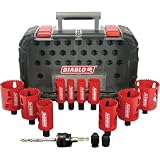

What’s actually inside a metal-rated set
A hole saw cutter set for metal differs from a wood/plumber’s kit in two ways: a hardened high-speed-steel tooth edge welded to a spring-steel body (the “bi-metal” construction), and finer or variable tooth pitch so several teeth stay engaged in thin sheet. A typical 9–13 piece set contains six to eleven cutters, one or two arbors, and a 1/4″ pilot bit. The size spread matters more than the piece count — a set that skips 22 mm or 32 mm is useless if those are the holes you actually drill.
- 16–20 mm: cable glands, small conduit, automotive grommets
- 22.5 mm: the industrial standard for pushbuttons and pilot lights on control panels — worth having if you build enclosures
- 25–32 mm: 1″ conduit knockouts, plumbing and HVAC pass-throughs
- 38–51 mm: ductwork takeoffs, larger conduit, stainless sinks
- 64 mm and up: low-RPM territory; sheet metal only, and only with a drill that has a side handle
Tooth types: bi-metal vs. carbide vs. grit
Most bi-metal saws use a 4/6 variable pitch (alternating 4 and 6 TPI), which is a good all-rounder down to about 2 mm sheet. For material under 1.5 mm, look for a fine constant pitch — the rule of thumb is keeping at least two to three teeth in contact, otherwise teeth snag and strip on the breakthrough side.
| Tooth type | Best material | Typical life vs. bi-metal | Price per 32 mm cutter (market range) | How it usually dies |
|---|---|---|---|---|
| Bi-metal (M42 cobalt edge) | Mild steel, aluminum, brass, occasional stainless | Baseline (1x) | $8–15 | Edge dulls from heat; teeth chip in thin vibrating sheet |
| Carbide-tipped | Stainless, galvanized, hardened fasteners, abrasive alloys | ~5–10x in stainless, ~3x in mild steel | $30–55 | Carbide chips from impact or a loose arbor long before it wears |
| Carbide grit | Cast iron, fiberglass-over-metal, ceramics | Slow but survives abrasives that kill teeth | $15–30 | Grit sheds; very slow in clean steel — wrong tool for it |
Lenox Speed Slot, Milwaukee Hole Dozer, Bosch, Starrett and DeWalt bi-metal sets are the common mid-market options, while carbide versions of the Hole Dozer and Diablo’s carbide line cover the heavy end. In the Indian market, a Taparia hole saw cutter set is the budget benchmark — bi-metal cutters in metric sizes sold as compact kits with a basic arbor. They’re serviceable for occasional mild steel and aluminum at correct RPM, but the pilot bits wear quickly and there’s no carbide upgrade path in the range, so frequent stainless users outgrow them fast.
Drill speed: the RPM-by-diameter chart that decides tooth life
More bi-metal hole saws die from overspeeding than from anything else — teeth that run hot turn blue and lose hardness permanently. These are conservative bi-metal figures (carbide can often run 50–100% faster — check the maker’s chart):
| Saw diameter | Mild steel RPM | Stainless RPM | Aluminum RPM |
|---|---|---|---|
| 16 mm (5/8″) | 500 | 250 | 750 |
| 19 mm (3/4″) | 460 | 230 | 690 |
| 25 mm (1″) | 350 | 175 | 525 |
| 32 mm (1-1/4″) | 275 | 140 | 410 |
| 38 mm (1-1/2″) | 230 | 115 | 345 |
| 44 mm (1-3/4″) | 195 | 95 | 295 |
| 51 mm (2″) | 170 | 85 | 255 |
| 64 mm (2-1/2″) | 140 | 70 | 205 |
| 76 mm (3″) | 115 | 55 | 170 |
| 102 mm (4″) | 85 | 45 | 130 |
The practical catch: a typical cordless drill’s low gear still tops out around 500–600 RPM, so anything over ~50 mm requires feathering the trigger well below full speed. In aluminum you can technically run fast, but chip welding loads the gullets — cutting wax or a squirt of WD-40 and frequent chip clearing matter more than RPM.
Arbor and pilot-bit compatibility — the part listings don’t explain
The good news: arbor threads are effectively standardized across brands, so a Milwaukee or Bosch arbor will drive a Lenox, Starrett or generic saw.
- 1/2″-20 thread: small arbors for saws roughly 14–30 mm, usually with a 3/8″ hex shank that fits any drill chuck.
- 5/8″-18 thread: large arbors for saws 32 mm and up, typically on a 7/16″ hex shank with flats — you want a 1/2″ chuck and a side handle at these diameters.
- Drive pins: larger arbors add two pins that engage holes in the saw’s base plate; nearly all modern saws share the same pin pattern, but cheap no-name saws occasionally don’t — check before mixing brands.
- Quick-change systems (Lenox Snap-Back, Milwaukee quick-release, Bosch Power Change) speed up swapping between sizes; the underlying threads remain standard, so the saw itself is still cross-compatible.
- Pilot bits: the 1/4″ HSS pilot in the box is fine for mild steel and aluminum. For stainless, buy a carbide-tipped or cobalt pilot — a dull pilot wanders, and the saw follows it across the surface. Pilots are a consumable ($2–5); a spare belongs in the case.
- Adapters: SDS-plus arbor adapters exist for rotary hammers, but only in rotation-only mode — hammer action destroys hole saw teeth.
What a hole actually costs: matching the set to your situation
Tooth life is where the carbide-versus-bi-metal math gets real. A $12 bi-metal cutter making ~200 holes in 3 mm mild steel with oil costs about $0.06 per hole. Run that same cutter in 304 stainless and it may survive only 15–30 holes before the edge gives up — $0.40–0.80 per hole. A $40 carbide cutter doing ~400 holes in the same stainless lands around $0.10 per hole, so carbide pays for itself somewhere between 50 and 75 stainless holes.
| Your situation | Buy this |
|---|---|
| Occasional DIY: mild steel brackets, aluminum sheet, a few holes a month | Budget 9–11 pc bi-metal set (DeWalt, Irwin, or Taparia in India) plus a can of cutting fluid |
| Electrician or panel builder: weekly holes in enclosures and backboxes | Quality bi-metal set (Lenox, Milwaukee Hole Dozer) with 20/22.5/25/32 mm covered; replace pilots regularly |
| Fabrication shop: stainless or galvanized daily | Buy carbide cutters individually in your three most-used diameters rather than a full set |
| Plate thicker than ~6 mm, repeated holes | Step outside hole saws entirely — an annular cutter in a mag drill or drill press is the right tool |
Note the depth limit: standard hole saw cutting depth is around 38–45 mm, but in metal they behave well only to about 3–5 mm per pass — beyond that, chip evacuation and heat become the problem, not tooth sharpness.
Ownership realities: what wears, what breaks, what ruins cutters
- Wear order: pilot bit first, then tooth edge, then arbor drive pins bending from overtightening. The saw body itself almost never fails.
- Biggest killer: dry cutting stainless. Rubbing instead of cutting work-hardens the surface within seconds, after which even a new saw just polishes it. Center-punch, use oil, keep pressure firm enough to produce chips.
- Plug ejection: stuck slugs are normal. Sets with side ejection slots (the Lenox Speed Slot design exists specifically for this) save minutes per hole; otherwise a screwdriver through the slot works.
- Thin-sheet technique: clamp the workpiece, drill from the side where burr matters least, ease off at breakthrough, and deburr with a file or deburring tool — the exit side always throws a sharper burr than the entry.
- Cordless drills handle saws up to ~50 mm in 18V class; beyond that, or in anything over 4 mm thick, a corded drill or drill press with a side handle is the honest answer.
Frequently asked questions
Can I run a hole saw cutter set for metal on an impact driver?
No — the percussive action chips both bi-metal and carbide teeth. Unless a cutter is explicitly rated for impact use, stick with a drill in rotary mode.
Why did my hole saw strip its teeth on the first hole?
Almost always one of three causes: RPM far above the chart value, no lubricant on stainless, or snagging on breakthrough in thin sheet. If the teeth turned blue, the heat already killed the edge — the saw is done.
Do I need a set, or should I buy single cutters?
If more than half the sizes in a set will never be used, buy the three or four diameters you need in the tooth material that matches your material — carbide where it counts, bi-metal elsewhere. Sets only win on cost when you’ll genuinely use the spread.