Best Curling Wands for Every Hair Type
What's inside
- Quick picks by hair type and curl goal
- Barrel diameter determines the result
- Ceramic, titanium, or tourmaline?
- Temperature range matters more than the maximum
- Features worth paying for
- Situation-based buying decisions
- Notable wand types and who they suit
- How to use a wand without creating uneven curls
- Ownership, cleaning, and common mistakes
- Final recommendation
As an Amazon Associate I earn from qualifying purchases. This post may contain affiliate links at no extra cost to you.
The best curling wands are the ones whose barrel size, heat control, material, and handling match your hair length, texture, and preferred curl—not necessarily the most expensive model.
Our Top Picks
 Wavytalk 5 in 1 Curling Wand Set withCurling Wand (0.5"-1.25")14.96 x 1.6 x 1.6 inches1.52 PoundsCheck on Amazon
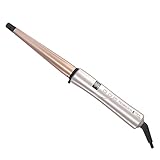
 Remington Shine Therapy Argan Oil & Keratin Infused1/2 - 1 Inch4.8 x 14.3 x 14.3 inches0.77 poundsCheck on Amazon


Quick picks by hair type and curl goal
- Fine, fragile, or color-treated hair: Choose a ceramic wand with adjustable heat beginning around 250°F (120°C), a 0.75- to 1-inch barrel, and a fast but controlled heat-up.
- Thick, coarse, or resistant hair: Look for a titanium or ceramic-titanium barrel, a top temperature near 410°F (210°C), and a 1- to 1.25-inch diameter.
- Short hair or tight curls: A 0.5- to 0.75-inch wand gives enough precision to reach shorter layers and create defined curls.
- Long hair or loose waves: A 1.25- to 1.5-inch barrel creates larger bends, while an extra-long barrel reduces the number of times you must reposition the hair.
- Several curl patterns: A convertible set with interchangeable barrels is more useful than one oversized barrel, provided the attachments lock securely and heat consistently.
- Beginners: A tapered wand or a straight barrel with a heat-resistant glove and automatic shutoff offers a forgiving starting point.
Barrel diameter determines the result
Barrel diameter is the most visible difference between curling wands, but hair length changes how that diameter behaves. On long hair, a 1.5-inch barrel may produce soft waves. On shoulder-length hair, the same barrel can create little more than a bend. A smaller barrel generally produces tighter curls that relax over several hours.
As an Amazon Associate we earn from qualifying purchases at no extra cost to you.



| Barrel diameter | Typical result | Best match | Useful hair length |
|---|---|---|---|
| 0.5-0.75 inch | Defined curls and coils | Short, fine, or resistant hair | Chin length and longer |
| 0.75-1 inch | Classic curls and flexible waves | Most hair types | Shoulder length and longer |
| 1-1.25 inches | Loose curls and polished waves | Medium to thick hair | Shoulder length and longer |
| 1.25-1.5 inches | Large, relaxed waves | Long, fine-to-medium hair | Below-shoulder length |
| Tapered 0.5-1 inch | Mixed-size curls and texture | Layered styles and experienced users | Short to long hair |
For a first wand, a straight 1-inch barrel is the safest all-purpose choice. A tapered wand adds variety, but it requires more consistent hand positioning because the curl size changes along the strand. If you want beach waves rather than ringlets, use a larger barrel than your desired final curl: the curl will loosen as it cools and as you brush or separate it.
Ceramic, titanium, or tourmaline?
Ceramic
Ceramic barrels are a strong choice for fine, dry, or easily over-processed hair because they tend to distribute heat evenly across the styling surface. Look for a full ceramic or ceramic-coated barrel rather than assuming that a product with “ceramic technology” has a thick ceramic surface. Coatings can wear, especially where the hair repeatedly contacts the barrel.
Titanium
Titanium heats quickly and transfers heat efficiently, making it useful for thick, coarse, or highly resistant hair. That efficiency also leaves less room for careless technique. Use the lowest temperature that forms the curl, keep each section moving, and avoid repeated passes over the same strand.
Tourmaline and mixed materials
Tourmaline is often used as a coating or mineral component in ceramic tools. It may be attractive if you want smooth-feeling results, but barrel material is not a substitute for heat control, suitable section size, or heat protectant. For most buyers, temperature range and surface condition matter more than the marketing label.
Temperature range matters more than the maximum
A wand that reaches 450°F is not automatically better than one that tops out at 410°F. The important question is whether it has useful low settings and enough adjustment between them. Fine or chemically treated hair commonly needs a lower starting point, while thick hair may need more heat or longer contact time.
| Hair situation | Starting range | Practical upper range | Technique |
|---|---|---|---|
| Fine, fragile, or bleached | 250-300°F (120-150°C) | 320°F (160°C) | Small sections and brief contact |
| Medium, healthy hair | 300-340°F (150-170°C) | 380°F (195°C) | One controlled pass per section |
| Thick, coarse, or resistant | 340-370°F (170-188°C) | 400-410°F (205-210°C) | Smaller sections; allow the curl to cool |
These are starting guidelines, not guarantees. Hair density, moisture, chemical processing, and styling products all change the result. Never style wet or damp hair with a standard curling wand unless the manufacturer specifically designs it for that use.
Features worth paying for
- Fast heat-up: Around 30 to 60 seconds is practical for daily use. Faster is convenient, but it should not replace an accurate temperature display or stable heat.
- Digital temperature control: A display with small increments is preferable to three vague settings, particularly for fine or mixed-texture hair.
- Automatic shutoff: A 30- to 60-minute shutoff reduces the consequence of forgetting the tool, although it is not a reason to leave it unattended.
- Swivel cord: A 7- to 9-foot, 360-degree swivel cord is useful at a crowded vanity or when styling the back of the head. A shorter cord is easier to store but may require an extension cord.
- Cool tip and stand: These are basic safety features that make a clamp-free wand easier to put down between sections.
- Heat-resistant glove: Especially valuable with a tapered wand, where the hand naturally moves near the narrower end.
- Dual voltage: If you travel internationally, verify that the tool is dual voltage, commonly marked 100-240V. A plug adapter may still be required, and not every tool supports voltage conversion.
Situation-based buying decisions
| Your situation | Best configuration | Why |
|---|---|---|
| Occasional user on a budget | 1-inch ceramic wand, 5-10 heat settings, auto shutoff | Covers common styles without paying for interchangeable parts |
| Daily user with long hair | 1-1.25-inch extra-long barrel, swivel cord, 60-second heat-up | Holds more length and reduces repositioning |
| Fine hair and limited styling experience | 0.75-1-inch ceramic wand, low setting near 250°F, glove | Offers control and reduces unnecessary heat exposure |
| Thick hair and frequent styling | Titanium or ceramic-titanium, up to 400-410°F, long barrel | Handles dense sections efficiently when used carefully |
| Small bathroom or shared space | Compact wand with locking travel cover and heat mat | Improves storage and protects the counter |
| Multiple hairstyles | Interchangeable 0.5-1.25-inch barrel system | One handle can cover tight curls, waves, and touch-ups |
Notable wand types and who they suit
Established examples include the ghd Curve Creative Curl Wand, T3 SinglePass Curl models, BaBylissPRO Nano Titanium wands, and Dyson Airwrap multi-stylers. They represent different approaches rather than a single ranking. ghd and T3 emphasize controlled, polished styling; BaBylissPRO offers titanium options suited to users who want strong heat transfer; Dyson Airwrap uses an air-powered styling system and is better viewed as a lower-temperature multi-styling alternative than as a conventional high-heat wand.
When comparing any named model, check the exact barrel size and regional version. Product families often include several diameters, and voltage, temperature settings, included attachments, and warranty terms can vary by country. A recognized brand does not make every size equally suitable for your hair.
How to use a wand without creating uneven curls
- Start with completely dry, detangled hair and apply a compatible heat protectant. Let the product dry before clamping or wrapping the hair.
- Choose sections about 0.5 to 1 inch wide. Thick hair usually curls more evenly in smaller sections; very fine hair may need slightly larger sections to avoid excessive heat.
- Wrap the hair away from your face, leaving the last half-inch out if you want a relaxed, modern finish. Alternate directions through the back for a less uniform result.
- Hold the section for roughly 5 to 10 seconds, then release it into your palm or let it cool without brushing. Shorter time is safer; increase time only if the curl will not form.
- Wait until the hair is cool before separating curls. Cooling allows the shape to set and is more effective than simply increasing the temperature.
Ownership, cleaning, and common mistakes
Residue from hairspray, oils, and styling creams eventually creates a rough or sticky barrel. Unplug the completely cool wand and wipe it with a soft, slightly damp cloth; follow the manufacturer’s cleaning instructions and never immerse the tool. Avoid abrasive pads, metal tools, and household solvents, which can damage ceramic coatings or insulation.
The parts most likely to wear first are a surface coating, the swivel-cord strain relief, the power switch, and interchangeable-attachment locks. Do not wrap the cord tightly around the hot barrel, pull the plug by the cable, or store the tool before it has cooled. A heat mat or storage case helps prevent both countertop damage and accidental coating scratches.
Common buying mistakes include choosing a barrel that is too large for short hair, selecting the highest temperature because curls seem to last longer, and ignoring cord length. A useful cost calculation can clarify whether a multi-barrel set is worthwhile: if a $120 interchangeable system replaces two $65 single wands and you use it 60 times per year for three years, its tool cost is about $0.67 per use ($120 divided by 180 uses), before replacing accessories or accounting for electricity. Buy the extra barrels only if you will use them; otherwise, a well-controlled single barrel is the better value.
Final recommendation
For most people, the best curling wands are a 0.75- to 1-inch ceramic model with adjustable heat from approximately 250°F to 400°F, a swivel cord, automatic shutoff, and a heat-resistant glove. Move toward a smaller barrel for short or resistant hair and tighter curls, a larger or extra-long barrel for long hair and waves, and titanium when thick hair needs faster heat transfer. Match the tool to your routine first; brand name, maximum temperature, and extra accessories come second.