Best Dog Strollers for Walks and Travel
What's inside
- Best Dog Strollers for Walks and Travel
- Quick picks by situation
- How to match stroller capacity to your dog
- Cabin dimensions: stroller comfort versus airline cabin rules
- Head-to-head: compact, all-terrain, and multi-pet designs
- Features that matter more than decorative extras
- What to expect from established stroller designs
- Setup and maintenance that prevent common problems
- Final buying checklist
- Best Dog Strollers for Walks and Travel
- Quick picks by situation
- How to match stroller capacity to your dog
- Cabin dimensions: stroller comfort versus airline cabin rules
- Head-to-head: compact, all-terrain, and multi-pet designs
- Features that matter more than decorative extras
- What to expect from established stroller designs
- Setup and maintenance that prevent common problems
- Final buying checklist
As an Amazon Associate I earn from qualifying purchases. This post may contain affiliate links at no extra cost to you.
Best Dog Strollers for Walks and Travel
The best dog stroller is the one that gives your dog enough interior length and weight support without becoming too wide, heavy, or difficult to fold for your usual trips. Small dogs may fit a compact, cabin-friendly carrier, while larger dogs, multiple pets, rough paths, or frequent car travel call for a stronger frame, larger wheels, and a more spacious cabin.
Quick picks by situation
| Situation | Best stroller type | Useful target specifications | Why it fits |
|---|---|---|---|
| Small dog, occasional pavement walks | Compact four-wheel stroller | 15–20 lb capacity; 18–24 in cabin length; 10–14 lb stroller weight | Easy to steer, store, and lift into a car |
| Frequent travel and limited storage | Lightweight folding stroller or stroller-carrier hybrid | 12–18 lb capacity; under 12 in folded height where possible; 8–14 lb stroller weight | More manageable in elevators, vehicles, and hotel rooms |
| Long walks, parks, or uneven sidewalks | Three-wheel all-terrain stroller | 25–75 lb capacity; 12–16 in wheels; adjustable front wheel; rear suspension | Tracks better and rolls over cracks, gravel, and grass |
| Two small dogs or one long-bodied dog | Large cabin or double stroller | 30–60 lb capacity; at least 25 in usable cabin length; reinforced base | Provides floor space rather than relying only on the weight rating |
| Senior, recovering, or easily tired dog | Low-entry stroller with stable four-wheel base | 20–50 lb capacity; wide opening; short step-in height; padded, washable floor | Reduces lifting and makes loading less awkward |
How to match stroller capacity to your dog
Start with your dog’s actual weight, then add a safety margin for movement, blankets, and a water bottle. A dog weighing 18 lb should not be placed in a stroller rated for exactly 18 lb. A practical target is a capacity at least 25% higher than the dog’s current weight: 18 × 1.25 = 22.5 lb, so choose a stroller rated for at least 25 lb.
As an Amazon Associate we earn from qualifying purchases at no extra cost to you.


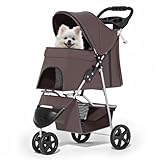

Weight is only one part of fit. Measure your dog from the chest to the base of the tail, then measure standing height from the floor to the top of the head or shoulders—whichever is taller. Compare those figures with the stroller’s usable interior, not its outside dimensions. Your dog should be able to lie down, turn around, and sit without pressing against the canopy.
For a long-bodied dog, interior floor length matters more than the advertised weight limit. A 25 lb dog may fit a compact stroller if it is short and slim, while a 15 lb dachshund may need a longer cabin. Look for a flat, firm base rather than a deeply sloped carrier floor.
Cabin dimensions: stroller comfort versus airline cabin rules
A stroller cabin and an airline-approved pet carrier are not automatically the same thing. Many strollers are too tall, wide, or rigid to fit beneath an aircraft seat, even when the removable pet compartment looks compact. Airlines also set their own maximum carrier dimensions, and those limits vary by aircraft, route, and ticket class.
If air travel is the goal, measure the stroller or removable carrier when folded and when detached. Pay particular attention to the narrowest doorway, wheel clearance, and whether the cabin can be separated from the chassis. Before booking, confirm the current airline rules and obtain approval if required. For airport use without taking the stroller into the aircraft cabin, a larger stroller may be more comfortable; for under-seat travel, a dedicated soft-sided carrier is often the safer choice.
Head-to-head: compact, all-terrain, and multi-pet designs
Compact four-wheel strollers
Compact models are usually the best dog strollers for apartment living, shopping centers, short walks, and car trips. Four small wheels provide a stable platform and a tight turning circle. Many use a one-hand or two-step fold and weigh roughly 10–18 lb.
The tradeoff is limited ground clearance. Small wheels can catch on curb edges, deep sidewalk joints, loose gravel, and wet grass. Check the entry opening carefully: a low price does not help if you must lift your dog through a small flap every time.
Three-wheel all-terrain strollers
Three-wheel designs generally steer more easily on longer routes, especially when the front wheel swivels for tight turns and locks straight for rougher surfaces. Wheels around 12–16 inches, sealed bearings, and rear suspension are useful on packed dirt, park paths, and uneven pavement.
These strollers are usually heavier and take more room in a vehicle. A large wheel also does not guarantee off-road performance. A narrow plastic wheel may roll poorly on sand, while pneumatic tires can puncture and require pressure checks. For regular grass or gravel use, prioritize tread, wheel width, suspension, and a rigid frame over canopy features.
Large-capacity and double strollers
Multi-pet models make sense when two small dogs travel together or one dog needs extra floor space. They often offer separate tether points, a larger basket, and a wider chassis. Confirm that each tether can be clipped to a harness rather than a collar, and check the floor for flex when the cabin is loaded.
The disadvantages are width, turning radius, and folded volume. Measure your doorway, elevator, vehicle hatch opening, and storage closet before buying. A stroller that fits one dimension may still be impractical if it cannot be turned through the doorway.
Features that matter more than decorative extras
- Folded dimensions: Record the folded length, width, and height, not just whether the stroller “folds.” A compact fold can determine whether it fits behind a car seat.
- Wheel construction: EVA or solid rubber wheels resist punctures and need little maintenance. Pneumatic tires absorb bumps better but require inflation and occasional tube or tire replacement.
- Brakes: A linked rear brake is preferable to a single small pedal. Test that it holds on a gentle slope before loading your dog.
- Ventilation: Mesh panels on at least two sides improve airflow and visibility. They should be protected by sturdy fabric borders so claws cannot quickly enlarge the mesh.
- Safety tether: Two adjustable interior tethers are useful for multiple pets, but they should be short enough to prevent climbing out and attached to a harness.
- Storage: A low basket is convenient, but keep heavy objects below the axle and within the stated basket limit. Overloading the handle can make the stroller tip backward.
- Cleaning: Removable, machine-washable liners save time. A smooth, waterproof base is easier to wipe after muddy paws or accidents.
- Handle height: An adjustable handle reduces wrist strain for different users and helps maintain control on ramps or uneven pavement.
What to expect from established stroller designs
Recognized product families such as the Pet Gear Happy Trails range, Gen7Pets Promenade models, HPZ Pet Rover designs, and ibiyaya stroller-carrier hybrids cover different parts of the market. Compact Pet Gear and Gen7Pets options are commonly aimed at small pets and everyday pavement use. HPZ and larger ibiyaya designs tend to offer more cabin space or conversion features, but exact capacity, folded dimensions, and wheel arrangements differ by model and revision.
Use the brand name as a starting point rather than a substitute for measuring. Within one product family, a “lite,” “deluxe,” or double version may have a substantially different cabin and weight limit. Check the current manufacturer specification sheet for interior dimensions, maximum pet weight, stroller weight, wheel diameter, and folded size before ordering.
Setup and maintenance that prevent common problems
- Assemble and unfold it indoors first. Confirm that the frame locks completely and that the cabin floor is level. A partially engaged folding joint can collapse or twist under load.
- Introduce the dog gradually. Put the stroller in a familiar room, leave the canopy open, and reward calm investigation. Begin with short stationary sessions before rolling.
- Adjust the tether before the first walk. Attach it to a harness and set enough length for sitting and lying down, but not enough for climbing over the rim.
- Check the wheels weekly. Remove hair and thread from axles, inspect solid wheels for splits, and check pneumatic tire pressure before longer trips.
- Wash and dry the cabin fully. Damp padding can develop odors and weaken fabric coatings. Follow the care label and avoid storing the stroller while wet.
- Inspect high-wear points. Look at mesh seams, zipper pulls, wheel fasteners, brakes, and the floor attachment. Replace damaged parts before the next outing.
For occasional use, a compact stroller in the general $60–$150 range may provide the best value. More robust all-terrain and multi-pet models commonly fall around $150–$400 or more, depending on frame materials, suspension, cabin size, and conversion features. The most useful comparison is cost per outing: a $240 stroller used twice a week for two years costs about $1.15 per use before replacement parts, while a $90 stroller used five times may not be a bargain if its wheels, zippers, or frame do not suit your route.
Final buying checklist
Choose the smallest stroller that gives your dog adequate standing and turning room, then verify that its folded dimensions fit your home and vehicle. Select small solid wheels for smooth pavement and storage convenience; choose larger wheels, suspension, and a stronger frame for parks or broken sidewalks. For flights, treat airline cabin approval as a separate requirement and confirm the current carrier limits before purchasing. The best dog strollers are not necessarily the largest or most feature-packed—they are the ones whose cabin, chassis, fold, and wheels match how and where you will actually use them.