Best Marine VHF Radio Antennas for Clear Signal
What's inside
- Top 3 Picks
- Quick Comparison
- How We Chose
- 1. Arridioter 48in 3.5dBi Fiberglass VHF Antenna – Best for Small Boats on a Tight Budget
- 2. Shakespeare 5101 8′ Classic VHF Antenna – Best for Coastal Powerboats
- 3. Bingfu Vehicle VHF Ham Mobile Radio Antenna – Best for Budget Backup and Dual-Band Use
- 4. UAYESOK 48 Inch VHF Marine Base Antenna – Best for Mid-Size Boats Without Room for an 8-Footer
- 5. HYS VHF Marine Antenna 3dBi with Ratchet Mount – Best for Buyers Who Want the Mount Included
- 6. Uniden UM385 25 Watt Fixed Mount VHF Radio – Best for Building a DSC-Capable Station
- 7. Arridioter 6.6ft Fiberglass VHF Antenna – Best for the Middle Ground on Range
- 8. Uniden UM385BK 25 Watt Fixed Mount VHF Radio – Best for a Full North American Channel Set
- 9. eifagur Long Range VHF Marine Antenna – Best Budget Antenna With Low-Loss Coax Included
- How to Choose
As an Amazon Associate I earn from qualifying purchases. This post may contain affiliate links at no extra cost to you.
For most coastal boaters, the best marine VHF radio antenna is the Shakespeare 5101 8′ Classic. An eight-foot fiberglass whip in the 6 dB gain class puts the radiating element roughly 10–14 feet above the waterline on a typical rail or deck mount, and height — not gain — is what buys you range on the water. It suits trailerable powerboats, center consoles, and cruisers that spend their time inside 20 nautical miles and want a no-drama antenna that has been the default on production boats for decades. If your budget is tight or your boat lives on a trailer and rarely sees salt, the Arridioter 48-inch 3.5 dBi unit with 22.9 ft of RG-58 is the value pick and will do everything a small lake or bay boat needs. If you are building a full fixed station with DSC and NOAA alerting, the two Uniden UM385 variants are the radio half of the signal chain and pair with any of the antennas below. Everything in this guide is compared on gain, physical length, mount type, and realistic line-of-sight range so you can match the antenna to your boat and your water.
Our Top Picks



Top 3 Picks
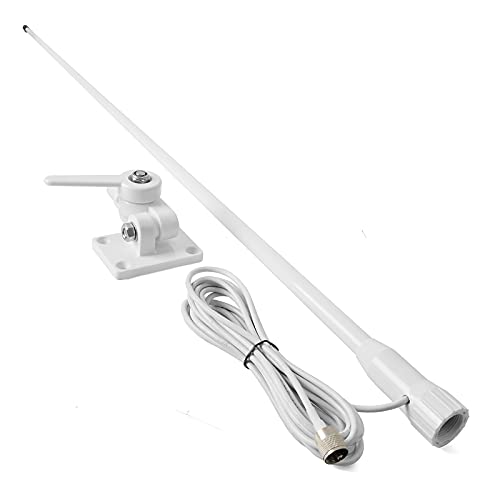
Best overall: Shakespeare 5101 8′ Classic VHF Antenna. Eight feet of white fiberglass, 6 dB gain class, 156–162 MHz marine band, standard 1-inch-14 threaded ferrule that drops into virtually every marine mount made. It is the antenna most boatbuilders install at the factory, which tells you something about how it behaves after five seasons of sun and spray. Best for coastal powerboats and cruisers that want maximum height with zero fuss.
Best budget: Arridioter 48in 3.5dBi Fiberglass VHF Antenna. A four-foot waterproof fiberglass whip with 22.9 ft (7 m) of RG-58 coax already attached, covering 156–163 MHz. The lower gain and shorter length cost you a little reach offshore, but on a bay boat, skiff, or pontoon it is more than enough, and the price leaves room for a decent mount.
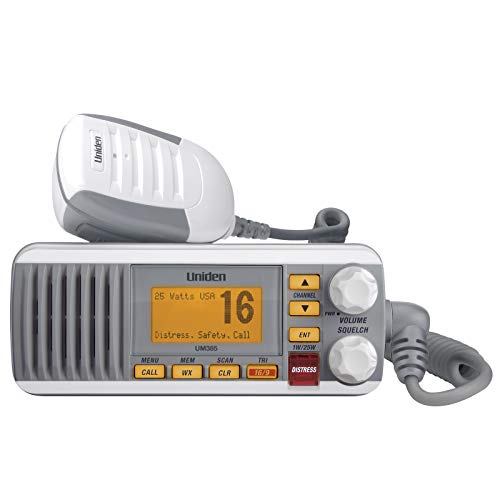
Best premium / best for a full station: Uniden UM385BK 25 Watt Fixed Mount VHF Radio. Twenty-five watts, IPX4 waterproof rating, DSC, NOAA weather alert, and all USA/International/Canadian marine channels in a black chassis. Pair it with the Shakespeare 5101 and you have a complete, DSC-capable fixed station — this is the pick when you want the radio and the antenna chosen together rather than bolted on one at a time.
Quick Comparison
| Product | Best for | Key specs | Price tier |
|---|---|---|---|
| Arridioter 48in 3.5dBi Fiberglass VHF Antenna | Small boats, trailer boats, inland and bay use | 48 in fiberglass whip; 3.5 dBi; 156–163 MHz; 22.9 ft / 7 m RG-58; waterproof; PL-259 | Budget |
| Shakespeare 5101 8′ Classic VHF Antenna | Coastal powerboats wanting maximum height and range | 8 ft fiberglass; 6 dB gain class; marine VHF band; 1″-14 threaded ferrule; mount sold separately | Premium |
| Bingfu Vehicle VHF Ham Mobile Radio Antenna | Budget backup, ham use, non-critical installs | Dual band 136–174 MHz / 400–520 MHz; mobile/vehicle design; 50 ohm; not marine-rated | Budget |
| UAYESOK VHF Marine Base Antenna 48 Inch | Mid-size boats wanting a clean deck or rail install | 48 in fiberglass; marine VHF 156–163 MHz; base/station style; waterproof radome | Mid-range |
| HYS VHF Marine Antenna 3dBi with Ratchet Mount | Buyers who want the mount included in the box | 3 dBi; 156–163 MHz; PL-259; NOAA weather receive; ratchet mount included | Mid-range |
| Uniden UM385 25W Fixed Mount VHF Radio | Building a DSC-capable fixed station | 25 W; IPX4; DSC; Triple Watch; NOAA weather with emergency alert; fixed mount | Premium |
| Arridioter 6.6ft Fiberglass VHF Antenna | Boats that want more reach than 4 ft without going to 8 ft | 6.6 ft fiberglass; 156–163 MHz; waterproof; 22.9 ft / 7 m RG-58 | Mid-range |
| Uniden UM385BK 25W Fixed Mount VHF Radio | Full station build; all North American marine channels | 25 W; waterproof; NOAA weather alert; USA/International/Canadian channels; black chassis | Premium |
| eifagur Long Range VHF Marine Antenna | Budget installs where coax quality matters more than price | 156–163 MHz; PL-259; 16.5 ft low-loss coaxial cable included | Budget |
How We Chose
This roundup is built from published manufacturer specifications, category standards, and the physics of VHF propagation over water — not from bench testing or hands-on time with each unit. The first filter was band coverage: a marine VHF antenna has to be built for 156–163 MHz, because that range includes Channel 16 at 156.800 MHz, the working channels, and the NOAA weather frequencies between 162.400 and 162.550 MHz. An antenna tuned for a different service may still pass a signal, but it will not be optimized for the marine band.
The second filter was the gain-and-length trade-off. We sorted each product by its rated gain in dBi and its physical length, because on a boat those two numbers decide how high the element sits and how flat its radiation pattern is. Third was mount type and connector: a marine antenna is only as good as the mount it sits on and the PL-259 termination that joins it to the coax. Fourth was cable — length, type, and whether it is included, since coax loss is the most common hidden range thief on small boats. Finally we weighted upgrade path: whether a buyer can start with the product today and still be using it after moving to a bigger boat.
1. Arridioter 48in 3.5dBi Fiberglass VHF Antenna – Best for Small Boats on a Tight Budget
As an Amazon Associate we earn from qualifying purchases at no extra cost to you.

This is the antenna for the person who just bought a 16-foot aluminum boat, a jon boat, or a used pontoon and needs to get on Channel 16 without spending more on the antenna than on the radio. The listing describes a 48-inch fiberglass whip covering 156–163 MHz with a 3.5 dBi gain rating, a waterproof radome, and 22.9 feet (7 meters) of RG-58 coax already terminated. That combination is aimed squarely at trailer boats, inland lakes, rivers, and protected bays where the nearest marina is two miles away and the Coast Guard station is visible from the ramp.
- Length: 48 in (about 1.2 m) — one-piece fiberglass whip
- Gain: 3.5 dBi rated
- Frequency: 156–163 MHz marine VHF (covers Channel 16 and NOAA weather receive)
- Construction: fiberglass radome, waterproof
- Coax: 22.9 ft / 7 m RG-58 included
- Connector: PL-259 (standard marine VHF)
- Mount: threaded base ferrule — check the box contents, since mounts are often sold separately at this price tier
The 3.5 dBi rating is the right choice for a small, lively boat. A low-gain antenna has a rounder, taller radiation pattern, which means it keeps working when the boat rocks, when you are heeled over, and when the antenna is mounted on a rail that is only three or four feet off the water. A high-gain whip on the same boat would be a mistake — it would squeeze the pattern flat and point your signal at the water every time the hull rolled.
The included 7-meter coax run is generous for a boat this size, and RG-58 is perfectly adequate over that distance. At roughly 2 dB of loss per 100 feet at 150 MHz, a 23-foot run costs you well under half a dB. That is a rounding error. Where the money went instead is the fiberglass radome, which is the part that actually dies first on cheap antennas — UV cracks the resin, water gets into the windings, and the antenna quietly stops working somewhere in season three.
Run the range math before you buy. A 4-foot antenna base-mounted 3 feet above the waterline puts the tip at 7 feet, which gives a radio horizon of about 1.22 × √7 ≈ 3.2 nautical miles. A boat on the other end with the same setup adds another 3.2 nm, so antenna-to-antenna you are looking at roughly 6.5 nm of realistic range, a little more with the atmospheric bending that always helps over water. That covers a busy bay, a lake, and near-shore fishing. It does not cover a 25-mile offshore run.
Pros
- Very low entry cost for a waterproof fiberglass whip
- 3.5 dBi pattern tolerates rocking and heeling better than high-gain designs
- 22.9 ft of coax included — no separate cable purchase for most small boats
- Standard PL-259 termination drops straight into a marine VHF radio
- Short 48-inch length stores and trailers easily without a fold-down mount
Cons
- Lower gain and shorter length cap your practical range at roughly 5–8 nm
- Mount is not guaranteed to be in the box — budget for one
- RG-58 is fine at 23 ft but is the wrong cable if you extend the run
- No premium ferrule or heavy-duty base hardware at this price tier
Compared with the HYS 3dBi antenna, this Arridioter is the cheaper path to roughly the same gain class, but the HYS unit ships with a ratchet mount included. If you do not already own a mount, the HYS is often the better total purchase even though its antenna spec is nearly identical. Compared with the Arridioter 6.6 ft model further down this list, you are trading about 2.6 feet of height — worth roughly an extra 0.7 nm of horizon each way — for a meaningful step up in price and a taller package to stow.
2. Shakespeare 5101 8′ Classic VHF Antenna – Best for Coastal Powerboats
If you want one antenna that you install once and forget for a decade, this is the one. The Shakespeare 5101 is an 8-foot white fiberglass whip in the 6 dB gain class, built for the 156–162 MHz marine band, and finished with the standard 1-inch-14 threaded ferrule that fits essentially every marine mount on the market. It is the antenna that shows up on the factory option list of a startling number of production boats, from 20-foot center consoles to 40-foot express cruisers, and that ubiquity is the strongest argument for it: thousands of installers have already worked out how to mount it well.
- Length: 8 ft (about 2.4 m) — one-piece fiberglass
- Gain: 6 dB gain class
- Frequency: 156–162 MHz marine VHF band
- Finish: white fiberglass radome, UV-stabilized
- Base: standard 1″-14 threaded ferrule
- Connector: PL-259 at the radio end (coax sold separately in most configurations)
- Mount: sold separately — ratchet, rail, or flush mount all fit
The real value here is height. An 8-foot whip on a 4-foot rail mount puts the tip about 12 feet above the water, and that changes the arithmetic in a way no gain rating can. Using the standard line-of-sight formula, 1.22 × √12 gives a radio horizon of about 4.2 nautical miles. A 48-inch antenna base-mounted 3 feet up gives 3.2 nm. Add the other station’s horizon and the eight-footer reaches a similarly equipped boat at roughly 8.5 nm versus about 6.5 nm for the short whip. Against a Coast Guard station with a mast-mounted antenna at 60 feet, the 8-footer sees about 13.6 nm of theoretical path; the 4-footer sees about 12.6 nm. Height is the gift that keeps giving, and no amount of gain compensates for a low mount.
The 6 dB gain class is the sweet spot for a powerboat. It flattens the radiation pattern enough to concentrate energy toward the horizon — which is where the other boats are — without making the antenna hypersensitive to roll. Boats that pitch and heel hard, especially sailboats, generally do better with a 3 dB antenna, but a planing hull that stays roughly level can use the extra reach.
What you are paying for at the premium tier is the ferrule, the winding quality, and the consistency of the fiberglass. A cheap whip fails at the base, where the coax transition meets the fiberglass tube and where water wicks in after a few freeze-thaw cycles. The 5101’s base hardware is the reason it lasts.
Pros
- 8 feet of height is the single biggest range upgrade available to most boats
- 6 dB gain class concentrates signal at the horizon without being fragile in a seaway
- Universal 1″-14 ferrule fits ratchet, rail, flush, and side mounts
- White UV-stabilized radome holds up to years of sun exposure
- Proven, widely installed design with plenty of mounting guidance available
Cons
- Premium price tier — the most expensive antenna-only option in this roundup
- Coax and mount are typically not included, so the installed cost is higher than the sticker suggests
- Eight feet is tall enough that a fold-down mount is worth considering for trailering and low bridges
- 6 dB gain is a poor match for a boat that heels heavily under sail
The nearest alternative in this list is the UAYESOK 48 Inch VHF Marine Base Antenna, which gives you the same fiberglass marine-antenna category at half the height and a mid-range price. The UAYESOK is the sensible pick for a boat that cannot physically carry an 8-foot whip — a small cuddy, a boat with a canvas top, or anything stored under a low garage door. The Shakespeare is the pick when height is available and you want the last mile of range.
3. Bingfu Vehicle VHF Ham Mobile Radio Antenna – Best for Budget Backup and Dual-Band Use

This one needs an honest framing, because it is not a marine antenna and it is not sold as one. The Bingfu unit is a vehicle-mounted dual-band antenna covering 136–174 MHz and 400–520 MHz — the classic 2-meter and 70-centimeter ham bands, plus land mobile VHF. Those frequency ranges happen to bracket the marine VHF band at 156–163 MHz and the NOAA weather channels around 162 MHz, which is why it shows up in searches for cheap marine antennas. It will pass a signal on Channel 16. It is not engineered for the marine service, and on a boat it should be treated as a backup, a second radio, or an experiment, not as your primary safety antenna.
- Frequency coverage: 136–174 MHz VHF and 400–520 MHz UHF
- Design: vehicle/mobile mount, dual-band
- Impedance: 50 ohm, standard for both ham and marine VHF
- Connector: PL-259 class on the versions sold for mobile VHF use
- Waterproofing: not specified as marine-rated — assume splash exposure only
- Intended use: amateur radio and land mobile, not the marine band
The honest use case is a dual-purpose owner: someone who runs a ham rig on the boat, or who wants a cheap antenna on a small tender that only ever talks to a handheld a mile away. For that job it is fine. For a boat that goes offshore, relies on DSC, or expects to reach the Coast Guard from 15 miles out, it is the wrong tool.
There are three concrete reasons. First, bandwidth and tuning: an antenna covering 136–174 MHz is a compromise across 38 MHz of spectrum, whereas a marine antenna is tuned across roughly 7 MHz of it. A narrower design concentrates performance where you need it. Second, durability: marine antennas are built for continuous salt spray, UV, and a flexing mount; a vehicle antenna is built for a roof rack. Third, mounting geometry: this class of antenna is short — typically a few feet at most — and height is the dominant range variable on the water.
Range expectations should be modest. A sub-3-foot antenna mounted a couple of feet above the water puts the tip at maybe 4–5 feet, giving a radio horizon near 2.4–2.7 nm. Add a similarly equipped boat and you are at roughly 5 nm antenna-to-antenna. On a small lake or a crowded harbor, that is genuinely adequate. On open water, it is not.
Pros
- Lowest cost of entry in this roundup
- Covers both VHF and UHF, useful if you also run amateur radio aboard
- Standard 50-ohm impedance works with marine VHF radios without an adapter
- Compact and easy to store, ideal for a dinghy or tender
- Reasonable choice as a backup antenna kept aboard in case the main whip is damaged
Cons
- Not a marine antenna — no marine-band tuning, no marine durability rating
- Short length severely limits line-of-sight range
- No specified waterproofing for permanent deck exposure
- Not an appropriate primary antenna for offshore or DSC-dependent use
Against the eifagur Long Range VHF Marine Antenna, the comparison is instructive. The eifagur costs a similar budget-tier amount but is actually built for 156–163 MHz, terminates in a PL-259, and ships with 16.5 feet of low-loss coax. If your goal is a cheap marine antenna, the eifagur is the correct choice and the Bingfu is not. The Bingfu only makes sense when you specifically want dual-band ham coverage.
4. UAYESOK 48 Inch VHF Marine Base Antenna – Best for Mid-Size Boats Without Room for an 8-Footer

The UAYESOK is a 48-inch fiberglass marine base antenna for the 156–163 MHz band, positioned between the budget no-name whips and the premium eight-footers. Its whole reason to exist is the boat owner who wants a proper marine-grade fiberglass antenna — correct band, correct connector, correct construction — but cannot use an 8-foot whip because of a canvas top, a radar arch, a low bridge, or a garage that the boat has to fit under.
- Length: 48 in (about 1.2 m)
- Frequency: 156–163 MHz marine VHF
- Construction: fiberglass radome, waterproof, base/station style
- Connector: PL-259
- Mounting: threaded base, compatible with standard marine mounts
- Coax: sold separately in most listings — budget for RG-8X or better
The gain figure on a 48-inch marine antenna generally lands in the 3 to 4.5 dBi range, which is the right profile for a boat that moves around a lot. The pattern is broad enough that a rolling hull does not drop the signal into the sea, and the antenna still behaves predictably when the boat is on plane and the bow is up.
Height math is where this antenna lives or dies. On a 4-foot rail mount, the tip sits at roughly 8 feet, giving a horizon of 1.22 × √8 ≈ 3.5 nm. On a 6-foot arch mount, that becomes 1.22 × √10 ≈ 3.9 nm. Mounted at 3 feet, it drops to 3.2 nm — identical to the budget Arridioter, which tells you something important: at this length, mount height matters more than which brand you bought. If you are choosing between a mid-range 4-footer on a low mount and a budget 4-footer on a high mount, take the high mount.
The mid-range premium over the budget units buys you a cleaner ferrule, better sealing at the base, and more consistent fiberglass. Those are exactly the failure points that kill cheap antennas in season three or four, so the extra spend has a real return if the antenna is going to live outdoors year-round.
Pros
- True marine-band tuning at 156–163 MHz
- Fiberglass radome with a waterproof base — appropriate for permanent deck exposure
- Short enough to fit under arches, biminis, and covered storage
- Broad radiation pattern handles roll and heel well
- Mid-range price tier sits well below the premium eight-foot class
Cons
- Four feet of height leaves 2–4 nm of range on the table versus an 8-footer
- Coax is usually not included, adding to the installed cost
- No fold-down feature, so trailering requires removing it or a low mount
- Less brand documentation than the long-established premium options
The direct alternative is the Arridioter 6.6 ft antenna at a similar mid-range tier. The Arridioter gives you 2.6 more feet of height and includes 22.9 ft of RG-58, which is a better deal if your mounting location has vertical clearance. The UAYESOK wins only when clearance is the binding constraint — in which case it is the right answer, and the Arridioter is not an option at all.
5. HYS VHF Marine Antenna 3dBi with Ratchet Mount – Best for Buyers Who Want the Mount Included

HYS sells this as a 3 dBi marine VHF antenna for 156–163 MHz with NOAA weather receive, a PL-259 connector, and — the part that matters — a ratchet mount in the box. That last detail changes the value calculation completely. Most marine antennas in the budget and mid-range tiers ship as a bare whip, and the mount is a separate purchase that can cost as much as the antenna. Getting both in one box removes a step, a shipping charge, and a compatibility question.
- Gain: 3 dBi rated
- Frequency: 156–163 MHz marine VHF plus NOAA weather receive
- Connector: PL-259
- Mount: ratchet mount included — adjustable for angle, folds for trailering
- Construction: marine antenna with waterproof base
- Coax: check the listing; runs vary by configuration
The 3 dBi rating is the low-gain end of the marine spectrum, and that is a feature rather than a limitation for the right boat. Low-gain marine antennas have a broad vertical pattern that keeps radiating at the horizon even when the hull is rolling 15 or 20 degrees. A sailboat, a small deep-V that pounds in a chop, or a boat with an unstable mount all benefit. The trade is theoretical reach on a dead-flat calm day, which is exactly when you least need it.
The ratchet mount is genuinely useful, not just a bundled accessory. It lets you set the antenna vertical regardless of the angle of the rail or deck surface, and it folds down flat for trailering, bridge approaches, and covered storage. That fold-down capability is the difference between leaving the antenna installed and taking it off every trip, which in turn is the difference between an antenna that lasts and one that gets cross-threaded at the ramp.
Expect roughly 3.2 nm of radio horizon from a 3-foot mount and 4.2 nm from a 4-foot rail, with antenna-to-antenna totals landing between 6 and 8.5 nm. Coastal and bay work, harbor traffic, lock and bridge coordination, and reaching nearby marina and TowBoat-type services are all well within range. Offshore passage-making is not what this antenna is for.
Pros
- Ratchet mount included — a real cost and convenience advantage
- Fold-down capability makes trailering and covered storage practical
- 3 dBi broad pattern stays effective when the boat rolls or heels
- Covers the full marine band plus NOAA weather receive
- Standard PL-259 termination works with any fixed-mount marine radio
Cons
- 3 dBi is the lowest gain class — limited reach on flat water
- Ratchet mounts can work loose over a season and need periodic checking
- Coax length varies by listing, so verify what is included
- Less raw range than any 6 dB-class or 6.6-foot option here
Compared with the Arridioter 48in 3.5dBi, the antenna performance is nearly a wash — 3 dBi versus 3.5 dBi is not a difference you will notice on the water. The deciding factor is the mount. If you do not already own a ratchet mount, the HYS bundle usually wins on total cost. If you do, the Arridioter’s longer included coax run may tip it the other way.
6. Uniden UM385 25 Watt Fixed Mount VHF Radio – Best for Building a DSC-Capable Station

This is the other half of the signal chain, and it belongs in an antenna roundup because the antenna is only as good as the radio driving it. The Uniden UM385 is a 25-watt fixed-mount marine VHF radio rated IPX4 for water resistance, with Digital Selective Calling, Triple Watch, and NOAA weather channels with emergency alert. Twenty-five watts is the maximum legal transmit power for a fixed-mount marine VHF in the United States, and it is the reason a fixed station reaches so much farther than a handheld.
- Transmit power: 25 W maximum (fixed mount)
- Water resistance: IPX4 rated — splash and spray, not submersion
- Features: DSC, Triple Watch, NOAA weather channels with emergency alert
- Installation: fixed mount, requires 12 V DC and a separate antenna
- Antenna requirement: any 156–163 MHz marine VHF antenna with a PL-259, plus coax and a mount
- DSC requirement: an MMSI number programmed into the radio
Twenty-five watts into a 3 dBi antenna produces roughly 50 watts of effective radiated power. The same 25 watts into a 6 dB-class antenna produces roughly 100 W ERP, and into a 9 dBi antenna around 200 W ERP. That is why pairing this radio with the Shakespeare 5101 or the Arridioter 6.6 ft is not overkill — it is how you actually convert transmitter power into distance.
DSC is the feature that separates a modern fixed station from an old one. Once you program an MMSI, a single button press transmits a digital distress alert carrying your vessel identity and, on units with GPS input, your position. That signal is designed to be received by any DSC-equipped radio in range and by shore stations, which makes the antenna’s range a safety specification rather than a convenience one.
IPX4 is worth understanding before you buy. It means protection against splashing water from any direction — spray, rain, a wave over the bow. It does not mean the radio survives being submerged, and it does not mean you should mount it where it takes green water. Mount it at the helm under cover and it will be fine for years.
Pros
- Full 25 W transmit power — the legal maximum for a fixed marine VHF
- DSC with distress alerting, which handhelds and older radios lack
- Triple Watch monitors Channel 16 plus two others, plus weather
- NOAA weather with emergency alert tones
- Straightforward pairing with any standard marine antenna and PL-259 coax
Cons
- Antenna, mount, and coax are all separate purchases
- IPX4 only — not designed to be submerged or take direct boarding seas
- DSC does nothing for you until an MMSI is programmed
- Fixed mount requires 12 V wiring, which is more work than a handheld
Its sibling, the Uniden UM385BK, is the same radio in a black chassis with the USA/International/Canadian channel set called out. The two are functionally near-identical; pick on color and on the channel configuration that matches where you boat. Either one paired with the Shakespeare 5101 is the strongest complete station in this roundup.
7. Arridioter 6.6ft Fiberglass VHF Antenna – Best for the Middle Ground on Range

The 6.6-foot Arridioter is the compromise antenna that a lot of boaters should actually be buying. It covers 156–163 MHz, uses a waterproof fiberglass radome, and includes 22.9 feet (7 m) of RG-58 coax with a PL-259 termination. It sits between the 48-inch budget whips and the 8-foot premium class in both height and price, and it captures most of the range benefit of the tall antenna without the storage and trailering headaches.
- Length: 6.6 ft (about 2 m)
- Frequency: 156–163 MHz marine VHF
- Construction: fiberglass, waterproof radome
- Coax: 22.9 ft / 7 m RG-58 included
- Connector: PL-259
- Mounting: threaded base, standard marine mounts
- Gain class: mid-length fiberglass whip, generally in the 4.5–6 dB range depending on the specific build
The height arithmetic is where this antenna earns its place. On a 4-foot rail mount, the tip reaches about 10.6 feet, giving a radio horizon of 1.22 × √10.6 ≈ 4.0 nm. That is within a few tenths of a mile of the 8-footer on the same mount (4.2 nm) and a full 0.8 nm better than a 4-footer at the same height. Add the other station’s horizon and you are at roughly 8 nm antenna-to-antenna versus 6.5 nm for a 48-inch whip.
The included 22.9-foot RG-58 run is a meaningful part of the value. At roughly 2 dB of loss per 100 feet at 150 MHz, that run costs you under half a dB. It is a perfectly reasonable cable for a boat this size, and having it pre-terminated removes the single most common installation mistake: a poorly soldered PL-259.
Where this antenna really wins is on a boat that is used hard and stored dry. Six and a half feet is short enough to leave mounted under most biminis and arches, and short enough to survive a boat ramp without a fold-down mount in many setups. It is long enough that you notice the difference on the water compared with a four-footer. That combination — noticeable range, tolerable length — is why the 6.6-foot class has become so popular on 18- to 24-foot boats.
Pros
- Captures most of the range of an 8-footer without the full height penalty
- 22.9 ft of pre-terminated RG-58 included
- Waterproof fiberglass radome suitable for permanent outdoor mounting
- Better gain and pattern than a 48-inch whip without going to a full-length antenna
- Easier to stow and trailer than an 8-foot whip
Cons
- Still 1.4 feet shorter than the premium class, worth a few tenths of a mile of horizon
- RG-58 is adequate but not the low-loss cable a long run would demand
- No mount included in most configurations
- Mid-range price tier — not a budget impulse buy
Compared with the UAYESOK 48 Inch, this is the better antenna whenever you have the vertical clearance: 2.6 more feet of height is roughly 0.5 nm of extra horizon each way. Compared with the Shakespeare 5101, it gives up about 0.2 nm of horizon and the premium base hardware, in exchange for a shorter package and a lower price tier. For most 20-foot boats, that trade is worth taking.
8. Uniden UM385BK 25 Watt Fixed Mount VHF Radio – Best for a Full North American Channel Set

The UM385BK is Uniden’s 25-watt fixed-mount marine VHF in a black chassis, with NOAA weather alert and the full USA, International, and Canadian marine channel sets available. Functionally it is the same radio as the UM385 above; the differences are cosmetic and configuration-related, and for a lot of buyers that is the entire decision. If your helm is black, this is the one that looks like it belongs there.
- Transmit power: 25 W maximum fixed-mount output
- Water resistance: waterproof-rated chassis for helm mounting
- Channels: USA, International, and Canadian marine channel sets
- Weather: NOAA weather alert
- Installation: fixed mount, 12 V DC, separate antenna required
- Antenna pairing: any 156–163 MHz marine antenna with PL-259 and coax
The value of having all three channel sets is easy to underestimate until you cross a border. Canadian and International channel allocations differ from the US set in ways that matter — duplex versus simplex operation on certain channels, and different uses for the same channel number in different waters. A radio that lets you switch sets is the difference between being able to call a Canadian marina on the correct channel and guessing.
Twenty-five watts plus a properly mounted antenna is the standard configuration for serious coastal cruising. Pair this radio with the Shakespeare 5101 and you have roughly 100 W of effective radiated power at the horizon from an antenna 12 feet up. Pair it with a 3 dBi whip on a 3-foot mount and you have about 50 W ERP from an antenna 6 feet up. Same radio, dramatically different reach — which is the central lesson of this entire guide.
One practical note: fixed-mount radios need a real power run. Twenty-five watts of transmit draws several amps at 12 V, so use appropriately sized marine-grade wire, fuse the circuit at the panel, and keep the run short. Voltage sag on transmit is a common and invisible cause of weak signal reports from other boats.
Pros
- Full USA/International/Canadian channel coverage for cross-border cruising
- 25 W transmit power, the maximum for a fixed marine VHF
- NOAA weather alert built in
- Black chassis matches dark helm layouts
- Works with any standard marine antenna, so upgrades are easy later
Cons
- Antenna, mount, and coax all sold separately
- Requires a proper fused 12 V circuit — not a plug-and-play install
- Channel-set switching adds menu complexity that occasional users find fussy
- Premium tier pricing for what is functionally the same radio as the UM385
Against the Uniden UM385, the choice is essentially aesthetic plus channel-configuration preference. Both are 25 W, both are waterproof-rated for helm duty, both carry NOAA alert. If you boat only in US waters and prefer a lighter faceplate, the UM385 is fine. If you cross into Canadian waters or want the international set readily available, the UM385BK is the more complete choice.
9. eifagur Long Range VHF Marine Antenna – Best Budget Antenna With Low-Loss Coax Included

The eifagur antenna is a 156–163 MHz marine VHF whip with a PL-259 connector and 16.5 feet of low-loss coaxial cable included. The low-loss cable is the headline here, because it is the one place where budget antennas usually cut the wrong corner. Most cheap kits ship with thin RG-58 and a short run; the eifagur’s included cable is specified as low-loss, which matters more as the run gets longer.
- Frequency: 156–163 MHz marine VHF
- Connector: PL-259
- Coax: 16.5 ft low-loss coaxial cable included
- Mounting: threaded base, standard marine mounts
- Price tier: budget
- Gain class: verify the listing — budget marine whips in this category typically land between 3 and 4.5 dBi
Why does cable type matter so much? Coax loss is proportional to length and to frequency. At 150 MHz, RG-58 typically loses around 2 dB per 100 feet. A 16.5-foot run of RG-58 loses about a third of a dB — negligible. But if you add 20 feet of extension cable, or you run the coax through a tight conduit and up a tower, the losses stack up. A “low-loss” cable of the RG-8X class loses roughly 1.4 dB per 100 feet, and RG-213 or LMR-400-class cable drops to under 1 dB per 100 feet. On a short run the difference is trivial; on a 50-foot run it can be the difference between reaching a station and not.
Sixteen and a half feet is a sensible length for a small to mid-size boat where the radio is at the helm and the antenna is on the rail or the arch. It is short enough to avoid a coiled excess (never coil coax in a loop — it creates a choke and can detune the antenna) and long enough to route cleanly with some slack.
Range expectations depend entirely on what you mount it to and how high. On a 3-foot rail with a 4-foot whip, expect about 3.2 nm of horizon and roughly 6.5 nm antenna-to-antenna. On a 6-foot arch mount, that climbs toward 8 nm. The antenna is not the limiting factor at this price tier — the mount height is.
Pros
- Low-loss coaxial cable included, which is unusual at the budget tier
- Correct 156–163 MHz marine band coverage
- Standard PL-259 termination works with any fixed-mount marine radio
- 16.5 ft cable suits small and mid-size boat layouts without excess
- Budget price leaves headroom for a good mount and a proper deck fitting
Cons
- Gain class should be verified on the listing before purchase
- 16.5 ft may be too short for larger boats with long cable routes
- Budget-tier base hardware and ferrule durability
- No mount included
Set against the Bingfu dual-band mobile antenna, the eifagur is the correct choice for anyone who actually wants a marine VHF antenna: it is tuned for the marine band rather than covering 38 MHz of ham spectrum, and it comes with better cable. Set against the Arridioter 48in, the eifagur trades a slightly shorter cable run for lower-loss cable, which is the better trade if your cable route is tight or your radio is mounted far from the antenna.
How to Choose
Antenna choice on a boat comes down to four numbers and one location: gain, length, mount height, cable loss, and where you physically can put the thing. Everything else — brand, finish, connector type — is secondary. Get those five right and the antenna will outperform a more expensive one installed badly.
Height beats gain, every single time
VHF is line of sight. At marine frequencies the signal essentially travels in a straight line and stops at the horizon, with a small amount of atmospheric bending that typically extends the path by 10 to 20 percent over water. The distance to the horizon from an antenna is approximated by:
Range (nautical miles) ≈ 1.22 × √(height in feet)
Run the numbers on real mounting heights and the picture is immediate:
| Antenna tip height above water | Horizon to a station at sea level | Total path to a boat with a 6 ft tip | Total path to a 60 ft Coast Guard mast |
|---|---|---|---|
| 4 ft | 2.4 nm | 5.4 nm | 11.8 nm |
| 6 ft | 3.0 nm | 6.0 nm | 12.4 nm |
| 8 ft | 3.5 nm | 6.5 nm | 12.9 nm |
| 10 ft | 3.9 nm | 6.9 nm | 13.3 nm |
| 12 ft | 4.2 nm | 7.2 nm | 13.6 nm |
| 16 ft | 4.9 nm | 7.9 nm | 14.3 nm |
| 20 ft | 5.5 nm | 8.5 nm | 14.9 nm |
Look at what happens between 4 feet and 12 feet: you gain 1.8 nm of horizon in each direction, or 3.6 nm of total path. Now compare that with the difference between a 3 dBi and a 6 dB gain antenna, which is worth perhaps 1 to 2 nm of usable improvement in ideal conditions. Moving the antenna up is cheaper and more reliable than buying gain. A 48-inch antenna on a 6-foot arch will outperform an 8-foot antenna on a 2-foot stern rail.
Gain: what it actually does and when it hurts
Gain in an antenna is not amplification. It is a redistribution of the same energy into a flatter, wider disc aimed at the horizon instead of a taller, rounder ball. Marine antennas are commonly rated in three classes:
- 3 dBi (low gain): round pattern, tolerates roll and heel, good for sailboats, small boats, and unstable mounts. Typical length 3–4 ft.
- 4.5–6 dBi (medium gain): the workhorse class for powerboats. Flatter pattern, more energy at the horizon, still usable when the boat moves. Typical length 6–8 ft.
- 9 dBi (high gain): very flat pattern, maximum reach on a stable, level platform. Suffers badly when the boat heels — the beam points at the water and the nulls point at the sky. Typical length 8 ft and above.
The trap is buying gain for a boat that cannot hold the antenna level. A 9 dBi antenna on a sailboat heeling 20 degrees will often perform worse than a 3 dBi antenna, because the flat beam is aimed at the sea surface. If your boat spends most of its time upright — a planing powerboat, a pontoon, a trawler — gain helps. If it heels or rolls heavily, buy the lower gain and put the antenna higher instead.
Length and the practical limits of your boat
Length is really a proxy for gain and for height, and it is also the number that decides whether you can live with the antenna. An 8-foot whip needs a fold-down mount for trailering and for low bridges. A 6.6-foot whip is manageable under most biminis. A 4-foot whip fits almost anywhere and can usually stay mounted permanently. Be honest about your storage situation before you buy, because an antenna that gets removed and reattached every trip is an antenna that will eventually be cross-threaded, dropped, or left at home.
Mount types and what they are actually for
| Mount type | Typical height gained | Best for | Watch out for |
|---|---|---|---|
| Rail mount (clamp to 1″–1.25″ tube) | 2–4 ft above deck | Small boats, quick installs, temporary setups | Rails flex; clamp can crush thin tubing |
| Ratchet / fold-down deck mount | 3–5 ft above deck | Trailer boats, low bridges, covered storage | Pivot wears and loosens; check tension yearly |
| Flush / through-deck mount | 0–2 ft above deck | Clean installations on larger boats | Requires drilling a large hole; sealing is critical |
| Radar arch or hardtop mount | 6–10 ft above deck | Cruisers, sportfishers, anything with an arch | Keep separation from radar and other antennas |
| Masthead mount (sail) | 30–60 ft above water | Sailboats wanting maximum range | Cable loss over a long run; hard to service |
Mounting height above the deck is only half the story — what matters is height above the water. A ratchet mount on the deck of a boat with 3 feet of freeboard gives less height than a rail mount on the stern of a low skiff. Measure from the waterline, not from the deck.
Cable, connectors, and the mistakes that cost you the most
Coax loss at marine VHF frequencies is real but modest over short runs. The table below shows typical attenuation at 150 MHz by cable type, and what it costs you on runs of realistic length:
| Cable type | Approx. loss per 100 ft at 150 MHz | Loss on a 20 ft run | Loss on a 50 ft run |
|---|---|---|---|
| RG-58 | ~2.0 dB | ~0.4 dB | ~1.0 dB |
| RG-8X | ~1.4 dB | ~0.3 dB | ~0.7 dB |
| RG-213 / LMR-400 class | ~0.7–0.9 dB | ~0.2 dB | P