Best Mortar Mixers for Brick and Stone Work
What's inside
- Top 3 Picks
- Quick Comparison
- How We Chose
- 1. Konvixon 7-Size Brick Jointing Tools & 20 Pcs Masonry Mortar Grout Bags Kit – Best for Pointing and Joint Finishing
- 2. QUIKRETE Construction Grade Mortar Mix – Best for Budget Repair Batches
- 3. Konvixon 22PCS Tile Grout Masonry Mortar Bag and Brick Jointing Tool Kit – Best for Larger Grouting Runs
- 4. Bon Tool Repl Blades for 6, 7 & 8 Cubic Feet Stone Mixer (11-559) – Best for Maintaining a Stone Mixer
- 5. Starbond Concrete Epoxy Putty (2 oz) – Best for Crack Repair and Bonding
- 6. Andi Mini Brick & Stone Dollhouse Miniature Grey Mortar, 8oz Powder – Best for Miniature and Model Masonry
- 7. SILVEL Cement Mixer, Max 2300W Electric Concrete Mixer – Best Overall Powered Mixing
As an Amazon Associate I earn from qualifying purchases. This post may contain affiliate links at no extra cost to you.
The best mortar mixer for most brick and stone work in 2026 is the SILVEL Cement Mixer, a 2300W electric portable unit with six adjustable speeds and a 110V motor. It is the only true powered mixing station in this roundup, and it covers everything from thin pointing mortar to stiff Type S for laying block. If your work is repair-scale rather than wall-scale, the QUIKRETE Construction Grade Mortar Mix is the best budget buy, because it removes the guesswork from the blend itself — masonry cement and graded sand, pre-proportioned, in a bag you carry to the wall. For tuckpointing, thin brick and metered grouting, the Quickpoint Mortar Gun Drill Adaptor is the best premium pick, converting an ordinary drill into a controlled mortar pump. The remaining five products fill out the rest of the same workflow: grout bags and jointing tools, replacement mixer blades, epoxy crack repair, and a fine-scale mortar for miniature masonry. The sections below compare drum capacity, motor power and portability so you can match batch size to jobsite reality instead of guessing.
Our Top Picks
 Konvixon 22PCS Tile Grout Masonry Mortar Bag and11" x 22"22 x 11 x 1 Inches1.2 poundsCheck on Amazon


Top 3 Picks
Best overall: SILVEL Cement Mixer
The SILVEL is the pick when you want one tool that scales from a single bag of pointing mortar up to a full day of laying block. Its 2300W motor and six-speed control let you drop the RPM for stiff masonry mixes and raise it for thin grout, which is the single most useful feature on a mortar mixer — speed control, not raw wattage. It runs on standard 110V, so it works from a household circuit or a small generator, and it is portable enough for one person to move between pours.
Best budget: QUIKRETE Construction Grade Mortar Mix
For repointing, small repairs and short walls, the mixing is not the hard part — the blend is. QUIKRETE’s preblended masonry cement and graded sand removes the sand-to-cement ratio decision entirely, and one 80 lb bag produces roughly two-thirds of a cubic foot of trowel-ready mortar. It is the cheapest way to get a consistent, code-recognizable mortar without buying sand and cement separately and hoping the proportions are right.
Best for tuckpointing and detail work: Quickpoint Mortar Gun Drill Adaptor
Grinding out joints and repacking them with a trowel is slow, sloppy work. The Quickpoint adaptor mounts a mortar gun to a standard drill and meters the mix into the joint with far more control than a pointing trowel allows, which matters on stone, thin brick and historic masonry where smearing the face is the main risk. It is the premium pick here because precision, not volume, is what you are buying.
Quick Comparison
| Product | Best for | Key specs | Price tier |
|---|---|---|---|
| Konvixon 7-Size Brick Jointing Tools & 20 Pcs Mortar Grout Bags Kit | Pointing and joint finishing | 7 jointing profiles; 20 mortar/grout bags; hand-powered; no motor or battery | Mid-range |
| QUIKRETE Construction Grade Mortar Mix | Budget repair batches | 80 lb bag; masonry cement + graded sand; yields roughly 0.6–0.7 cu ft mixed; lays about 35–45 modular brick | Budget |
| Konvixon 22PCS Tile Grout Masonry Mortar Bag and Brick Jointing Tool Kit | Larger grouting and veneer runs | 22 pieces; mortar bag plus brick jointing tools; hand-powered | Mid-range |
| Bon Tool Repl Blades for 6, 7 & 8 Cubic Feet Stone Mixer (11-559) | Maintaining a stone mixer | Replacement blades; fits 6, 7 and 8 cu ft stone mixers; part 11-559 | Premium |
| Starbond Concrete Epoxy Putty (2 oz) | Crack repair and bonding | 2 oz two-part epoxy putty; hand-kneaded; no mixing equipment required | Budget |
| Andi Mini Brick & Stone Dollhouse Miniature Grey Mortar, 8oz Powder | Miniature and model masonry | 8 oz powder; grey; fine-scale, spoon-mixed batches | Budget |
| SILVEL Cement Mixer | Powered mixing, any batch size | Max 2300W; 6 adjustable speeds; 110V; portable electric | Mid-range |
| Quickpoint Mortar Gun Drill Adaptor | Tuckpointing precision | Drill-mounted adaptor; drives a mortar/grout gun; for brick, stone, thin brick and grouting | Premium |
How We Chose
This roundup was assembled from published manufacturer specifications, product documentation and established masonry practice rather than from bench work, and no product here was purchased, borrowed or run by us. Selection turned on four things. First, specification fit: for anything that mixes, we looked at motor wattage, speed adjustability, voltage and stated capacity, and we discarded items whose listed specs could not support the batch sizes their marketing implied. Second, category fit: a mortar mixer, a mortar bag, a jointing tool and a repair putty are not competitors, so each entry is judged against the job it is actually built for rather than against the others. Third, use case: the realistic range is enormous — from an 8 oz dollhouse powder to a 2300W mixer — and a tool that is excellent for repointing a chimney can be useless for laying a garden wall. Fourth, upgrade path: we favored items that stay useful as a beginner moves up, so a drill-mounted adaptor that still earns its place after you buy a drum mixer scores better than a single-purpose gadget. Where a manufacturer’s listing did not state an exact figure, we describe the product by specification class instead of inventing a number.
1. Konvixon 7-Size Brick Jointing Tools & 20 Pcs Masonry Mortar Grout Bags Kit – Best for Pointing and Joint Finishing
As an Amazon Associate we earn from qualifying purchases at no extra cost to you.

This is the finishing half of the mortar workflow. Mixing gets mortar to the wall; jointing decides whether the wall looks like masonry or like a science project. The Konvixon kit pairs twenty mortar and grout bags with a set of seven jointing tools, which is the combination you want when the mortar is already mixed and the work is filling, packing and shaping joints on brick, block or stone veneer.
Who it suits: anyone repointing an existing wall, filling joints on a thin-brick or stone-veneer install, grouting tile and stone, or doing repair work where mixing a full batch is wasteful. It is also the right first purchase for a homeowner who owns a drill and a tub but has no interest in buying a powered mixer yet. The mortar bags let you place small, controlled amounts of mix directly into a joint instead of troweling from a board, which is the difference between a clean face and a smeared one on soft or porous masonry.
Key specs
- Seven jointing tool profiles to match common joint widths and finishes
- Twenty mortar/grout bags in the kit, so you can dedicate bags to different mixes
- Entirely hand-powered — no motor, no battery, no cord, no fuel
- Small enough to carry in a bucket; nothing to plug in on a scaffold
- Consumable-light: the bags wear, the steel tools largely do not
Strengths
The main advantage is placement control. A grout bag puts mortar exactly where the joint is and nowhere else, which is why pointing crews use them on anything with a face they cannot afford to stain — historic brick, cut stone, cast stone, and any masonry with a tooled or split face. Squeezing from a bag also lets you fill deep joints from the back forward in passes, which is how you avoid the classic failure where the visible mortar is strong and the recessed mortar is dust.
Second, the seven-profile tool set covers the joint shapes you will actually encounter. A concave or grapevine jointer compacts the mortar and sheds water; a flat or V profile suits different architectural styles. Having multiple sizes means you can match the tool to the joint rather than forcing a joint to match the tool. Third, the kit has almost no failure points. There is no motor to burn out, no belt to slip and no gearbox to strip. The bags are the consumable, and at twenty of them you have spares for years of small repairs.
The limitation is throughput. A mortar bag moves a few pounds of mortar per minute on a good day, so it is not a production tool for laying a full wall. It is also hard on the hands during long grouting sessions — squeezing a bag for an hour is real work. And on very wide, very deep joints, a bag alone is slow; you fill the back of the joint with a trowel and finish with the bag and jointer.
Pros
- Precise placement keeps mortar off the face of brick and stone
- Twenty bags included — plenty of spares, and you can keep separate bags for separate mixes
- Seven jointing profiles cover concave, V, flat and rake-back styles
- No power source, no fuel, no cord, no noise
- Ideal batch scale for repairs where a full mixer load would be wasted
- Very low ongoing cost — bags are the only real consumable
Cons
- Slow for anything larger than a repair or a veneer panel
- Hand fatigue on long grouting runs
- No mixing capability at all — you still need a tub, a paddle or a mixer
- Deep joints still need a trowel to build up the back of the mortar
- Not a substitute for a powered mixer on production work
How it compares
The nearest alternative in this list is the Konvixon 22-piece kit. The 7-size kit leans toward joint finishing and gives you a large stock of bags; the 22-piece kit leans toward larger grouting and tile work with a broader tool assortment. If your jobs are repointing, pointing and veneer joints, the 7-size kit is the more focused buy. If you also handle tile, wider grout lines and bigger bag-fed runs, the 22-piece set covers more ground. Neither one mixes anything — for that, look at the SILVEL mixer or a drill-mounted paddle.
2. QUIKRETE Construction Grade Mortar Mix – Best for Budget Repair Batches
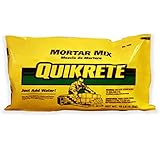
Every mortar mixer discussion eventually runs into the same truth: the mixer is the cheap part of the job. The material is where the money and the risk sit, and a bad blend will fail no matter how good the drum is. QUIKRETE Construction Grade Mortar Mix is a preblended masonry cement and graded sand product for laying brick and concrete units, and it is the budget pick here precisely because it removes the blending decision from the equation.
Who it suits: homeowners and repair-scale masons who need a consistent, predictable mortar for repointing, small wall sections, brick steps, planters, mailbox piers and patching. It is also the right answer for anyone who does not want to buy masonry cement and bulk sand separately, measure proportions by volume and hope the sand is the right gradation. If you are mixing one or two bags at a time, this is the material that makes the whole job manageable.
Key specs
- Preblended masonry cement and graded sand in a single bag
- Commonly packaged in 80 lb (36.3 kg) bags, with smaller formats also available
- Yields roughly 0.6 to 0.7 cubic feet of trowel-ready mortar per 80 lb bag, depending on water content
- Planning rule of thumb: about 35 to 45 modular brick per 80 lb bag with 3/8 in. joints
- Roughly 10 to 15 standard 8 x 8 x 16 in. concrete blocks per 80 lb bag
- Water demand varies; most 80 lb bags of preblended mortar take roughly three to five quarts of clean water to reach trowel consistency
Strengths
Consistency is the headline. Because the cement and sand are blended at the plant, every bag behaves the same way, which means your first batch and your twentieth batch cure to the same strength and color. On repair work, that matters more than it sounds: a repointed joint that cures harder than the surrounding historic brick can spall the brick as it shrinks and expands, so predictability is a durability feature, not a convenience one.
Second, the material is genuinely portable. An 80 lb bag is heavy but manageable with a hand truck, and it goes up a ladder, into a bucket, or into the back of a car without a bulk sand pile and a cement hopper. Third, the working characteristics are forgiving. Preblended mortar is designed to be trowelable at a range of water contents, so a slightly wet batch does not ruin the job the way it does with site-mixed concrete. Fourth, it is the cheapest entry point in this entire roundup — you can repoint a chimney for the cost of a couple of bags and a jointing tool, no powered equipment at all.
The trade-off is that you pay per bag for a product that is mostly sand, and at larger volumes that premium adds up quickly against buying sand and masonry cement in bulk. It also does not let you tune the mix. If your brick is highly absorptive and sucks the water out of the mortar in seconds, or if you need a specific mortar type by specification, you are working within the range the bag gives you rather than dialing in your own proportions.
Pros
- Consistent, repeatable blend bag to bag — no measuring, no guessing ratios
- Portable in 80 lb bags, no bulk sand pile required
- Lowest cost of entry in this roundup
- Predictable working time and trowelability
- Works with hand mixing, a drill paddle, or any drum mixer
- Straightforward coverage math for estimating
Cons
- Per-bag premium becomes expensive at wall-scale volumes
- No ability to tune the blend for unusual brick absorption or a specified mortar type
- 80 lb bags are heavy to carry up ladders and scaffolds
- Requires a mixing vessel, a hoe, a paddle or a mixer — none included
- Needs dry storage; moisture sets the bag hard
How it compares
The nearest alternative in this list is the SILVEL Cement Mixer, and the pairing is natural: the mixer is the tool, this is the material. If you are choosing between them, you are really asking whether your bottleneck is mixing speed or material supply. For one or two bags, a tub and a hoe are faster than setting up a machine. For five bags and up, the SILVEL starts paying for itself in time and in consistent, lump-free mortar. Buy the material first — a mixer with nothing to mix is just furniture.
3. Konvixon 22PCS Tile Grout Masonry Mortar Bag and Brick Jointing Tool Kit – Best for Larger Grouting Runs

The 22-piece Konvixon kit is the bigger sibling of the 7-size set, trading specialization for breadth. Where the smaller kit is a pointing and jointing outfit, this one spreads across tile grouting, brick jointing and general masonry placement, with a wider assortment of bags and tools bundled together.
Who it suits: the reader who wants one box that covers mortar bags, grout bags and jointing tools without buying each piece separately. It fits best on jobs that mix categories — a stone veneer wall with grouted tile work nearby, a patio project with both brick edging and tile, or a contractor or serious DIYer who would rather have the full assortment on the truck than hunt for a specific profile mid-job. If you already own the 7-size kit and only do pointing, you do not need this. If you are starting from nothing and your work spans more than pointing, the 22-piece set is the more efficient single purchase.
Key specs
- 22 pieces total — mortar and grout bags plus brick jointing tools
- Hand-powered throughout; no motor, battery or cord
- Covers both masonry jointing and tile grouting tasks
- Bag-fed placement for controlled mortar and grout application
- Packs down into a bucket or small tote for transport
Strengths
The value argument is the strongest one. Buying mortar bags and jointing tools individually adds up, and you usually end up with duplicates you do not need or missing profiles you do. A single kit with twenty-two pieces solves that in one purchase and gives you a consistent tool family — same handle feel, same finish quality, same sizing logic — which sounds trivial until you have spent a day switching between mismatched tools.
The second strength is range. Because the kit spans tile grouting and masonry jointing, it handles the transitional work that shows up on real jobs: grouting a stone hearth and pointing the brick around it, or filling joints on a veneer wall and grouting the tile floor in front of it. Bag-fed grout is also much cleaner than a float on vertical tile and on any stone with a rough face, because you are pushing material into the joint rather than spreading it across the surface.
The third strength is durability by omission. There is nothing electronic here to fail, nothing to charge, and nothing to maintain beyond rinsing the bags and wiping the tools. On a jobsite with unreliable power or a long walk from the truck, that simplicity is worth more than a spec sheet suggests.
The limits are the same as any bag-based system. Output is measured in small quantities per minute, so a 300-brick wall is a long day with this kit alone. Some users find the bag seams are the first thing to give out under sustained squeezing pressure, and mortar left to cure in a bag will harden it permanently — rinse immediately, every time. The tool assortment also includes pieces you may never use, which is the flip side of breadth.
Pros
- One purchase covers mortar bags, grout bags and jointing tools
- 22 pieces at a mid-range price beats buying components separately
- Handles both tile grouting and masonry jointing
- Bag placement keeps mortar off faces and out of texture
- No power, no fuel, no maintenance beyond rinsing
- Everything stores in one tote
Cons
- Slower than a powered system on large runs
- Includes tools you may never reach for
- Bag seams are the first component to wear under heavy use
- Bags must be rinsed immediately or they set hard
- Still requires separate mixing equipment
How it compares
Against the Konvixon 7-size kit, this is the broader, more general-purpose choice. The 7-size kit is better if your work is almost entirely brick and stone pointing and you want maximum bag count and jointing focus. The 22-piece kit wins if your projects mix tile and masonry, or if you are equipping from scratch and want one box that covers more situations. Both are hand tools, so if your real problem is mixing speed, neither one solves it — that is what the SILVEL mixer is for.
4. Bon Tool Repl Blades for 6, 7 & 8 Cubic Feet Stone Mixer (11-559) – Best for Maintaining a Stone Mixer

This is the least glamorous entry in the roundup and one of the most practical. Bon Tool’s replacement blades fit 6, 7 and 8 cubic foot stone mixers under part number 11-559, and they exist because the blades are the part of a mixer that wears out first. If you own or are considering a drum mixer in that size class, understanding the blade replacement cycle is a bigger ownership decision than the drum capacity itself.
Who it suits: anyone running a 6, 7 or 8 cubic foot stone mixer on masonry work — a contractor, a landscaper building stone walls and patios, or a serious property owner who mixes mortar and concrete regularly enough to have bought a drum machine. It is also relevant to the buyer evaluating a used mixer: blades are the first thing to inspect, and knowing they are replaceable with a specific part number changes the economics of a used purchase.
Key specs
- Replacement blades for stone mixers in the 6, 7 and 8 cubic foot classes
- Bon Tool part number 11-559
- Steel mixing blades — the wear surface that contacts aggregate and mortar
- Sold as replacement components, not as a complete mixer
- Designed to be swapped as a set so the drum stays balanced
Strengths
The core value is that blades are a consumable, and treating them as one extends the life of an expensive machine. In a drum mixer, the blades do the actual work: they lift, fold and shear the mix against the drum wall. Abrasive sand and aggregate grind them down, and a worn blade set produces exactly the symptoms people misdiagnose as a failing motor — slow, uneven mixing, unmixed pockets at the bottom of the drum, and mortar that never reaches a smooth consistency no matter how long you run it.
Second, buying the correct part number for the size class matters more than it sounds. A blade that is too short leaves a dead zone; a blade that is too long drags the drum and loads the gearbox. Specifying blades for 6, 7 and 8 cubic foot mixers by part number takes the guesswork out of a fit that is genuinely hard to eyeball. Third, replacing blades is a low-skill job — drain, clean, unbolt, swap, torque — which means a worn mixer can be brought back to full performance for the cost of a component rather than the cost of a machine.
The obvious limitation is that this product does not mix anything on its own. It is a maintenance part, and if you do not own a compatible mixer it has no use. The premium tier reflects that these are purpose-made steel components rather than a commodity item, and that replacement sets for larger machines are not cheap relative to a hand tool.
Pros
- Restores mixing performance without replacing the whole machine
- Correct part number for 6, 7 and 8 cu ft stone mixers removes fit guesswork
- Simple bolt-on replacement, no special tools required
- Prevents the misdiagnosis of “worn blades” as a motor or gearbox fault
- Makes a used drum mixer a much safer purchase if blades are available
- Steel construction suited to abrasive sand and aggregate
Cons
- Useless without a compatible drum mixer
- Does not include the mixer, drum, frame or drive
- Premium pricing for what is, physically, a set of steel paddles
- Requires disassembly and cleaning before installation
- Must be replaced as a balanced set, which raises the cost per service
How it compares
The nearest alternative in this list is the SILVEL Cement Mixer, and the comparison is really “maintain a big machine” versus “own a small one.” A 6 to 8 cubic foot stone mixer with fresh blades will out-mix the SILVEL by a wide margin on volume — several bags per batch against one or two — but it is a heavy, bulky, expensive machine that needs space, transport and a serious power or fuel supply. The SILVEL is the portable, one-person answer. If you already own the big drum, blades are the smarter spend. If you do not, buy the mixer before you buy parts for one.
5. Starbond Concrete Epoxy Putty (2 oz) – Best for Crack Repair and Bonding

Not every mortar job is a wall. Chipped step edges, spalled corners, cracked cast stone, anchor points and loose units all fall outside what a trowel and a bag of mortar can fix well, because they need a material that bonds and cures hard rather than one that beds and compacts. Starbond’s two-part epoxy putty is a hand-kneaded repair compound for exactly those jobs.
Who it suits: the reader doing detail repair — filling a chipped brick corner, rebuilding a spalled step nose, bonding a loose stone cap, anchoring a rail plate, or sealing a hairline crack in a concrete or masonry surface before finishing. It suits small, precise jobs where mixing a batch of mortar would be absurd and where you need the repair to be sandable, drillable and paintable afterward. It is also a sensible thing to keep in a truck or a workshop drawer for the repair that shows up unannounced.
Key specs
- 2 oz (about 57 g) two-part epoxy putty — enough for multiple small repairs
- Hand-kneaded: the two components are mixed by working them together until uniform in color
- No mixing tools, no drill paddle, no measuring cups required
- Cures to a hard, machinable solid that can be sanded, filed and drilled
- Suited to concrete, masonry, stone and similar mineral substrates
- Compact enough to store in a toolbag without drying out if sealed properly
Strengths
The format is the feature. Two-part epoxy putty is the only repair material in this roundup that needs no equipment at all — no drill, no paddle, no tub, no drum. You cut a slice, knead it until the color is even, press it into the defect, and shape it before it sets. For a chipped brick on the fourth course of a wall, that is the difference between a fifteen-minute fix and a project.
Second, epoxy putty bonds rather than simply fills. Cementitious patching materials rely on mechanical keying and can pop out of a shallow or smooth-edged defect; an epoxy bonds chemically to the substrate and cures to a strong, dimensionally stable solid. That makes it the right choice for load-adjacent repairs like a step edge that takes foot traffic, or for anchoring hardware into masonry where a loose mechanical fixing has already failed once.
Third, the cured material is workable. You can sand it flush, carve it to match a profile, drill it, and in many cases paint or stain it to blend. On visible masonry, that is what separates a repair that disappears from one that announces itself. Fourth, the 2 oz format is genuinely the right size for repair work — a larger container is more likely to cure in the package before you use it than it is to save you money.
Limitations: epoxy putty is expensive per ounce relative to cementitious mortar, so it is not a material for filling volume. It has a finite working time once kneaded, and once it begins to set, you cannot add water or rework it. It is also a chemical product — skin contact and fumes need to be managed with gloves and ventilation, and the manufacturer’s safety documentation should be followed. If you have a respiratory or skin condition, or the repair involves significant surface area, consult a professional before proceeding. Cured epoxy does not match masonry in vapor permeability, so it is generally a poor choice for large areas of historic fabric that need to breathe.
Pros
- No mixing equipment, no power, no cleanup beyond gloves
- Chemical bond to masonry, stone and concrete
- Cured material can be sanded, drilled and shaped
- 2 oz size suits repair work rather than bulk filling
- Stores compactly and is ready immediately on site
- Works in small quantities where mortar would be wasted
Cons
- High cost per ounce compared with mortar
- Limited working time once kneaded — no rework
- Requires gloves and ventilation; follow the safety documentation
- Not suitable for filling large volumes economically
- Low vapor permeability makes it a poor match for large historic masonry repairs
- Not a structural substitute for engineering-grade repair where that is specified
How it compares
The nearest alternative in this list is the QUIKRETE mortar mix, and the two are complementary rather than competing. QUIKRETE is the material for bedding and pointing units over an area; Starbond is the material for repairing a defect in one unit. If you are repointing a wall, buy the mortar. If you are fixing a chipped corner or bonding a loose cap, buy the putty. Many masonry repairs call for both, and the putty is the one you keep in the bag.
6. Andi Mini Brick & Stone Dollhouse Miniature Grey Mortar, 8oz Powder – Best for Miniature and Model Masonry

Miniature masonry is a real discipline with its own material demands, and it is the one place where a full-size mortar mix is actively wrong. Andi Mini Brick & Stone’s grey mortar powder comes in an 8 oz container and is formulated for dollhouse and model brick and stone work, where joint widths are measured in fractions of a millimeter and a single stray grain of aggregate ruins the scale.
Who it suits: dollhouse builders, architectural model makers, miniature diorama artists and hobbyists building 1:12 and similar scale brick or stone structures. It also suits anyone doing small-scale craft masonry — miniature garden walls, model chimneys, miniature fireplaces — where the goal is a realistic, matte, grey mortar joint that reads correctly at close viewing distance. If your work is measured in spoonfuls rather than bags, this is the category to be in.
Key specs
- 8 oz powder format — enough for many miniature structures
- Grey color formulated to read as realistic mortar at miniature scale
- Fine powder consistency suited to narrow model joints
- Mixed in small quantities with water, typically in a cup or on a palette
- No powered mixing equipment — a stir stick is the whole tool kit
- Stores dry; moisture is the main enemy
Strengths
The particle size is the point. Full-size mortar contains graded sand up to several millimeters; in a 1:12 dollhouse wall, a single sand grain is a boulder. A fine powder lets you fill a 1 mm joint cleanly and wipe the face without dragging grit across the brick faces. That single property is what makes miniature mortar a distinct product rather than a small bag of the real thing.
Second, the color is chosen for the application. Miniature grey mortar is intended to sit between miniature bricks and read as mortar from a normal viewing distance — not to match a structural specification. Third, the scale of mixing matches the scale of the work: a spoonful of powder and a few drops of water, stirred in a disposable cup, gives you a batch sized to a wall section rather than a wheelbarrow you then throw away. Fourth, the 8 oz container is generous at this scale. Used at miniature batch sizes, one container supports a large number of projects, which makes the cost per project very low even though the cost per ounce looks high next to full-size mortar.
The limitations are entirely about scale. This product has no role in structural masonry, repointing, tuckpointing or any full-size application, and using it there would be a mistake. The joints it fills are cosmetic. It also has a short open time in small batches because the volume is so low that it dries quickly, so you mix what you can place in a few minutes and no more. And like any dry powder, it clumps if it takes on moisture in storage.
Pros
- Fine particle size that behaves correctly at miniature joint widths
- Realistic grey color chosen for scale viewing
- Mixes in spoon-sized batches with water only
- 8 oz goes a very long way at miniature consumption rates
- No equipment, no power, no cleanup beyond a cup and a stick
- Ideal for 1:12 dollhouse and diorama brick and stone
Cons
- No use whatsoever in full-size masonry
- Cosmetic joints only — not structural
- Small batches dry out fast once mixed
- Powder clumps if stored in humid conditions
- High cost per ounce compared with full-size mortar, though low cost per project
- Requires patience and small tools rather than strength
How it compares
The nearest alternative in this list is the QUIKRETE mortar mix, and the comparison is a pure scale mismatch: QUIKRETE is for real brick and block, Andi Mini is for models of them. There is no overlap and no reason to choose between them except to confirm which kind of masonry you are actually building. The one useful link is that model makers often keep both on the bench — full-size mortar for a garden wall, miniature powder for the model of it on the shelf.
7. SILVEL Cement Mixer, Max 2300W Electric Concrete Mixer – Best Overall Powered Mixing

This is the best overall pick because it is the only product in the roundup that actually solves the mixing problem at scale. The SILVEL is a portable electric mixer rated to a maximum of 2300W with six adjustable speeds and a 110V motor, and the speed control is the specification that matters most for masonry work.
Who it suits: anyone mixing more than a bag or two at a time — laying a garden wall, building brick steps, pouring small footings, setting fence posts, mixing mortar and concrete for a patio or a repair that spans a weekend. It suits the homeowner who is tired of hand-mixing in a wheelbarrow and the small contractor who wants a machine that one person can move, plug into a household circuit and run all day. It is also the right pick for anyone who values consistency: a machine mixes the same way every time, which is the single biggest determinant of whether your mortar cures uniformly.
Key specs
- Maximum 2300W electric motor — high power for stiff masonry and concrete mixes
- Six adjustable speeds, so you can slow down for mortar and speed up for concrete
- 110V input, compatible with standard household circuits and small generators
- Portable format — moveable by one person between batches and locations
- Electric drive: no fuel, no exhaust, no pull-start, usable indoors and in enclosed spaces
- Handles both mortar and concrete mixing duty
Strengths
Speed control is the feature that separates a mortar mixer from a concrete mixer in practice. Mortar is not concrete — it is placed by trowel, it needs to stay workable, and over-mixing it at high RPM drives off water and produces a stiff, unworkable batch that sets faster than you can place it. Six speeds let you run a slow, folding action for mortar and a faster shear for concrete, and that one capability is why this machine is the best overall pick rather than just the most powerful one.
Second, 2300W is enough headroom for stiff mixes. The most common failure mode in cheap mixers is bogging down under a full load of dense material, which stalls the drum, strains the motor and forces you to under-fill the machine — meaning more batches, more time and more inconsistency. Power headroom lets you run fuller, more efficient batches.
Third, the 110V electric format is a genuine jobsite advantage. There is no fuel to buy or store, no exhaust to manage, no carburetor to service after a winter in the shed, and no pull-cord to fight at 7 a.m. On a residential job where an outlet is within reach of an extension cord, electric is faster to set up and much quieter. It also means you can mix inside a garage in cold weather, which extends your working season in a way that matters more than most spec-sheet comparisons suggest.
The trade-offs are real but predictable. Electric ties you to a power source or a generator, so a remote site with no power is a problem. A 2300W motor draws serious current at full load, and long undersized extension cords will cause voltage drop, sluggish performance and heat — use a heavy-gauge cord kept as short as practical. And like any drum or paddle mixer, the parts that wear first are the ones that touch the mix: blades or paddles, then the drum surface, then the drive. Cleaning promptly after every batch is not fussiness; cured mortar in a mixer is a grinding paste that accelerates wear on everything downstream.
Pros
- 2300W maximum power with enough headroom for full, stiff batches
- Six speeds — slow for mortar, faster for concrete
- 110V electric: no fuel, no exhaust, no cold-start problems
- Quiet enough for residential work and usable in a garage
- Portable and manageable by one person
- Consistent mixing, which drives consistent cure and color
Cons
- Requires a power source; not suitable for remote sites without a generator
- High current draw demands a properly sized extension cord
- Blades, drum and drive are wear items that need cleaning after every use
- Needs storage space and dry conditions
- Overkill for single-bag repair jobs
<