Best Miter Saws for Accurate Cuts Buying Guide
What's inside
- Top 3 Picks
- Quick Comparison
- How We Chose
- 1. Metabo HPT C10FCG2 – Best for Budget Finish Trim
- 2. SKIL MS6305-00 – Best for Trim Plus Light Framing
- 3. DEWALT DCS361B – Best for Cordless Jobsite Work
- 4. SEESII 8-1/4″ Compound Miter Saw – Best for Small Shops and Occasional Cuts
- 5. Evolution S355CPSL – Best for Metal Cutting on a Premium Budget
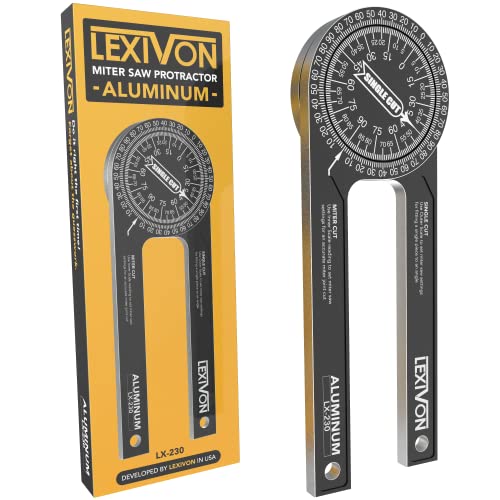
- 6. LEXIVON Aluminum Miter Saw Protractor – Best for Setup and Angle Verification
- 7. Evolution S14MCS – Best for Production Metal Miters
- How to Choose
- Related Guides
As an Amazon Associate I earn from qualifying purchases. This post may contain affiliate links at no extra cost to you.
For accurate trim and framing cuts, the best miter saw for most buyers is the SKIL 10-Inch Dual Bevel Sliding Compound Miter Saw (MS6305-00). Its sliding carriage and dual-bevel head let one saw handle baseboard, crown, casing, and 2x stock, and its detented miter table repeats the common trim angles without a re-check on every piece. If budget is the binding constraint and the work is finish trim only, the Metabo HPT C10FCG2 is the value pick. If you cut steel rather than wood, the Evolution S355CPSL dry-cut saw is the premium answer, with the Evolution S14MCS as the mitering step up.
Accuracy is the whole point of this category, and it is not one number. It is the sum of three things: how repeatable the miter detents are, how well the fence stays square to the blade, and how much the blade deflects when you feed it. A saw can be dead-on at 0° and still leave a visible gap on a 45° crown cut. This guide breaks down what each of those variables actually costs you in inches, which saws in each price tier handle them best, and how to set up and maintain a saw so it stays accurate after the first hundred cuts.
Our Top Picks
 SKIL 10" Dual Bevel Sliding Compound Miter Saw-MS6305-0010''35.43 x 22.44 x 14.17 Inches39.4 poundsCheck on Amazon



Top 3 Picks
Best overall: SKIL 10″ Dual Bevel Sliding Compound Miter Saw (MS6305-00). The dual-bevel head means you can swing the blade either direction for a 45° bevel instead of flipping the workpiece, which matters constantly on crown and casing. The sliding carriage adds crosscut capacity for wider trim and 2x material, and the detent plate covers the angles trim carpenters actually use. It is the widest-capability saw here that still fits a mid-range budget.
Best budget: Metabo HPT 10-Inch Compound Miter Saw, 15-Amp, Single Bevel (C10FCG2). A 15-amp direct-drive motor, a 10-inch blade, and a miter table with positive stops at the standard trim angles — nothing you don’t need. It is a non-sliding, single-bevel saw, so crown molding requires more planning, but for baseboard, casing, and general 2x cutting it is the most accuracy per dollar in this list.
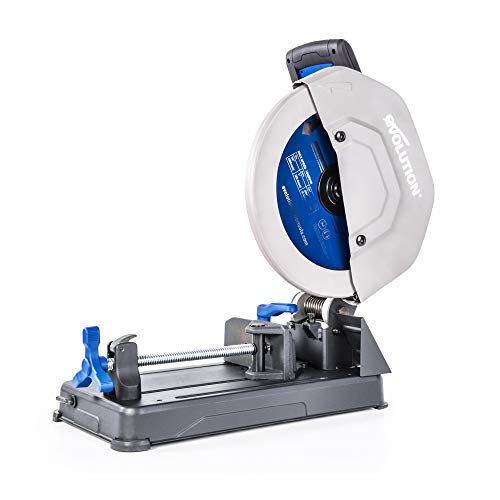
Best premium for metal: Evolution S355CPSL 14-Inch Dry-Cut Chop Saw. A low-RPM, carbide-tipped dry-cut saw leaves a cool, nearly burr-free edge instead of a hot, abrasive-smeared one, and the cost per cut over a long project often undercuts abrasive discs. Choose the Evolution S14MCS instead if you need a mitering head for angled steel joints.
Quick Comparison
| Product | Best for | Key specs | Price tier |
|---|---|---|---|
| Metabo HPT C10FCG2 | Budget finish trim | 10 in. blade, 5/8 in. arbor, 15 A corded, single bevel (left, 0–45°), miter 0–52° left and right with detents, ~25 lb class | Budget |
| SKIL MS6305-00 | Overall for trim plus light framing | 10 in. blade, 15 A corded, dual bevel 0–45° both sides, sliding carriage, detented miter table, ~35 lb class | Mid-range |
| DEWALT DCS361B | Cordless jobsite work | 7-1/4 in. blade, 20V MAX battery platform, sliding, single bevel (left), detented miter table, tool only (no battery or charger), ~30 lb class | Mid-range |
| SEESII 8-1/4″ Compound Miter Saw | Small-shop and occasional cuts | 8-1/4 in. blade, corded, 4,900 RPM no-load class, single bevel 0–45°, laser cut line, compact footprint | Budget |
| Evolution S355CPSL | Metal cutting, straight cuts | 14 in. carbide-tipped blade, dry cut, low-RPM geared motor, chip collection, laser guide, cuts mild steel, stainless, and aluminum | Premium |
| LEXIVON Aluminum Miter Saw Protractor | Setup, angle transfer, and verification | 7 in. aluminum body, rust-proof finish, laser-engraved scales, works with miter saws, circular saws, and trim layout | Budget |
| Evolution S14MCS | Production metal miters | 14 in. blade, EVOMAX intelligent motor, cold-cut steel saw, mitering head for angled cuts, long blade-life claim from the manufacturer | Premium |
How We Chose
Selection started with published manufacturer specifications and the physical realities of the category, not with marketing copy. Each saw was judged on the numbers that determine whether a cut lands where you aimed it: blade diameter and kerf, arbor size, motor amperage or battery platform, bevel type and range, miter range and the presence of positive stops at the angles trim work actually uses, fence design, and weight.
From there we filtered by category fit. A 14-inch dry-cut saw competes against abrasive chop saws and band saws, not against a 10-inch compound miter saw, so each product is evaluated inside its own job. We also weighed the upgrade path: does a saw leave you room to grow into crown molding, wider stock, or metal, or does it cap you at one task? Finally, we considered ownership — blade availability, consumable cost, replacement parts, and the failure points that show up first on saws in each tier. Where a listing does not state an exact figure, we describe the specification class rather than guess at a number.
1. Metabo HPT C10FCG2 – Best for Budget Finish Trim
As an Amazon Associate we earn from qualifying purchases at no extra cost to you.

The C10FCG2 is the saw to buy when the job is baseboard, casing, door and window trim, and general 2x cutting, and when the budget needs to stay in the entry tier. Metabo HPT builds this as a straightforward 10-inch single-bevel compound miter saw: a 15-amp corded motor driving a 10-inch blade on a 5/8-inch arbor, with the head tilting to the left for bevels and the table rotating both directions for miters. There is no sliding carriage, which keeps the head rigid and the price down.
Who it suits: a first-time buyer, a homeowner finishing a basement, a trim carpenter who wants a dedicated second saw for punch-list work, or anyone whose cuts are almost all at 90° and 45° in material under about 5-1/2 inches wide. It also suits a shop where space is limited, because the fixed head means the saw needs less rear clearance than a slider.
Key specs
- Blade: 10 in. with 5/8 in. arbor — the most common size in the category, so blades are cheap and widely stocked
- Motor: 15 A corded, direct drive, no-load speed in the 4,000 RPM class
- Bevel: single, left side, 0–45°
- Miter: 0–52° left and right, with positive detents at the standard trim angles including 0°, 15°, 22.5°, 31.6°, and 45°
- Weight: roughly 25 lb class — one of the lighter saws here, and genuinely carryable by one person
- Included: a carbide-tipped blade, dust bag, and a vertical work clamp
Strengths. The rigid, non-sliding head is the underrated advantage. Sliding saws introduce a second axis of movement, and any play in the rails shows up as blade deflection at full extension. A fixed-head saw has none of that, so a sharp, properly aligned blade cuts cleanly and stays predictable. The miter detents land at the angles trim work uses, which means most cuts are a swing and a lock rather than a protractor and a squint. The 10-inch blade size is the sweet spot for blade selection: 40-tooth blades for framing and general cutting, 60- to 80-tooth for trim, all readily available at low cost.
Where it gives ground. Single bevel means every bevel cut requires you to plan the workpiece orientation. Cutting both halves of a crown molding joint usually means flipping one piece end for end, and that is exactly where small errors creep in — you are now relying on the saw’s detents and your own layout rather than on a mirrored bevel. The non-sliding head also caps crosscut capacity. You can cut a 2×4 and a 4×4 at 90°, but wide shelving stock and nested crown are out of reach.
Pros
- Lowest entry cost of any saw in this roundup while still delivering a 15-amp motor and a 10-inch blade
- Fixed head removes the deflection variable that sliding saws introduce
- Light enough to move between rooms or carry up stairs without help
- 10-inch blade and 5/8-inch arbor mean cheap, universally available consumables
- Positive miter detents at the standard trim angles speed up repetitive cuts
Cons
- Single bevel — no mirrored bevel cuts, which slows crown molding work
- No sliding carriage, so crosscut capacity is limited to narrower stock
- Smaller table and fence than mid-range saws, so long stock needs more support
- Dust collection is basic; expect to sweep up after a trim run
How it compares. Against the SKIL MS6305-00, the Metabo HPT gives up the sliding carriage and the second bevel direction in exchange for a lower price and a stiffer head. If your work is 90° and 45° cuts in trim, the capacity difference rarely bites, and you save money. If you plan to install crown molding or cut wide stock, the SKIL pays for itself quickly. Against the SEESII 8-1/4″, the Metabo HPT is the more capable saw: a bigger blade, more crosscut capacity, and a more established parts and blade ecosystem. The SEESII wins only on footprint and price.
2. SKIL MS6305-00 – Best for Trim Plus Light Framing

The MS6305-00 is the saw most buyers should start with. It is a 10-inch dual-bevel sliding compound miter saw with a 15-amp corded motor, which means it combines the two features that matter most for accurate trim work — a bevel that swings both directions and a carriage that slides forward to extend crosscut capacity. That combination is what lets a single saw handle baseboard, casing, crown, and dimensional lumber without a second tool.
Who it suits: a remodeler or serious DIYer running trim through a whole house; a carpenter who wants one saw that does finish work and light framing; anyone who intends to install crown molding and does not want to fight a single-bevel head. It is the natural step up from an entry-level fixed-head saw and the point at which the tool stops being a limitation.
Key specs
- Blade: 10 in. with 5/8 in. arbor
- Motor: 15 A corded, no-load speed in the high-4,000 RPM class
- Bevel: dual — 0–45° to both the left and the right, so mirrored cuts need no workpiece flipping
- Miter: rotating table with positive detents at the common trim angles, plus the ability to lock at any angle in range
- Carriage: sliding rails that extend the head forward for wider crosscuts
- Weight: roughly 35 lb class — portable but no longer a one-hand carry
- Included: carbide-tipped blade, dust bag, and work clamp
Strengths. The dual-bevel head is the single biggest accuracy advantage in this list, and it is worth being precise about why. On a single-bevel saw, cutting both halves of a miter joint with a bevel means flipping one workpiece end-for-end. That flip introduces a new set of variables: the workpiece must sit flat against the same reference surfaces, your layout marks must be mirrored correctly, and any fence irregularity now acts in the opposite direction on the second piece. A dual-bevel saw removes all of it. You set the bevel once and cut both pieces with the same face against the same fence.
The sliding carriage adds capacity, which is more useful than it sounds. It lets you cut wide baseboard standing against the fence, nested crown, and wider dimensional stock. That capacity is what turns a trim saw into a light-framing saw. The 10-inch blade keeps consumables cheap and the saw’s overall weight manageable.
Where it gives ground. Sliding saws flex. When the head is fully extended and you bear down on the handle, the blade can walk slightly off the vertical plane, and that shows up as a slightly dished cut face or a miter that closes at the top and opens at the bottom. The fix is technique, not hardware: let the blade reach full speed, feed slowly, and never push the head sideways. Sliding rails also accumulate sawdust and pitch, so they need occasional cleaning and a light lubrication schedule to stay smooth. Finally, the extra weight and the rear clearance the rails require mean it is less convenient in a small shop than a fixed-head saw.
Pros
- Dual bevel eliminates workpiece flipping for mirrored cuts — the biggest single accuracy gain in this roundup
- Sliding carriage extends crosscut capacity to wide trim and dimensional lumber
- One saw covers finish trim and light framing, avoiding a second purchase
- 10-inch blade and 5/8-inch arbor keep blade costs low and selection wide
- Detented miter table repeats the standard trim angles quickly
Cons
- Heavier and bulkier than a fixed-head saw; needs more bench depth and rear clearance
- Sliding rails can develop play and must be kept clean
- Head deflection is possible if you feed too fast or push sideways
- Stock dust bag fills quickly; a shop vacuum connection is a worthwhile add-on
How it compares. Against the Metabo HPT C10FCG2, the SKIL costs more but removes two hard limits: bevel direction and crosscut capacity. If you are installing crown molding or cutting anything wider than a 2×6, that is the difference between finishing the job with this saw and finishing it with this saw plus a workaround. Against the DEWALT DCS361B, the SKIL is corded, heavier, and cuts larger material; the DEWALT trades capacity for cordless freedom and a smaller 7-1/4-inch blade. If your work is in a shop with power, the SKIL is the more capable tool. If your work is on a job site with no outlet nearby, the DEWALT wins on logistics.
3. DEWALT DCS361B – Best for Cordless Jobsite Work

The DCS361B is a 20V MAX cordless 7-1/4-inch sliding miter saw sold as a bare tool. It exists to solve one problem: cutting trim and framing where there is no convenient outlet, or where running an extension cord across a finished floor is not acceptable. It is the saw you carry to the second-floor bathroom, the deck, or the far end of a job site.
Who it suits: remodelers working in occupied homes, deck builders, punch-list carpenters, and anyone already invested in the 20V MAX battery platform. Because it ships tool-only, it makes financial sense only if you already own compatible batteries and a charger — otherwise you are buying into an ecosystem, not just a saw.
Key specs
- Blade: 7-1/4 in. — smaller than the 10-inch saws here, which reduces both capacity and blade stiffness
- Power: 20V MAX battery platform; no-load speed in the high-3,000 RPM class, lower than corded saws
- Bevel: single, left side, with a range extending slightly past 45°
- Miter: detented miter table with positive stops at the common angles, plus free rotation to the extremes of its range
- Carriage: sliding, which is what gives the small blade useful crosscut capacity
- Weight: roughly 30 lb class without battery
- Included: tool only — no battery, charger, or case in this configuration
Strengths. Portability is the entire value proposition, and it is a real one. Setting up a corded saw in an occupied house means cords, trip hazards, and outlets that may or may not be live. A cordless saw sets up in thirty seconds anywhere. The 7-1/4-inch blade on a sliding carriage is a deliberate trade: a small blade is lighter and cheaper, and the slide recovers enough crosscut capacity to handle typical trim profiles and 2x material. The detented table covers the standard angles, and DEWALT’s miter detent plates are generally well-machined with clean, positive stops.
Runtime reality. Cordless miter saws are not slow so much as finite. A 4.0 Ah battery at 20 volts stores roughly 80 watt-hours. A saw of this class draws on the order of 400 watts under average cutting load, so you get roughly 12 minutes of actual blade-in-wood time per charge — which, at about three seconds per cut, is on the order of 200 to 250 cuts. That is a full day of trim for most people, but it is not an unlimited day, and heavy 2x framing will cut that number down substantially.
Where it gives ground. Blade deflection is the accuracy concern. A 7-1/4-inch blade is thinner and less stiff than a 10-inch blade, and a smaller blade on a sliding carriage means less mass to resist side loading. Feed too fast and the cut face will not be flat. Bevel range is left-only, so mirrored bevel cuts require workpiece flipping — the same limitation as the Metabo HPT, but on a saw that also has less capacity. And because it is tool-only, the true cost depends on batteries you may not own.
Pros
- No cord, no outlet, no extension cord across a finished floor
- Sliding carriage makes the 7-1/4-inch blade far more useful than its size suggests
- Light enough to carry one-handed up a ladder or into a crawlspace
- Integrates with an existing 20V MAX battery lineup
- Detented miter table covers the standard trim angles
Cons
- Tool-only configuration means the real cost depends on batteries and charger you may not own
- Runtime is finite — heavy framing will drain a charge quickly
- Single bevel, left only; mirrored cuts need workpiece flipping
- Smaller blade deflects more under fast feed than a 10-inch blade
- Less crosscut capacity than the corded 10-inch saws in this list
How it compares. Against the SKIL MS6305-00, the DEWALT trades capacity, dual bevel, and unlimited runtime for cordless freedom. If you have power at the bench, the SKIL is the more accurate and more capable saw. If you do not, the DEWALT is the difference between working and not working. Against the SEESII 8-1/4″, the DEWALT is the more refined tool with a better-supported battery platform, while the SEESII is corded, cheaper, and free of battery dependency — a reasonable choice for a hobbyist who never leaves the shop.
4. SEESII 8-1/4″ Compound Miter Saw – Best for Small Shops and Occasional Cuts

The SEESII 8-1/4-inch compound miter saw is a compact, corded, single-bevel saw with a laser cut-line guide and a no-load speed in the 4,900 RPM class. It is aimed at the buyer who needs a miter saw occasionally — picture frame stock, small trim repairs, shelf brackets, craft and hobby work — and who values a small footprint and a low price over capacity.
Who it suits: apartment and garage woodworkers, hobbyists, and anyone whose cutting is intermittent and light. It also suits a secondary role: a small saw kept on a bench for quick cuts while a larger saw handles the big stock.
Key specs
- Blade: 8-1/4 in. — smaller and lighter than the 10-inch standard, with fewer blade choices available
- Motor: corded, no-load speed in the 4,900 RPM class
- Bevel: single, 0–45°
- Miter: rotating table covering the standard range with lockable angles
- Cut line: laser guide projected onto the workpiece
- Footprint: compact — the smallest saw in this roundup
Strengths. High RPM on a small blade produces a fast, clean cut in thin stock, which is exactly the material this saw is built for: 1x trim, shoe molding, picture frame stock, dowels, and small dimensioned lumber. The laser guide is genuinely useful on a saw at this level, because it lets you line up a cut without lowering the blade to check the kerf — a real time saver when you are making many short, repetitive cuts in narrow stock. The compact body fits on a small bench and stores on a shelf, which matters more than it sounds in a garage shop where every tool competes for space.
Where it gives ground. Capacity is the hard limit. An 8-1/4-inch blade cuts narrower stock than a 10-inch blade, and with no sliding carriage there is no way to extend that capacity. If your project involves 2×8 or wider material, or nested crown molding, this saw cannot do it. Blade deflection is also more of a factor: a small, thin blade has less mass and stiffness, so feeding too fast will bow the cut. Blade availability is narrower than the 10-inch standard, and the single-bevel head means mirrored cuts require flipping the workpiece.
Detents and setup. At this price tier, the detent plate is stamped rather than precision-ground, and the difference is measurable. On a stamped plate, the detent notch has a small amount of slop, and the pointer can be off by a fraction of a degree even when the pin feels seated. The practical test is simple: make a cut at 45°, flip one offcut end-for-end, and butt the two cut faces together against a straightedge. Any gap means the detent is not exactly at 45°, and you should lock the table by hand at the true angle rather than trusting the pin. It is worth doing this check on any budget saw before you start a trim run.
Pros
- Lowest cost and smallest footprint of the saws in this roundup
- High RPM in the 4,900 class produces clean cuts in thin stock
- Laser cut line speeds up repetitive short cuts
- Light and easy to store; no dedicated bench space required
- Good secondary saw for quick cuts while a larger saw handles heavy work
Cons
- Limited crosscut capacity; cannot handle wide stock or nested crown
- Single bevel only — mirrored cuts require flipping the workpiece
- Small blade deflects more easily under fast feed
- Fewer blade options than the 10-inch standard
- Stamped detent plate at this price tier may need hand-checking at 45°
How it compares. Against the Metabo HPT C10FCG2, the SEESII is cheaper and smaller but gives up crosscut capacity and blade availability. If your cuts are all narrow stock, the difference is invisible; if you ever need to cut a 2×6, the Metabo HPT is the saw that can do it. Against the DEWALT DCS361B, the SEESII is corded, so it never runs out of power, and it costs far less — but it cannot travel to a job site the way the cordless DEWALT can. The SEESII is a shop saw; the DEWALT is a site saw.
5. Evolution S355CPSL – Best for Metal Cutting on a Premium Budget

The S355CPSL is a different animal from everything else in this list. It is a 14-inch dry-cut chop saw — a low-RPM machine running a carbide-tipped blade that slices through mild steel, stainless, and aluminum rather than grinding through it. If your accurate-cut problem is steel tube, angle iron, strut, or aluminum extrusion, this is the category you should be shopping in, and this saw is the straight-cut specialist.
Who it suits: fabricators, welders, and metalworking shops cutting square tube, angle, channel, and plate; HVAC and electrical contractors cutting strut and unistrut; anyone who is tired of abrasive dust, hot sparks, and grinding the burr off every cut.
Key specs
- Blade: 14 in. carbide-tipped, dry cut — no abrasive disc, no coolant required
- Motor: corded, geared to a low RPM in the 1,400–1,600 class, which is what allows carbide teeth to survive in steel
- Cut type: dry cut — the chip is evacuated as a solid curl rather than vaporized
- Materials: mild steel, stainless steel, and aluminum, per the manufacturer’s stated capability
- Features: chip collection, laser cut-line guide, and a vise-style clamping system
- Cut orientation: straight 90° cuts are the primary use; check the specific listing for any miter capability
Strengths. The cut quality is the reason to buy it. An abrasive chop saw melts its way through steel: the disc wears away, the cut edge is hot enough to burn you, and it leaves a burr that has to be ground or filed off before the part fits. A dry-cut saw removes a chip. The cut face comes off cool enough to handle almost immediately, the burr is minimal, and the edge is square enough that welded joints close up without extra fitting. For anyone doing production or repeated cuts, that is a significant time saving on every single part.
Cost per cut. The economics favor dry cut over abrasive once you are past a modest number of cuts. Consider an illustrative 500-cut job in 1/4-inch-wall square tube. An abrasive disc at the entry tier costs a few dollars and realistically manages on the order of 30 to 60 cuts in that material before it is worn down — call it roughly a dozen discs across the job, so somewhere in the $80 to $150 range, plus the time spent changing discs and grinding burrs. A carbide-tipped dry-cut blade costs considerably more up front, in the $100-plus range, but lasts for hundreds of cuts in the same material. Run the numbers at 500 cuts and the dry-cut blade comes in at a fraction of a dollar per cut versus a couple of dollars per cut for abrasive — and the labor saved on deburring is not in that math at all.
Where it gives ground. Carbide teeth are brittle relative to an abrasive disc, so technique matters. You cannot plunge the blade into the work; you have to let it reach speed and then feed steadily. Thin-wall material and interrupted cuts are harder on the teeth than solid stock. The blade is also a real consumable at a real price, and if you chip teeth by forcing the cut, you will feel it. The machine itself is heavy and loud, and it is a dedicated metal saw — it will not cut wood for you.
Pros
- Cool, nearly burr-free cuts that need little or no cleanup before fitting or welding
- No abrasive dust cloud and dramatically fewer sparks than a chop saw
- Cost per cut drops well below abrasive discs on any sizable job
- Cuts mild steel, stainless, and aluminum with the same blade
- Chip collection keeps the work area far cleaner than abrasive cutting
Cons
- High up-front cost for both the saw and the carbide blade
- Carbide teeth can chip if you force the cut or hit interrupted material
- Heavy and loud; not a tool you move casually
- Metal only — no wood cutting capability
- Straight-cut focus; angled work may need a different machine in this list
How it compares. Against the Evolution S14MCS, the S355CPSL is the straight-cut workhorse and the S14MCS is the mitering upgrade. If every cut you make is at 90°, the S355CPSL does the job and you do not pay for a mitering head you will not use. If your work involves angled joints — handrails, frames, braces — the S14MCS is the saw to choose, and the difference in cost is the price of that capability. Against the wood-cutting saws in this list, there is no comparison at all: they are different tools for different materials, and no amount of blade swapping turns a 10-inch wood miter saw into a steel-cutting machine.
6. LEXIVON Aluminum Miter Saw Protractor – Best for Setup and Angle Verification
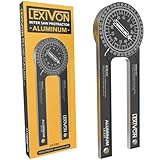
The LEXIVON miter saw protractor is not a saw, and that is precisely why it belongs in a guide about accurate cuts. It is a 7-inch aluminum angle finder with laser-engraved scales and a rust-proof finish, used to read an existing angle, transfer it to a saw, and verify that the saw is actually set where you think it is. Most accuracy problems in trim work are not saw problems — they are measurement problems, and this tool solves them for less than the cost of a single trim blade.
Who it suits: trim carpenters cutting against walls that are not square, anyone installing crown or baseboard in an older house, and anyone who wants to verify a saw’s detents rather than trust them. It is also a useful check tool for a budget saw with a stamped detent plate.
Key specs
- Size: 7 in. — long enough to span most trim and molding profiles for a stable reading
- Material: aluminum body with a rust-proof finish
- Scales: laser-engraved markings, which resist wearing off the way printed scales do
- Function: reads inside and outside angles and transfers them to a miter saw or circular saw setting
- Compatibility: works with any miter saw, regardless of brand or blade size
Strengths. The core insight is that walls are almost never at exactly 90°, and rooms are almost never perfectly square. A corner that measures 88.5° needs a 44.25° miter on each side, not a 45° detent. If you cut both pieces at the detent, the joint will not close — and no amount of saw upgrade fixes that, because the saw is doing exactly what you told it to. A protractor tells you what the actual angle is so you can set the saw to it. Laser-engraved scales matter more than they sound: a printed or painted scale on a tool that lives in a tool bag will wear away, and an unreadable scale is worse than no scale because you will trust it anyway.
Where it gives ground. It is a manual tool. You have to place it correctly, read it carefully, and then set the saw by hand — there is no digital readout and no memory. On a saw with a sloppy table lock, you can set the correct angle and still have the table move under load, so the protractor only solves half the problem. It also does not replace a square for checking fence-to-blade alignment; those are two different checks.
Pros
- Lets you cut to the actual wall angle instead of a nominal detent
- Laser-engraved scales stay readable far longer than printed ones
- Aluminum body with rust-proof finish survives a tool bag
- Works with any miter saw, so it does not become obsolete when you upgrade
- Costs a fraction of a blade and solves a problem no saw feature can
Cons
- Manual reading — no digital display or angle memory
- Does not correct a saw whose table lock slips under load
- Requires practice to read consistently on short or irregular trim profiles
- Does not replace a square for checking fence-to-blade alignment
How it compares. There is no direct alternative in this list, because everything else is a cutting tool. The right way to think about it is as an add-on: pair it with the Metabo HPT C10FCG2 or the SEESII 8-1/4″ to compensate for a budget detent plate, or pair it with the SKIL MS6305-00 when cutting trim in an older house where no corner measures 90°. On a job with square walls and modern trim, you may never need it. On a job with a 1920s living room, it will save you an entire afternoon of recuts.
7. Evolution S14MCS – Best for Production Metal Miters

The S14MCS is Evolution’s 14-inch mitering cold-cut saw, built around the company’s EVOMAX intelligent motor and a mitering head that lets you cut steel at an angle rather than only at 90°. The listing also cites a blade-life figure of 3,500-plus, which is a manufacturer claim about the included blade rather than an independently measured result — treat it as a design target, not a guarantee.
Who it suits: fabricators building frames, railings, gates, and braces where angled steel joints are routine; shops that want to cut a miter in steel without setting up a band saw or grinding a bevel by hand; anyone doing production metal work where blade changes and burr removal are eating time.
Key specs
- Blade: 14 in., cold cut — chip-forming rather than abrasive grinding
- Motor: EVOMAX intelligent motor, corded, geared for low-RPM carbide cutting
- Head: mitering, so angled cuts in steel are made on the saw rather than by layout and grinding
- Cut quality: cold cut — the workpiece stays cool and the edge needs minimal cleanup
- Blade life: manufacturer cites a 3,500-plus figure for the included blade
- Materials: steel and similar ferrous stock per the manufacturer’s stated capability
Strengths. Mitering a steel joint is normally a multi-step process: mark the angle, cut oversize, grind to the line, check the fit, repeat. A mitering cold-cut saw collapses that into a single setup. You set the head to the angle, clamp the stock, and cut — and the cut comes off cool and square with a minimal burr, so the joint closes without a grinding step. On a run of angled braces or a handrail with multiple bends, that is a large labor saving, and it is the reason this saw exists alongside the straight-cut S355CPSL.
The EVOMAX motor and what it means practically. An “intelligent” motor in this context refers to motor control that manages current draw and torque delivery so the blade keeps its speed under load instead of bogging down. That matters for carbide cutting, because the failure mode of a dry-cut blade is almost always the same: the blade slows, the operator pushes harder to compensate, the teeth take a heavier chip than they were designed for, and a tooth chips. A motor that holds RPM under load reduces the temptation to force the cut, which is a genuine durability benefit rather than a marketing line.
Where it gives ground. Cost is the first consideration — this is a premium-tier tool with a premium-tier blade, and the blade is a consumable. It is also heavy and dedicated to metal; it will not do woodwork, and it will not replace a wood miter saw for trim. The mitering head adds a moving joint that must be kept clean and locked firmly, because any play in the head translates directly into an out-of-square cut on steel, where the error is far less forgiving than in softwood.
Pros
- Mitering head cuts angled steel joints in one setup instead of layout-and-grind
- Cold cut leaves a cool, low-burr edge that fits up with minimal cleanup
- EVOMAX motor control holds blade speed under load, which protects carbide teeth
- Manufacturer cites a long blade-life figure for the included blade
- Eliminates the abrasive dust and heavy sparking of a traditional chop saw
Cons
- Premium-tier price for the saw and for replacement carbide blades
- Heavy and dedicated to metal — no woodworking capability
- The mitering head adds a joint that must be kept clean and locked tight
- Blade-life figures come from the manufacturer and will vary with material and technique
How it compares. Against the Evolution S355CPSL, the S14MCS adds the mitering head and the EVOMAX motor control. If every cut you make is at 90°, the S355CPSL is the more economical choice and gives up nothing you need. If your work involves angled joints in steel — and if you are fabricating anything structural, it probably does — the S14MCS is the saw that removes the grinding step, and the price difference is repaid in labor within a few jobs. Against the wood-cutting saws in this list, there is no overlap: different material, different blade, different machine.
How to Choose
The right miter saw is the one whose limits sit outside the work you actually do. That sounds obvious, but most buyers shop by blade size and price and end up with a saw that either cannot cut their material or cannot repeat the angle they need. Here is what to weigh, in the order it matters.
Start with the cut accuracy you need, not the blade size
Accuracy in miter work is measured in fractions of a degree, and fractions of a degree become visible inches over the length of a joint. This is the single most useful calculation in the whole category:
| Angle error | Gap at 4 ft | Gap at 8 ft | Gap at 16 ft |
|---|---|---|---|
| 0.1° | 0.08 in. | 0.17 in. | 0.33 in. |
| 0.25° | 0.21 in. | 0.42 in. | 0.84 in. |
| 0.5° | 0.42 in. | 0.84 in. | 1.68 in. |
| 1.0° | 0.84 in. | 1.68 in. | 3.35 in. |
Read that table against your actual work. A picture frame with 10-inch sides tolerates a surprising amount of error — half a degree shows up as less than a tenth of an inch across the joint, and wood filler hides it. A 16-foot run of baseboard does not. At 0.5° of error you are nearly an inch and three-quarters out by the end of the wall, and that is not a joint you can caulk. This is why a trim carpenter cares about detent quality far more than a hobbyist does, and why “it looks square to me” is not a measurement.