Best Milling Machine for Home Machine Shop Picks
What's inside
- Top 3 Picks
- Quick Comparison
- How We Chose
- 1. MechMaxx 1.5HP Benchtop Mini Mill Drill – Best for Most Home Machine Shops
- 2. Shop Fox M1036 Micro Milling Machine – Best for Micro Parts and Small-Scale Precision
- 3. VEVOR Milling Working Table 17.7 x 6.7 Inch – Best for Adding Controlled X-Y Movement to a Drill Press
- 4. VEVOR Rotary Table 4″/100 mm – Best Budget Addition for Circular and Angular Work
- 5. IntXanth 110V Benchtop Mini Milling Drilling Machine – Best for Maximum Drilling Capacity in a Benchtop Mill
- 6. XENDOLL Power Metal Milling Machine – Best for Hobby and Garage Use on Mixed Materials
- 7. Unimat SL Setup and Calibration (Home Workshop Monograph) – Best for Owners of a Used Unimat SL
As an Amazon Associate I earn from qualifying purchases. This post may contain affiliate links at no extra cost to you.
For most home machine shops, the best milling machine is the MechMaxx 1.5HP 7″ x 27-1/2″ Benchtop Mini Mill Drill: a 1.5 HP brushless motor, an R8 spindle, and a 7 x 27-1/2 inch table give it enough work envelope and tooling compatibility to cut aluminum, brass, and mild steel without consuming an entire garage bay. It suits the hobby machinist or small-shop builder who has a reinforced bench or stand, a 110 V circuit, and the willingness to tram and set up a machine properly. If you only make small parts — model engineering, RC hardware, small brackets, clock and instrument work — the Shop Fox M1036 Micro Milling Machine takes up a fraction of the space and cost. If you already own a drill press or a small mill and want more capability for the least money, the VEVOR 4″/100 mm rotary table is the single most useful budget addition. This guide compares nine currently available options by footprint, spindle power, travel dimensions, and the materials each one can realistically cut.
Our Top Picks
 VEVOR Milling Working Table 17.7 X 6.7 Inch17.7 X 6.7 Inch23 x 13 x 5 inches66 poundsCheck on Amazon
 VEVOR Rotary Table for Milling Machines6.3 x 5.8 x 4.7 in6.3 x 5.83 x 4.72 Inches11.68 poundsCheck on Amazon
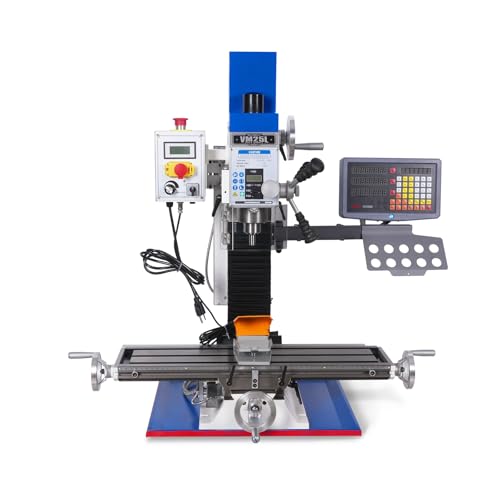


Top 3 Picks
Best Overall: MechMaxx 1.5HP Benchtop Mini Mill Drill
The MechMaxx pairs a 1.5 HP brushless motor with an R8 spindle and a 7 x 27-1/2 inch table — the largest table in this roundup and the same class of envelope you find on many floor-standing mill-drills. That combination of table length, R8 tooling availability, and 110 V operation makes it the machine that covers the widest range of real home-shop jobs, from fly cutting a small plate to boring holes in mild steel.
Best Budget: VEVOR Rotary Table, 4″/100 mm
At the budget tier, a rotary table delivers more capability per dollar than anything else here. Mounted horizontally it cuts bolt circles and arcs; mounted vertically it holds work at an angle for compound setups. It works on a small benchtop mill, a mill-drill, or even a drill press with a suitable table, which makes it the sensible first accessory purchase.
Best Premium for Small Parts: Shop Fox M1036 Micro Milling Machine
The M1036 is a genuine micro mill — tiny footprint, small work envelope, and the rigidity profile of a machine designed for small cutters and small parts. It is the right answer when bench space is measured in inches rather than feet, and when your work is measured in millimeters rather than inches. It is a premium-tier buy because you are paying for precision at small scale, not for capacity.
Quick Comparison
The table below covers every product in this roundup. “Price tier” is a general market band rather than a fixed figure, because listing prices on machine tools move constantly with stock and promotions. Key specs are taken from the product listings themselves.
| Product | Best for | Key specs | Price tier |
|---|---|---|---|
| MechMaxx 1.5HP Benchtop Mini Mill Drill | Most home machine shops; aluminum through mild steel | 1.5 HP brushless motor, 110 V, R8 spindle, 7″ x 27-1/2″ table, variable speed | Premium |
| Shop Fox M1036 Micro Milling Machine | Micro parts, model and instrument work | Micro-class benchtop mill, small footprint, variable-speed spindle, compact work envelope | Premium |
| VEVOR Milling Working Table 17.7 x 6.7 in | Adding controlled X-Y movement to a drill press | 17.7″ x 6.7″ compound work table, 2-axis with four directions of movement, manual feed | Mid-range |
| VEVOR Rotary Table 4″/100 mm | Bolt circles, arcs, angle work on a small machine | 100 mm (4″) table, horizontal and vertical mounting, graduated handwheel | Budget |
| IntXanth 110V Benchtop Mini Mill Drill | Buyers who want maximum drilling capacity in a benchtop mill | 1.5 HP / 1100 W brushless, 110 V, R8 spindle, 0.97″ drilling capacity | Premium |
| XENDOLL Power Metal Milling Machine | Hobby and garage use on wood, plastics, light metal | Small-size mini mill, hobby/garage class, motorized spindle | Mid-range |
| Unimat SL Setup and Calibration (Home Workshop Monograph) | Owners of a used or inherited Unimat SL | Printed setup, alignment and calibration guide specific to the Unimat SL lathe/mill | Budget |
| Jianyana Universal Mini Metal Milling Machine | Hobby, science education, light DIY milling | Motorized benchtop mini mill, compact frame, hobby-grade work envelope | Mid-range |
| Deeffe Magnetic Work Light | Lighting the work on any mill, lathe or drill press | LED machine light, flexible gooseneck, magnetic base | Budget |
How We Chose
This guide is built from published product specifications, manufacturer documentation, and established knowledge of how manual milling machines behave in a home shop — not from operating the machines ourselves. The selection criteria were deliberately narrow. First, category fit: does the item actually do what a home machinist needs, or is it an accessory that only makes sense alongside a machine you already own? A rotary table and a work light belong in a buying guide, but they are described as accessories, not as mills. Second, specs that determine capability: spindle power, spindle taper, table dimensions, and travel. A 1.5 HP motor and a 7 x 27-1/2 inch table describe a completely different class of machine than a micro mill with a few inches of travel, and the guide says so plainly. Third, use case: what material and what part size the machine is realistically suited to, from aluminum and brass up to mild steel. Fourth, upgrade path: where each item sits in the progression from drill press to full machine, so a reader can buy the right step rather than skipping two. Every entry is a real, currently listed product. Where a listing does not state an exact figure, we describe the spec class instead of inventing a number.
1. MechMaxx 1.5HP Benchtop Mini Mill Drill – Best for Most Home Machine Shops
As an Amazon Associate we earn from qualifying purchases at no extra cost to you.
This is the machine that makes the most sense for the largest number of people reading this page. The MechMaxx combines a 1.5 HP brushless motor, an R8 spindle, variable speed, 110 V operation, and a 7 x 27-1/2 inch table. That table length is the headline number. In the benchtop mill world, table length translates directly into how much work you can clamp down and how far the cutter can travel in X before you have to stop, unclamp, and reposition. A 27-1/2 inch table is roughly the same length as the tables on many round-column floor-standing mill-drills, which is why this machine blurs the line between “benchtop” and “small floor machine.”
Key specs
- Spindle motor: 1.5 HP brushless, 110 V
- Spindle taper: R8
- Table size: 7 in x 27-1/2 in
- Speed control: variable
- Class: benchtop mill-drill, round-column style
- Typical accessories you will add: milling vise, R8 collet set, clamping kit, edge finder, dial indicator
The R8 spindle is arguably as important as the motor. R8 is the most widely supported taper in the small-mill world, which means collets, end mill holders, drill chucks, boring heads, fly cutters, and arbors are all available in a deep secondhand market as well as new. If you buy a machine with an unusual taper, you spend the next three years hunting tooling. R8 removes that problem entirely. A standard R8 collet set in eighth-inch increments up to 3/4 inch covers the overwhelming majority of home-shop end mill shanks.
The brushless motor is worth understanding rather than just ticking off. Brushless motors in this class run cooler and more efficiently than brushed motors, and there are no carbon brushes to inspect and replace on a maintenance schedule. They also typically hold torque better across a wider speed range, which matters when you drop RPM to cut steel with a small cutter and then spin back up to cut aluminum with a larger one. A variable-speed drive also means you can dial in the correct surface speed for the material instead of picking from a handful of belt positions.
What it can actually cut
With 1.5 HP on tap and an R8 spindle, this machine is comfortable in aluminum, brass, and bronze, and workable in mild steel with sensible cutter choices. In practical terms, that means a 1/2 inch HSS end mill taking moderate depths of cut in 6061 aluminum, and smaller cutters — 3/8 inch and under — taking lighter passes in mild steel. Stainless is possible with very conservative feeds and sharp tooling, but it is not the material this class of machine was designed around, and no honest guide would pretend otherwise. The limiting factor on a machine of this size is almost never the motor; it is rigidity. Deep, aggressive cuts in steel deflect the workpiece, the cutter, or both, and the finish suffers.
A quick surface-speed calculation shows why small machines live on small cutters in steel. The standard formula is RPM = (SFM x 4) / cutter diameter in inches. For mild steel with high-speed steel tooling, a reasonable surface speed is about 100 SFM. With a 1/2 inch cutter that gives 800 RPM; with a 1/4 inch cutter it gives 1,600 RPM. For aluminum, a typical HSS surface speed is around 350-400 SFM, which with a 1/2 inch cutter works out to roughly 2,800-3,200 RPM. A variable-speed 1.5 HP mill with a reasonable top-end RPM can hit the aluminum number comfortably and hold the steel number with torque to spare.
Footprint and setup reality
A machine with a 7 x 27-1/2 inch table is heavy — machines in this class generally run into the several-hundred-pound range — so the bench matters as much as the mill. A standard folding workbench will not do. You need a rigid bench rated well above the machine’s weight, bolted down or otherwise stabilized, or a purpose-made machine stand. Plan for a working footprint considerably larger than the table itself: you need clearance for the table to travel to both ends of its range, room for the handwheels to turn, and space behind the column for the motor housing. A practical allocation is a bench area roughly 3 feet wide by 2 feet deep, plus operator space in front.
Setup involves tramming the head so the spindle is perpendicular to the table in both axes, checking backlash in the leadscrews, and adjusting the gibs so the table moves smoothly without slop. That is normal for any new manual mill and takes an afternoon, not a week. Round-column machines add one more consideration: if you raise or lower the head to change spindle-to-table height, you lose your X-Y registration, because the head rotates on the column. The workaround is to do all your drilling and milling at one head height wherever possible, or to re-indicate the work after moving the head.
Pros
- Largest table in this roundup at 7 x 27-1/2 inches, giving generous X travel for the class
- R8 spindle means the widest possible tooling ecosystem and strong secondhand availability
- 1.5 HP brushless motor with variable speed covers aluminum, brass and mild steel
- 110 V operation avoids rewiring a circuit in most home shops
- No carbon brushes to replace as routine maintenance
Cons
- Heavy enough that it demands a reinforced bench or a proper machine stand
- Round-column design loses X-Y registration when the head height is changed
- No power feed or digital readout as standard — expect to add both
- Requires tramming, gib adjustment and backlash checks before accurate work
- Overkill in both price and footprint if you only make very small parts
How it compares with the nearest alternative
The closest machine in this list is the IntXanth 110V Benchtop Mini Mill Drill, which shares the same 1.5 HP, 110 V, R8 formula but is specified around a 0.97 inch drilling capacity. The practical difference comes down to emphasis: the MechMaxx listing leads with its 7 x 27-1/2 inch table, which points to milling travel and workholding space, while the IntXanth listing leads with drilling capacity, which points to hole-making. If your work is mostly long parts, plate work, and setups that need clamping room, the MechMaxx table is the deciding factor. If you drill a lot of large holes and mill secondarily, the IntXanth’s stated drilling capacity is the number to weigh. Both are premium-tier, both are 110 V, and both take R8 tooling, so the choice is about which dimension you use most.
2. Shop Fox M1036 Micro Milling Machine – Best for Micro Parts and Small-Scale Precision

The Shop Fox M1036 is a different animal from the mill-drills above. It is a micro milling machine: a small, compact benchtop unit built around small cutters and small workpieces. Shop Fox is an established name in home-shop machinery, which matters here for a specific reason — support, documentation, and parts availability. With micro mills, the biggest risk is buying a generic unit that becomes an orphan when a gear strips or a bearing fails. A recognized brand reduces that risk substantially.
Key specs
- Class: micro milling machine, benchtop
- Footprint: small — designed for a bench top with room to spare
- Work envelope: compact; suited to small cutters and small parts
- Spindle: variable-speed drive in the micro-mill class
- Finish: black metallic
- Best material range: aluminum, brass, plastics, small mild steel cuts
The honest framing of a micro mill is this: you are trading capacity for precision-per-square-foot. A micro mill sits on a bench where a 7 x 27-1/2 inch mill-drill simply will not fit, and it lets you work with cutters down to a few millimeters without the machine feeling absurdly oversized for the job. For model engineering, small steam and IC engines, RC components, instrument brackets, and anything where the part fits in the palm of your hand, a micro mill is often the more accurate and more pleasant machine to use than a big mill running tiny cutters at the bottom of its speed range.
What you give up is everything related to size. Depth of cut is limited, both because the motor is in the micro class and because the machine’s rigidity is scaled to small work. Long parts will not fit. Large vises will not fit. A 6 inch milling vise that clamps comfortably on the MechMaxx table would dominate the M1036’s work envelope entirely — you would be looking at a 2 inch or 3 inch vise instead. That cascades through your whole tooling purchase: smaller vise, smaller clamping kit, smaller collets, smaller end mills. On the plus side, small tooling is cheap, and the total cost of outfitting a micro mill is a fraction of outfitting a full-size benchtop machine.
Speed and feed on a micro mill
Small cutters need high RPM. A 1/4 inch end mill in aluminum wants roughly 5,000-6,000 RPM by the standard surface-speed formula, and a 1/8 inch cutter wants twice that. This is exactly why micro mills are built with high-speed spindles and small, high-RPM motors rather than scaled-down versions of a big mill’s drive. The trade-off is torque: at very low RPM, a micro mill’s motor has limited power, so cutting steel means small cutters, light depths of cut, and patience. If your material is mostly aluminum and brass, a micro mill is in its element. If you intend to cut a lot of mild steel, this is not the machine to plan around.
Pros
- Very small footprint — fits on a bench where larger mills cannot go
- Recognized brand with better documentation and parts support than generic micro mills
- High spindle speeds suit small cutters in aluminum and brass
- Tooling costs are low because everything is small
- Excellent for model engineering, instrument work and small precision parts
Cons
- Very limited work envelope — long or large parts are simply not possible
- Micro-class motor means steel cutting is restricted to small cutters and light passes
- Premium-tier pricing for a machine with modest capacity
- Requires its own small-tooling ecosystem — full-size vises and clamps will not fit
- Depth of cut and material removal rate are far below a 1.5 HP benchtop mill
How it compares with the nearest alternative
The closest alternative in this list is the Jianyana Universal Mini Metal Milling Machine, another compact, motorized benchtop mill aimed at hobby and educational use. The difference is positioning and support. The Jianyana is a mid-range, general-purpose hobby mini mill that covers wood, plastics and light metal work; the Shop Fox M1036 is a premium-tier micro mill aimed squarely at precision metal work at small scale. If you want a single small machine for mixed materials and general tinkering, the Jianyana sits at a lower price tier and a broader brief. If your work is small metal parts where accuracy matters more than versatility, the M1036’s brand support and micro-mill design are the reason to pay the premium.
3. VEVOR Milling Working Table 17.7 x 6.7 Inch – Best for Adding Controlled X-Y Movement to a Drill Press

This is not a milling machine. It is a compound milling work table — an X-Y slide that you mount on a drill press, a small mill, or a bench, giving you controlled, graduated movement in two axes. The listing describes a 17.7 x 6.7 inch table with two axes and four directions of movement. Understanding what that means is the whole point of this section, because this is one of the most commonly misunderstood categories in home machining.
Key specs
- Table size: 17.7 in x 6.7 in
- Axes: 2-axis compound slide, four directions of movement
- Feed: manual, via graduated handwheels
- Mounting: bench or drill press table
- Class: work-positioning accessory, not a milling machine
Who it suits: the person who owns a drill press and wants to position work accurately rather than clamping a part down and hoping. With a compound table under the drill chuck, you can move the workpiece in precise increments, drill a row of evenly spaced holes, slot a part by stepping the table under an end mill in a drill chuck, or set up repeatable positions without unclamping. That is a genuine capability upgrade for a few hundred dollars of mid-range spend, and it is the cheapest meaningful step on the path from “drill press” to “milling.”
What it does not do is turn a drill press into a milling machine. A drill press spindle is designed for axial loads, not side loads. Its chuck is mounted on a taper that can be knocked loose by lateral cutting forces, its spindle bearings are not designed for radial load, and its quill and table lock are not built to resist the vibration that milling produces. You can use a compound table plus a drill press for light work — slotting soft materials, stepping small end mills through plastic and aluminum with very light passes — but pushing it hard risks the chuck coming loose, the taper spinning, and the finish turning to garbage. The compound table itself is a good tool; it just needs to be paired with realistic expectations.
Where it shines and where it does not
The table’s real strength is precision positioning for drilling operations. If you build brackets, plates, or frames that need holes in exact locations, a compound table with graduated dials is a straightforward upgrade over layout and punch marks. It also works well as a secondary table on a small mill that lacks travel in one axis, and it can be used on a bench with a vise for layout and inspection work.
The limitations are backlash and rigidity. Manual compound tables in this price class typically have measurable backlash in both leadscrews — often a few thousandths of an inch — and you manage it the same way you manage backlash on any manual machine: always approach your final position from the same direction, and account for the backlash in your dial readings. Rigidity is the other issue. The table sits on a dovetail or slideway, and under cutting load it will deflect. That deflection is invisible on a dial indicator until you measure it, and it shows up as chatter and poor surface finish.
One practical note on setup: mount the table securely and indicate it in. A compound table that is not aligned with the spindle axis will drill holes that wander as you move the table. Clamp it down properly rather than relying on magnetic hold, and check alignment with a dial indicator swept in the chuck.
Pros
- Adds graduated X-Y positioning to an existing drill press for a mid-range price
- 17.7 inch table length gives useful travel for plate and bracket work
- Useful as a secondary table on small mills that lack travel in one axis
- Simple, mechanical, and easy to maintain — no electronics to fail
- Immediately improves hole-location accuracy over layout lines and punch marks
Cons
- Not a milling machine — there is no spindle, and a drill press is not a mill
- Side loads on a drill press chuck can loosen the taper or damage spindle bearings
- Noticeable backlash in the leadscrews on tables in this class
- Rigidity limits depth of cut and surface finish under load
- Requires careful mounting and alignment to deliver accurate results
How it compares with the nearest alternative
The natural companion in this list is the VEVOR Rotary Table 4″/100 mm. They solve different problems. The compound table gives you linear positioning in X and Y — straight lines, hole patterns, slots. The rotary table gives you angular positioning — arcs, bolt circles, radiused slots, angled faces. If you can only buy one, buy based on the geometry of the parts you actually make. Most home machinists end up wanting both, and at the budget tier the rotary table is usually the better first purchase because it unlocks operations the compound table cannot do at all, whereas linear positioning can be approximated with clamps and a dial indicator.
4. VEVOR Rotary Table 4″/100 mm – Best Budget Addition for Circular and Angular Work

A rotary table is the single most capability-per-dollar accessory in a home machine shop. This VEVOR unit is a 100 mm (approximately 4 inch) table that mounts either horizontally or vertically, with a graduated handwheel for controlled rotation. It is budget-tier, and it is the item in this roundup most likely to change what you can actually build.
Key specs
- Table diameter: 100 mm / 4 in
- Mounting: horizontal and vertical
- Rotation: manual handwheel with graduated dial
- Class: precision milling rotary table, budget tier
- Workholding: T-slots for clamps, small vises or chucks
Who it suits: anyone with a small mill, mill-drill, or drill press who needs to cut arcs, radiused slots, bolt circles, or angled faces. Mounted flat on the mill table, it rotates work beneath the cutter so you can machine a curved profile in a series of small steps — a technique called generating an arc. Mounted vertically on an angle plate or the table’s vertical face, it holds work at an angle so you can machine chamfers, tapers, and compound angles without complex fixturing.
The bolt circle use case is the one that sells most people. Say you need six holes evenly spaced on a 3 inch circle in an aluminum plate. Without a rotary table you lay it out with dividers, center-punch each hole, and hope. With a rotary table you center the plate on the table, zero the dial, drill the first hole, rotate exactly 60 degrees, drill the next, and repeat. Six holes land exactly where they belong with no layout error at all. For anyone who makes flanges, adapter plates, hubs, or anything with a repeating circular pattern, this is transformative.
What to check before buying
Three practical constraints matter. First, height. A rotary table adds height between the work and the spindle. On a small mill or a drill press with limited spindle-to-table clearance, a 100 mm rotary table plus a chuck or clamp set can eat most of your available Z space. Measure your clearance before you buy, not after. Second, clamping. A 4 inch table has limited T-slot area, so your workholding options are small vises, small clamps, and small three-jaw chucks. Parts much larger than the table itself will overhang and become unstable. Third, backlash. Budget rotary tables have backlash in the worm gear. The fix is the same as with any leadscrew: always rotate in the same direction when approaching a final position, and lock the table before cutting where possible.
For a drill press owner, a rotary table plus a compound table is a genuinely useful combination. The compound table handles linear positioning, the rotary table handles angular positioning, and together they cover a surprising range of small-part operations. You are still limited by the drill press spindle’s inability to take heavy side loads, but for light cuts in aluminum and plastics the combination works well and costs a fraction of a real milling machine.
Pros
- Unlocks bolt circles, arcs, radiused slots and angled work that nothing else in this list can do
- Budget-tier price for a large capability jump
- Horizontal and vertical mounting covers both flat and angled setups
- Works on a small mill, a mill-drill, or a drill press table
- Mechanical and simple — nothing electronic to fail, easy to maintain
Cons
- Consumes vertical clearance between spindle and table, which small machines lack
- 100 mm table limits workpiece size — larger parts overhang and become unstable
- Worm-gear backlash requires consistent approach direction or a lock
- Adds setup time to every job compared with clamping work directly to the table
- No dividing plates included in this class, so arbitrary angular indexing needs a calculator and care
How it compares with the nearest alternative
Compared with the VEVOR Milling Working Table 17.7 x 6.7 inch, the rotary table is the more specialized but more capable tool. The compound table moves work in straight lines; the rotary table moves work in circles. Both sit at the same end of the market — affordable accessories that extend a machine you already own — but the rotary table opens up operations that are genuinely difficult to fake any other way, while straight-line positioning can be improvised with clamps and indicators. If your parts have curves, holes on a circle, or angled faces, the rotary table is the priority purchase.
5. IntXanth 110V Benchtop Mini Milling Drilling Machine – Best for Maximum Drilling Capacity in a Benchtop Mill

The IntXanth is the closest direct competitor to the MechMaxx in this roundup, and it makes a different argument. Where the MechMaxx leads with table size, the IntXanth leads with a stated 0.97 inch drilling capacity alongside a 1.5 HP / 1100 W brushless motor, an R8 spindle, and 110 V operation. If your work is hole-heavy — drilling, boring, reaming large diameters — that number is the one that matters most.
Key specs
- Spindle motor: 1.5 HP / 1100 W brushless, 110 V
- Spindle taper: R8
- Drilling capacity: 0.97 in (stated)
- Speed control: variable
- Class: benchtop milling and drilling machine
A 0.97 inch drilling capacity means the machine is rated to drive a drill bit just under one inch in diameter into the material it is designed for. In practice, that is a substantial hole for a benchtop machine, and it tells you something about the spindle, quill and bearing assembly: it is built to take meaningful thrust loads. Combined with R8 tooling, that capacity means you can run a drill chuck in the spindle for general drilling, then swap to an R8 collet and end mill holder for milling without changing machines or setups. That workflow — drill, then mill, same setup, same spindle — is exactly what a mill-drill is for.
The 1100 W rating works out to 10 amps at 110 V on paper, and realistically 12 to 13 amps once you account for motor efficiency and power factor. That matters for planning: this machine wants a dedicated 15 amp circuit at minimum, and a 20 amp circuit gives you headroom if you share the bench with a shop vacuum or a compressor. Running a 1.5 HP motor on a circuit that is already loaded with lights and a battery charger is a recipe for nuisance breaker trips in the middle of a cut. Check your circuit before the machine arrives, not after.
Where the extra capacity pays off
Big holes are where small machines struggle. A 1/2 inch drill in mild steel is routine for a machine in this class; a 3/4 inch or 7/8 inch drill is a genuine load, and machines with less spindle power or lighter quill assemblies will stall or chatter. If you build things that need large bores — hubs, bushings, bearing housings, mounting plates — the stated drilling capacity is not a marketing footnote, it is the specification that decides whether the machine can do your job. Pair it with a boring head in the R8 spindle and you can open a drilled hole to a precise diameter, which is the standard way to make an accurate bore on a machine without a lathe.
Milling performance follows the same pattern as the MechMaxx: comfortable in aluminum and brass, workable in mild steel with appropriate cutter sizes and depths of cut. The brushless motor’s torque characteristics help here, particularly at the lower RPM range you use for steel. As with any benchtop machine, rigidity is the practical ceiling rather than motor power — light, fast passes produce better results than heavy, slow ones.
Pros
- Stated 0.97 inch drilling capacity is the largest in this roundup’s benchtop mill class
- 1.5 HP / 1100 W brushless motor with variable speed
- R8 spindle accepts the full range of common small-mill tooling
- 110 V operation suits a typical home shop without rewiring
- Drill-then-mill workflow on one spindle without changing machines
Cons
- Wants a dedicated 15-20 amp circuit to avoid nuisance trips under load
- Rigidity, not power, limits heavy cuts in steel
- Premium-tier pricing for a machine that still needs tooling purchased separately
- No power feed or DRO included as standard
- Table dimensions are not the headline spec, so check your workholding needs against the actual table size
How it compares with the nearest alternative
Against the MechMaxx 1.5HP Benchtop Mini Mill Drill, the IntXanth trades the spotlight on table length for a spotlight on drilling capacity. Both are 110 V, both are 1.5 HP brushless, both are R8, and both are premium tier, so the decision comes down to which specification your work stresses. If you regularly clamp long parts, run a 6 inch vise, or need X travel for plate work, the MechMaxx’s 7 x 27-1/2 inch table is the stronger argument. If your typical job is a thick plate with a few large, accurately placed holes plus some light milling around them, the IntXanth’s 0.97 inch capacity is the number that gets the job done. Neither is wrong; they are optimized differently.
6. XENDOLL Power Metal Milling Machine – Best for Hobby and Garage Use on Mixed Materials

The XENDOLL is a small, hobby-oriented milling machine aimed at garage workshops and mixed-material work — the listing explicitly mentions timber and wood alongside metal. That framing tells you what it is: a compact, entry-point machine for someone who wants to mill occasionally, on a range of materials, without committing the space or the budget of a full benchtop mill-drill.
Key specs
- Class: hobby/garage mini milling machine, small size
- Material range per listing: metal, timber, wood
- Drive: motorized spindle
- Footprint: compact — designed for a garage bench
- Brand: generic (no established service network)
Who it suits: the woodworker or general maker who wants to cut slots, grooves, and simple profiles in wood and plastics, and occasionally take light cuts in aluminum or brass. If your projects are jigs, fixtures, brackets, small furniture components, model parts, and the occasional aluminum plate, a machine in this class covers the work. It is a mid-range tier purchase, which means it costs meaningfully more than an accessory but considerably less than a premium 1.5 HP benchtop mill.
The honest caveat with hobby-class machines from generic brands is support. There is no established dealer network, no widely documented parts catalog, and no long history of user-maintained machines to draw on. That does not make the machine bad — many hobby mills work fine for years — but it does mean you should buy with the expectation that you are your own service department. Before ordering, look for documentation on the spindle taper, the motor type, and the available accessories. If those details are not published, factor in that uncertainty.
Materials: what a hobby mill can and cannot do
The material list matters more than any other specification. Wood, MDF, plastics, and modeling foams are easy — a hobby mill handles these comfortably, and carbide router-style cutters work well at higher RPM. Aluminum and brass are next: with sharp two-flute or three-flute end mills, modest depths of cut, and correct spindle speeds, these cut cleanly. Mild steel is where hobby machines hit their limit. You can cut steel on a light machine, but only with small cutters, light depths of cut, slow feed rates, and a great deal of patience. The machine will let you know it is unhappy through chatter and poor finish long before it stalls.
If your material mix is 80 percent wood and plastic and 20 percent non-ferrous metal, a hobby mill in this class is a reasonable buy. If it is the other way around — mostly steel with occasional wood — you want a machine with a rigid column, a heavier spindle assembly, and at least 1 HP. Rigidity, not horsepower, is what makes steel cutting work, and a light frame cannot be compensated for with a bigger motor.
Pros
- Compact size suits a garage bench with limited space
- Handles wood, plastics and light non-ferrous metal — a broad hobby material range
- Mid-range price tier keeps the entry cost below a premium benchtop mill
- Motorized spindle means no separate drive conversion is needed
- Good fit for jig making, model work and general maker projects
Cons
- Generic brand with limited documentation, parts support and service network
- Not suited to sustained steel cutting — light machine class with limited rigidity
- Hobby-class work envelope limits part size
- Specifications like spindle taper and motor details are not always clearly published
- Will need a separate budget for a vise, clamps and cutters
How it compares with the nearest alternative
The nearest comparison is the Jianyana Universal Mini Metal Milling Machine, another compact, motorized, mid-range hobby mill. They occupy very similar ground: small footprint, hobby-grade work envelope, mixed-material capability. The distinction comes down to documentation and how each listing positions the machine — the XENDOLL listing leans toward garage and timber work, while the Jianyana listing leans toward hobby and science-education use. If you can find clearer published specifications for one over the other, that is a legitimate tiebreaker, because on a hobby-class machine the availability of accurate specs and a documented tooling interface matters more than a marginal difference in claimed capability.
7. Unimat SL Setup and Calibration (Home Workshop Monograph) – Best for Owners of a Used Unimat SL

This is a book, not a machine, and it earns its place in this roundup for a specific reason: the Unimat SL is one of the most common used small lathe-and-mill combinations in the home-shop market, and it is long out of production. Buying a used Unimat SL is easy. Getting it set up, aligned, and calibrated to actually hold tolerances is the hard part, and that is exactly what this monograph addresses.
Key specs
- Format: printed book (Home Workshop Monograph series)
- Subject: setup and calibration of the Unimat SL lathe and milling machine
- Class: reference/documentation, budget tier
- Best for: owners of a used, inherited, or newly acquired Unimat SL
Who it suits: someone who has picked up a Unimat SL at a garage sale, inherited one from a relative’s workshop, or bought one used and found that it turns tapers, drills off-center, or mills out of square. The Unimat SL is a versatile little machine — it converts between lathe and milling configurations — but that versatility comes with a lot of adjustment points, and a machine that has been sitting in a shed for fifteen years will need all of them checked.
The value proposition is straightforward: a book costs less than a single ruined workpiece, and considerably less than paying someone to set the machine up for you. Alignment work on a small lathe-mill involves checking the headstock alignment, the tailstock alignment, the vertical slide squareness, and the column perpendicularity in milling configuration. Getting these wrong produces parts that look fine and do not fit. A dedicated calibration guide walks through the sequence in order, which matters because alignment adjustments interact — correcting one can throw off another, and doing them in the wrong order means repeating work.
What calibration actually involves
On a small lathe-mill, the setup sequence typically runs from the largest structure to the smallest. First you establish that the machine sits on a flat, rigid surface without twist — a bench that rocks or flexes will telegraph error into every cut. Then you check the bed or column for straightness and the headstock for alignment with the bed axis. Then you move to the tail