Best Value Brad Nailer for the Money
What's inside
- Best-value brad nailers ranked by situation
- 1. Metabo HPT NT50AE2: best overall value
- 2. Ryobi P321: best cordless value for DIY users
- 3. Bostitch BTFP12233: best for frequent pneumatic work
- 4. DEWALT DCN680: best premium cordless option
- 5. Milwaukee 2746-20 M18: best for an existing M18 system
- Decision matrix: which value matters most?
- Calculate the real cost before buying
- Setup and maintenance that prevent jams
- What wears out first?
- Related Guides
- Best-value brad nailers ranked by situation
- 1. Metabo HPT NT50AE2: best overall value
- 2. Ryobi P321: best cordless value for DIY users
- 3. Bostitch BTFP12233: best for frequent pneumatic work
- 4. DEWALT DCN680: best premium cordless option
- 5. Milwaukee 2746-20 M18: best for an existing M18 system
- Decision matrix: which value matters most?
- Calculate the real cost before buying
- Setup and maintenance that prevent jams
- What wears out first?
- Related Guides
As an Amazon Associate I earn from qualifying purchases. This post may contain affiliate links at no extra cost to you.
The best value brad nailer for the money is usually the Metabo HPT NT50AE2 pneumatic nailer for frequent trim work, while the Ryobi P321 AirStrike is the better buy when you need cordless convenience and already own Ryobi 18V batteries.
Neither is the universal winner. A compressor nailer costs less at the tool counter and tends to run lighter, cooler, and more consistently. A battery nailer costs more initially but avoids hoses, compressor noise, and setup time. The right value depends on how often you install trim, which nail lengths you need, and whether you already own compatible batteries or a compressor.
As an Amazon Associate we earn from qualifying purchases at no extra cost to you.


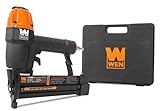
Best-value brad nailers ranked by situation
| Rank and model | Nail range | Power source | Approx. tool weight | Best use | Typical tool price |
|---|---|---|---|---|---|
| 1. Metabo HPT NT50AE2 | 5/8–2 in., 18 gauge | Pneumatic, 70–120 PSI | About 2.2 lb | Everyday trim, cabinets, and crafts | $60–$90 |
| 2. Ryobi P321 AirStrike | 5/8–2-1/8 in., 18 gauge | 18V battery | About 6 lb bare | DIY trim without a compressor | $130–$180 bare |
| 3. Bostitch BTFP12233 | 5/8–2-1/8 in., 18 gauge | Pneumatic, 70–120 PSI | About 3.2 lb | High-volume installation and finish work | $100–$150 |
| 4. DEWALT DCN680 | 5/8–2-1/8 in., 18 gauge | 20V battery | About 6 lb bare | Professional punch-list and remodeling work | $250–$350 bare |
| 5. Milwaukee 2746-20 M18 | 5/8–2-1/8 in., 18 gauge | 18V battery | About 6 lb bare | Users already invested in M18 tools | $250–$350 bare |
Weights vary slightly by configuration and whether a battery, belt hook, or magazine is included. Market prices also change; battery nailers are often sold as tool-only products, so the battery and charger may add $80–$180 if you are starting a platform.
1. Metabo HPT NT50AE2: best overall value
The NT50AE2 offers the most useful combination of low ownership cost, light weight, and adequate adjustment for typical 18-gauge work. Its 5/8- to 2-inch nail range covers door casing, baseboard returns, window trim, shoe molding, small furniture parts, and most craft assemblies. A depth-adjustment dial helps set the nail head slightly below the surface without changing air pressure for every material.
Its pneumatic design also has a practical advantage: no motor, fan, or battery adds weight to the nose. With a modest compressor capable of roughly 0.5–1.5 CFM at 90 PSI, it can handle intermittent trim work comfortably. The main drawback is the compressor and hose. If you need to move from room to room repeatedly, setup time can outweigh the low tool price.
The NT50AE2 is the strongest pick for an occasional remodeler who wants a dependable tool without paying for a cordless platform.
2. Ryobi P321: best cordless value for DIY users
The Ryobi P321 is the most economical cordless choice when you already own Ryobi 18V batteries. It accepts 5/8- to 2-1/8-inch 18-gauge brads, giving it a little more reach than many inexpensive pneumatic models. Its onboard air-pressure and depth controls let you tune the result for soft pine, hardwood trim, or painted molding.
It is well suited to installing baseboard in a few rooms, hanging casing during a door project, building simple cabinets, and completing repairs where dragging a compressor is inconvenient. A larger battery increases working time but also makes the tool heavier. Exact shot counts vary with nail length, wood density, temperature, and battery condition, so treat runtime claims as estimates rather than a guaranteed capacity.
Jam resistance is generally good when you use clean, correctly collated brads and keep the magazine free of damaged fasteners. A cordless nailer is more likely to slow or pause as its battery falls near empty, whereas a pneumatic model normally maintains consistent speed until the compressor cannot keep up.
3. Bostitch BTFP12233: best for frequent pneumatic work
The BTFP12233 costs more than a basic pneumatic nailer but adds features that matter when you are driving hundreds of fasteners: tool-free depth adjustment, a selectable trigger, a rear exhaust, and a magazine designed for 18-gauge brads from 5/8 to 2-1/8 inches. That range handles most interior trim and light assembly work.
Its extra cost is easier to justify for a contractor or serious DIY user who already has a compressor and values reduced interruptions. It can drive longer brads into thicker casing and hardwood edging than a 2-inch-only tool, although it is still not a substitute for a 15-gauge finish nailer when joints need more holding power.
For jam resistance, magazine alignment and nail quality matter as much as the brand. Keep the nose clean, do not mix strips from different manufacturers in the magazine, and release air pressure before clearing a jam.
4. DEWALT DCN680: best premium cordless option
The DCN680 uses a 20V battery and accepts 5/8- to 2-1/8-inch brads. It offers tool-free depth adjustment, selectable actuation, a narrow nose, and a dry-fire lockout. These details make it attractive for repeated installation where a hose would catch on corners, stairs, or finished flooring.
Its value is strongest for someone already using DEWALT 20V batteries. Buying the complete battery, charger, and tool package makes the effective cost much higher than a pneumatic nailer. The DCN680 is also heavier in the hand, particularly with a high-capacity battery, so overhead casing work can become tiring sooner.
Choose it when mobility and predictable cordless setup are worth the premium—not simply because it has the longest feature list.
5. Milwaukee 2746-20 M18: best for an existing M18 system
The M18 nailer covers the common 5/8- to 2-1/8-inch range and includes depth adjustment, selectable firing modes, and a dry-fire lockout. It is a sensible choice for remodelers who already carry M18 batteries and chargers. Its ownership economics are poor only when purchased as a completely new battery platform for occasional trim.
Like other full-size cordless nailers, it trades some balance for freedom from a hose. It can handle baseboard, casing, panel molding, and cabinet parts, but a pneumatic tool remains easier to hold for a long day of repetitive fastening.
Decision matrix: which value matters most?
| Your situation | Best choice | Why |
|---|---|---|
| Lowest total tool cost and occasional use | Metabo HPT NT50AE2 | Low purchase price and inexpensive brads; add a small compressor if needed. |
| No compressor, small workspace | Ryobi P321 | No hose or compressor noise; particularly economical with existing 18V batteries. |
| Several rooms of trim or repeated projects | Bostitch BTFP12233 | Light pneumatic handling and a 2-1/8-inch maximum nail length. |
| Professional punch-list work | DEWALT DCN680 | Fast cordless setup and broad 20V battery availability. |
| Already own M18 tools | Milwaukee 2746-20 | The battery cost is easier to absorb when chargers and packs are already on hand. |
Calculate the real cost before buying
Suppose a pneumatic nailer costs $75 and you need a $130 small compressor, for a combined $205. A cordless nailer at $160 bare may seem cheaper, but adding a $100 battery and charger brings it to about $260. If you already own the cordless battery, the cordless option costs $160; if you already own the compressor, the pneumatic setup costs only $75.
For a single weekend project, the least expensive route may be borrowing or renting the missing power source. For three or more projects, compare the complete setup, not the tool-only price. Brads are a continuing cost, but 18-gauge nails are usually inexpensive enough that power-source ownership dominates the calculation.
Setup and maintenance that prevent jams
- Use only 18-gauge brads within the stated length range. Nails that are too long, too short, or poorly collated can cause feeding failures.
- Load the magazine with the nail heads aligned in the channel. Do not force a strip past resistance.
- Start with a moderate depth setting and test on scrap from the same material. Soft pine often needs less driving force than dense oak.
- For pneumatic models, use a clean, dry air supply and set pressure within the manufacturer’s range. Excess pressure can bury heads, split thin trim, and accelerate wear.
- Disconnect the air hose or remove the battery before opening the nose to clear a jam.
- Wipe dust from the nose and magazine after each project. Follow the manual’s lubrication instructions; some modern pneumatic tools require little or no routine oiling.
- Replace bent brads rather than trying to straighten them. One damaged strip can create repeated jams.
What wears out first?
On pneumatic nailers, the nose seal, driver blade, trigger valve, and O-rings eventually wear, especially when the compressor supplies water or excessive pressure. On cordless models, batteries lose capacity before the firing mechanism necessarily fails. A battery that once completed a trim job may eventually require a midday recharge, making a second pack more useful than a larger nail magazine.
For the best balance of purchase price and usable capability, choose the Metabo HPT NT50AE2 with a suitable compressor. Choose the Ryobi P321 instead when avoiding hoses matters more than minimizing total cost. Move to the Bostitch, DEWALT, or Milwaukee when frequent work, longer 2-1/8-inch brads, or an existing battery system justifies the extra spending.