Best Sound Card for PC
As an Amazon Associate I earn from qualifying purchases. This post may contain affiliate links at no extra cost to you.
A motherboard’s integrated audio codec is fine until it isn’t. Gamers who want positional clarity in competitive titles, musicians who need low-latency monitoring, and anyone whose built-in output starts crackling under electrical load all share the same frustration: a sound card for pc is the cheapest hardware upgrade that fixes a problem you cannot solve in software. The difference between a good add-in card and a mediocre one comes down to signal-to-noise ratio, driver stability, and whether the analog stages are actually shielded from the noise flooding a modern tower. External USB adapters sidestep internal interference entirely but add their own latency and quality ceiling.
This roundup compares eight options that span roughly nine dollars to over a hundred seventy, covering internal PCIe cards, budget 5.1 adapters, and USB dongles with surround decoding. None of these require professional audio experience to set up, but they do not all deliver on the same priorities. We ranked them by how well their published specs and owner-reported reliability match what a typical buyer actually needs, filtering out anything that only performs well on a spec sheet.
As an Amazon Associate we earn from qualifying purchases at no extra cost to you.






Our Top Picks
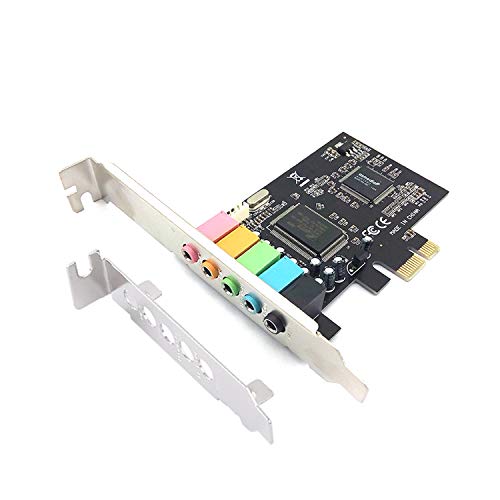
 Creative Sound Blaster Audigy Fx Pro Hi-Res PCIe4.13 inches6.93 x 5.59 x 1.57 inches0.1 PoundsCheck on Amazon


Quick Picks
| Product | Best For | Price |
|---|---|---|
| Creative Audigy Fx Pro Hi-Res | Clean hi-res listening over PCIe | $75.99 |
| Creative Audigy FX V2 | Discrete 5.1 with software EQ | $79.34 |
| Optimal Shop PCIe 5.1 | Low-profile budget builds | $18.99 |
| SABRENT AU-MMSA | Plug-and-play laptop or kiosk use | $8.99 |
| Creative Sound Blaster AE-X | High-impedance headphone driving | $172.99 |
| Padarsey PCIe 5.1 | Restoring older Windows PCs cheaply | $18.77 |
| biaze USB Audio Adapter | Cross-platform console and laptop audio | $12.99 |
| Cubilux 7.1 USB | Virtual surround with aluminum build | $31.59 |
How We Picked
We weighted four criteria: analog signal quality relative to price, driver and OS compatibility (especially for older Windows builds), physical fit inside a standard or low-profile case, and real-world durability of connectors over months of ownership. A sound card for pc that scores well on all four earns a top slot regardless of brand recognition.
The 8 Best Sound Card For Pc in 2026
Creative Sound Blaster Audigy Fx Pro Hi-Res
This card suits gamers and casual listeners who want a clear, measurable jump from a motherboard’s integrated codec without investing in external DACs.
- Pro: Hi-res playback up to 192 kHz means studio monitors or good headphones get a clean digital-to-analog path.
- Pro: The PCIe interface eliminates the USB stack entirely, cutting latency for competitive shooters and rhythm games.
- Con: Only a single analog line-out limits discrete multi-channel setups; you need a separate DAC for home theater.
Skip this if your priority is seven-channel surround or you want to drive a home-theater receiver directly from analog outputs.
Creative Sound Blaster Audigy FX V2
The V2 refresh targets builders who want Audigy’s software suite without paying for hi-res decoding hardware.
- Pro: Creative’s Sound Blaster Connect software adds EQ profiles and a basic acoustic framework at no extra cost.
- Pro: Five 3.5 mm jacks give discrete 5.1 surround out of the box.
- Con: Playback tops out below the Fx Pro’s ceiling, and owners note occasional driver conflicts after major Windows updates.
Skip this if you already own a hi-res-capable receiver or want a single USB cable solution for a laptop.
Optimal Shop PCIe Sound Card for PC (5.1)
A budget 5.1 internal card for anyone restoring older Windows machines or filling an empty PCIe slot cheaply.
- Pro: The low-profile bracket fits small-form-factor cases where standard-height cards cannot go.
- Pro: CMI8738 chip is a mature, well-documented solution with broad legacy Windows support.
- Con: SNR is noticeably lower than Creative’s offerings; background hiss is audible through sensitive headphones.
Skip this if your primary use is music production, competitive gaming, or anything where the analog noise floor matters.
SABRENT USB External Stereo Sound Card Adapter (AU-MMSA)
The most affordable external option, designed for laptops, kiosks, and anyone whose internal sound chip has failed.
- Pro: True plug-and-play with no driver install on modern Windows; works immediately on hot-swappable ports.
- Pro: The compact shell adds almost no cable clutter and survives being tossed in a laptop bag.
- Con: Stereo only, and the small DAC chip limits dynamic range for critical listening.
Skip this if you need surround channels, mic monitoring with zero latency, or any kind of audio editing workflow.
Creative Sound Blaster AE-X Hi-Res
The premium pick for enthusiasts who demand the best analog output a consumer PCIe card can deliver.
- Pro: Dedicated headphone amp drives high-impedance cans that lesser cards handle poorly or not at all.
- Pro: SWVR audio routing lets you send different game, chat, and music streams to separate outputs simultaneously.
- Con: The price is more than double the next-best internal option, and the feature set is overkill for casual use.
Skip this if you listen through budget earbuds or never exceed standard 44.1 kHz content.
Padarsey PCIe 5.1 Internal Sound Card for PC
Nearly identical in silicon to the Optimal Shop card, aimed at the same budget internal-sound niche.
- Pro: CMI8738 chip provides the same legacy-driver compatibility at a fraction of Creative’s price.
- Pro: Compact board fits low-profile brackets without requiring case modifications.
- Con: Build quality is utilitarian; owners report connector loosening over time and occasional channel dropout in surround mode.
Skip this if you want a card you will still be using confidently three years from now without re-seating it.
biaze USB Audio Adapter
A no-frills stereo adapter covering consoles, laptops, and desktops alike with zero configuration.
- Pro: Works across Windows, PS5, PS4, and most USB-C laptops without any driver step.
- Pro: Includes separate 3.5 mm jacks for headphone out and mic in, unlike many single-port dongles.
- Con: Audio quality is functional rather than refined; the budget DAC chip produces a slightly muddy low end.
Skip this if you are connecting studio monitors, using software-based zero-latency monitoring, or need a transparent signal chain.
Cubilux 7.1 USB Surround Sound Card
The only entry here that virtualizes 7.1 surround through USB while offering a wide sample-rate range.
- Pro: Full aluminum-alloy housing dissipates heat and resists electromagnetic interference, a rarity at this price.
- Pro: Line-in and stereo mic-in jacks make it usable for casual podcasting or voice-over work.
- Con: Surround is virtual, not discrete; true seven-channel output still requires an internal multi-jack card.
Skip this if you have a physical seven-speaker array and want independent analog signals per channel rather than algorithmic processing.
Buying Guide
Internal PCIe vs. External USB
PCIe cards draw power from the board and process audio on the card itself, keeping latency low and shielding the analog stages from USB bus noise. USB adapters are faster to swap and work on laptops, but they introduce a small buffer delay and are vulnerable to ground-loop hum on poorly designed ports. If your machine has a free PCIe slot and you sit at a desk, go internal. If you travel or need a quick fix on a dead codec, USB wins on convenience.
Sample Rate and Bit Depth: What Actually Matters
Playback resolution only matters if your content and your DAC both support it. A card rated to 192 kHz or 384 kHz will not improve MP3s or standard game audio, but it removes the ceiling for FLAC, DSD, and high-resolution streaming. Below forty dollars, expect 16-bit/48 kHz as the realistic ceiling. Above that range, hi-res support becomes a genuine differentiator rather than a marketing checkbox.
Channel Configuration: Stereo, 5.1, and the 7.1 Question
Discrete 5.1 requires five separate analog outputs, which only internal multi-jack cards provide reliably. USB “7.1 surround” is almost always virtual: a stereo signal with algorithmic spatialization applied on the host side. That works well for immersive gaming on headphones but cannot feed a physical multi-speaker array independently. Decide whether your end goal is headphone surround or speaker surround before paying a premium for channel count.
Our Verdict
The Creative Sound Blaster AE-X is our top pick because it pairs the best analog output stages in this group with a headphone amp that removes the need for a separate desktop unit. The Optimal Shop PCIe 5.1 is our budget pick, offering a working 5.1 internal solution for under twenty dollars with proven legacy compatibility. However, if your situation is a laptop or a dead onboard codec that must be fixed in under ten seconds with zero software, the SABRENT AU-MMSA wins outright on speed and simplicity.
FAQ
Do I still need a sound card if my motherboard has Realtek audio?
You need one only if the integrated codec introduces audible noise, lacks the output level for your headphones, or cannot decode formats you play. For most casual users with average headphones, Realtek onboard audio is adequate and a dedicated card adds little. Enthusiasts and competitive gamers benefit most.
Will an external USB sound card reduce game audio latency?
Generally no. Internal PCIe cards have lower and more consistent latency than USB adapters because they bypass the USB polling stack. A USB sound card for pc can actually add a few milliseconds of delay compared to a PCIe solution, which matters in rhythm games or competitive FPS titles.
Can I use a 7.1 USB surround sound card with a real seven-speaker home theater?
No. USB surround adapters output a stereo signal that your operating system or a driver spatializes into virtual channels. A physical 7.1 speaker array needs discrete analog or digital per-channel feeds, which only an internal multi-jack card or an AV receiver can provide.
Are low-profile brackets important for a PCIe sound card?
They matter only in small-form-factor or slim desktop cases where clearance above the slot is under two centimeters. In a standard mid-tower, a full-height bracket fits without issue. Some cards include both bracket sizes in the box, while others require a separate purchase, so check the package contents before ordering.