DeWalt 10-Inch Compound Miter Saw Buying Guide
What's inside
- DeWalt 10-Inch Compound Miter Saw Comparison
- What the 15-Amp Motor Can—and Cannot—Do
- DWS713 vs. DWS715: The Practical Head-to-Head
- When the DWS717 Is Worth Choosing
- What About a DeWalt 10-Inch Sliding Miter Saw?
- Decision Matrix: Which Model Fits Your Work?
- Capacity in Real Use: A Quick Fit Check
- Blade, Dust, and Durability Considerations
- Bottom Line
- Related Guides
- DeWalt 10-Inch Compound Miter Saw Comparison
- What the 15-Amp Motor Can—and Cannot—Do
- DWS713 vs. DWS715: The Practical Head-to-Head
- When the DWS717 Is Worth Choosing
- What About a DeWalt 10-Inch Sliding Miter Saw?
- Decision Matrix: Which Model Fits Your Work?
- Capacity in Real Use: A Quick Fit Check
- Blade, Dust, and Durability Considerations
- Bottom Line
- Related Guides
As an Amazon Associate I earn from qualifying purchases. This post may contain affiliate links at no extra cost to you.
The best DeWalt 10 compound miter saw for most trim and framing work is the DWS715, while the DWS713 is the lighter budget choice and the DWS717 is the better pick when you need a double-bevel saw.
DeWalt’s 10-inch corded models share a 15-amp motor and use the same general blade size, but they are not interchangeable in everyday use. The important differences are bevel direction, cutting capacity, weight, and how much adjustment convenience you want.
As an Amazon Associate we earn from qualifying purchases at no extra cost to you.

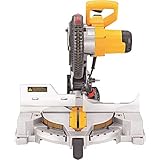


DeWalt 10-Inch Compound Miter Saw Comparison
| Model | Motor | Bevel range | Maximum crosscut capacity | Approx. weight | Best for |
|---|---|---|---|---|---|
| DeWalt DWS713 | 15 amp, corded | 0–48° left | 2 x 6 at 90°; 2 x 4 at 45° | About 35 lb | Basic trim, flooring, and occasional framing |
| DeWalt DWS715 | 15 amp, corded | 0–48° left | 2 x 8 at 90°; 2 x 6 at 45° | About 42 lb | Frequent cutting of wider boards |
| DeWalt DWS717 | 15 amp, corded | 0–48° left and right | 2 x 6 at 90°; 2 x 4 at 45° | About 35 lb | Crown molding and compound-angle work |
Specifications can vary slightly by production version and regional package. Check the manual for the exact model number before buying replacement parts or a stand.
What the 15-Amp Motor Can—and Cannot—Do
All three saws use a 15-amp electric motor, so motor power is not the main reason to choose one over another. A corded 15-amp motor is appropriate for repeated cuts in pine, construction lumber, hardwood trim, and similar stock when paired with a sharp blade. It also avoids the runtime limits of a battery saw.
The motor does not make these saws suitable for cutting thick structural timbers in one pass. Their 10-inch blades are designed around common trim and dimensional-lumber sizes. Pushing slowly, using a sharp blade, and supporting long boards properly will produce better results than forcing the saw through oversized material.
For a workshop with reliable electrical power, the corded motor is usually the practical choice. For remote punch-list work, a cordless saw may be more convenient, but DeWalt’s commonly recognized cordless compact models use smaller blade sizes and should not be assumed to match the capacity of these 10-inch corded saws.
DWS713 vs. DWS715: The Practical Head-to-Head
Choose the DWS713 for portability and lower cost
The DWS713 is the sensible option when most cuts involve baseboard, casing, shoe molding, shelving parts, and 2 x 4 stock. Its roughly 35-pound weight is manageable for one person, and its single-left-bevel design keeps the controls relatively simple.
Its limitation is capacity. A 2 x 6 can generally be crosscut at 90 degrees, but wider boards may need to be flipped or cut with a different tool. That is acceptable for occasional use, but repeated repositioning becomes inefficient on a busy job.
Choose the DWS715 for wider boards
The DWS715 is also a single-bevel 15-amp saw, but its larger listed capacity—up to approximately 2 x 8 at 90 degrees—makes it more versatile for decking components, shelving, framing parts, and wide trim. The tradeoff is a heavier body, typically around 42 pounds, so it is less pleasant to carry up stairs or move between rooms.
If the price difference is modest and you regularly cut boards wider than 6 inches, the DWS715 usually delivers more useful capacity than buying a lighter saw and working around its limits.
When the DWS717 Is Worth Choosing
The DWS717’s key advantage is its double-bevel mechanism. It can tilt left and right, so you can make opposing compound cuts without turning the workpiece around. That matters when installing crown molding, producing repeated bevels, or working on assemblies where the finished face must remain oriented in one direction.
Its crosscut capacity is closer to the DWS713 than the DWS715, so it is not automatically the best saw for wide lumber. Choose it for angle flexibility, not simply because it has a higher model number.
What About a DeWalt 10-Inch Sliding Miter Saw?
Searches such as DeWalt 10 inch compound miter saw, DeWalt compound miter saw 10 inch, and DeWalt 10 in sliding miter saw often get mixed together. The DWS713, DWS715, and DWS717 are compact, non-sliding compound saws. They pivot and bevel, but the motor head does not travel forward on rails.
A true DeWalt 10-inch sliding miter saw would provide greater crosscut capacity, but DeWalt’s widely encountered current corded lineup is better known for 10-inch non-sliding models and larger sliding models. If a listing calls a DWS715 a “10-inch sliding” saw, verify the photographs, manual, and model plate before ordering. A sliding saw should have visible rails or articulated slide arms.
Decision Matrix: Which Model Fits Your Work?
| Your situation | Recommended choice | Why |
|---|---|---|
| Occasional homeowner projects and limited storage | DWS713 | Lower carrying burden and sufficient capacity for common trim |
| Weekly work with 2 x 8 boards or wide shelving | DWS715 | Greater 90-degree crosscut capacity |
| Crown molding and repeated compound angles | DWS717 | Double bevel reduces workpiece repositioning |
| Frequent transport between floors or vehicles | DWS713 | Approximately 7 lb lighter than the DWS715 |
| Mostly large boards wider than 8 inches | Consider a larger sliding model | A 10-inch non-sliding saw will require compromises or multiple cuts |
Capacity in Real Use: A Quick Fit Check
Suppose a project requires 30 pieces of 2 x 8 lumber cut square. A saw rated for 2 x 8 at 90 degrees can normally complete those cuts in one pass, subject to the actual board dimensions and fence setup. A 2 x 6-capacity model may require flipping each board, turning 30 cuts into 60 cutting operations and increasing the opportunity for an offset or mismatched kerf.
That does not mean the DWS715 always saves money. If you cut only ten wide boards per year, the lighter DWS713 may be the better ownership choice. If you cut 30 wide pieces every month, the extra capacity can repay its higher purchase price through saved setup time long before the motor wears out.
Blade, Dust, and Durability Considerations
The included general-purpose blade is adequate for construction cuts, but fine trim work benefits from a high-quality 60- or 80-tooth 10-inch blade with the correct arbor size. A coarse blade cuts faster; a finer blade generally leaves a cleaner edge but may cut more slowly and accumulate resin sooner.
- Replace the blade when cut quality deteriorates, burning appears, or extra force is needed.
- Clean dust from the table, fence, pivot points, and bevel mechanism regularly.
- Keep the blade guard moving freely; never tie it back or operate with a damaged guard.
- Support long stock at the same height as the saw table to prevent the board from lifting or twisting.
- Check fence alignment and the saw’s 0-degree stops after transport.
The parts most likely to need attention are the blade, dust bag or collection connection, stop hardware, and adjustment surfaces—not usually the motor when the saw is used within its capacity. Common mistakes include cutting unsupported long boards, using a dull blade, relying on an inaccurate fence, and assuming a 10-inch blade can crosscut any 2 x 8 in every angle position.
Bottom Line
Buy the DWS713 if portability, price, and ordinary trim work matter most. Choose the DWS715 if wider boards are a regular part of the job. Select the DWS717 when double-bevel convenience is more valuable than maximum crosscut width. None of these should be confused with a sliding miter saw; for wide crosscuts beyond their listed capacities, move up to a larger sliding design rather than forcing a compact 10-inch compound saw.