Best Down-Cutting Jigsaw Blades for Splinter-Free Tops
What's inside
- Best Down-Cutting Jigsaw Blades for Splinter-Free Tops
- What “down-cutting” means in practice
- Reverse-tooth blades compared by material and capacity
- Best choice by situation
- Head-to-head: clean finish versus cutting control
- Are aluminium cutting jigsaw blades the same?
- How to set up a reverse-tooth cut
- Ownership, wear and common mistakes
- Related Guides
- Best Down-Cutting Jigsaw Blades for Splinter-Free Tops
- What “down-cutting” means in practice
- Reverse-tooth blades compared by material and capacity
- Best choice by situation
- Head-to-head: clean finish versus cutting control
- Are aluminium cutting jigsaw blades the same?
- How to set up a reverse-tooth cut
- Ownership, wear and common mistakes
- Related Guides
As an Amazon Associate I earn from qualifying purchases. This post may contain affiliate links at no extra cost to you.
Best Down-Cutting Jigsaw Blades for Splinter-Free Tops
The best down cutting jigsaw blades for a clean top surface are fine-tooth reverse-tooth blades matched to the material: use a 10–12 TPI laminate or wood blade for thin panels, a 14–20 TPI blade for harder laminates, and a dedicated non-ferrous metal blade—not a wood reverse-tooth blade—for aluminium. The trade-off is slower feeding and less visible cut control because the teeth cut on the downward stroke and press the workpiece against the base.
What “down-cutting” means in practice
A conventional jigsaw blade cuts mainly on the upward stroke. That tends to leave the cleanest edge on the underside and can tear or splinter the top. A reverse-tooth, or down-cutting, blade reverses the tooth direction so the top face receives the cleaner cut.
As an Amazon Associate we earn from qualifying purchases at no extra cost to you.


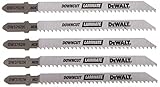
This is especially useful for laminate worktops, melamine-faced chipboard, veneered plywood, cabinet panels and other materials where the visible surface matters more than the hidden edge. The blade’s downward force also helps hold a thin panel against the shoe, but it can make the saw feel slower and less responsive.
Do not confuse a reverse-tooth blade with a blade that merely has fine teeth. A fine conventional blade can still chip the top surface. Look for wording such as “reverse tooth,” “down cut,” or “clean cut on the top surface” in the manufacturer’s specification. Bosch’s T101BR is one established example of a reverse-tooth wood blade; comparable blades are also sold by other major jigsaw-blade manufacturers.
Reverse-tooth blades compared by material and capacity
| Blade type | Typical material | Typical tooth pitch | Practical thickness range | Top-surface result | Main compromise |
|---|---|---|---|---|---|
| Reverse-tooth laminate blade | Laminate, melamine, thin worktops | 2.0–2.5 mm, about 10–13 TPI | 3–20 mm | Very clean on the decorative face | Slow feed; can clog in resin-heavy board |
| Fine reverse-tooth wood blade | Veneered plywood, hardwood panels | 2.5–3.2 mm, about 8–10 TPI | 6–30 mm | Clean with limited breakout | Less efficient in thick solid wood |
| Extra-fine reverse-tooth blade | Thin plastic-faced board and delicate trim | 1.5–2.0 mm, about 13–17 TPI | 2–10 mm | Best control on thin sheets | Heats quickly and cuts slowly |
| Fine-tooth non-ferrous metal blade | Aluminium sheet, profiles and thin plate | 1.0–2.0 mm, about 13–25 TPI | 1–6 mm, depending on alloy | Clean when supported and lubricated | Not normally a reverse-tooth wood blade; chips need clearing |
Thickness figures are working ranges rather than universal limits. The saw’s stroke length, motor power, blade length and the alloy or board density can change the result. A blade rated for 30 mm of wood may struggle in a dense laminated countertop, particularly when the cut is curved.
Best choice by situation
| Your situation | Best blade choice | Why |
|---|---|---|
| Occasional shelf or countertop cut | 10–12 TPI reverse-tooth laminate blade | Good top-face finish without buying a large specialist assortment |
| Frequent cabinet or furniture work | Separate fine reverse-tooth blades for thin and thick panels | Reduces overheating and preserves cut control across materials |
| Beginner making visible straight cuts | Short, stiff reverse-tooth blade with 8–12 TPI | Easier to keep aligned than a long, flexible blade |
| Curved cuts in veneered plywood | Narrow reverse-tooth scrolling blade, around 2–3 mm wide | Turns more easily, though it sacrifices some straight-line stability |
| Aluminium cutting | Dedicated fine-tooth non-ferrous metal blade | Designed for aluminium’s soft, gummy chips and heat generation |
Head-to-head: clean finish versus cutting control
Reverse-tooth blades
These win when the top face is the priority. The teeth tend to leave less splintering around the visible edge, and the downward cutting action can reduce vibration in thin panels. They are particularly effective on factory-finished laminate, where a small chip can expose a contrasting substrate.
The downside is that the cut line is harder to see. The blade pulls the saw toward the workpiece, the chips are thrown downward, and the shoe may cover the marking. They also require a slower feed than an aggressive progressive-tooth blade. Forcing the saw can burn the edge, flex the blade or cause it to wander below the surface.
Standard clean-cut blades
A conventional fine-tooth blade often offers better visibility and a more natural feed rate. It may be the better choice when both faces will be visible, when you are cutting a long curve, or when the underside is the important finished surface. Applying masking tape along the cut line and using a zero-clearance support can make a conventional blade surprisingly clean.
Down-cut versus scoring
A reverse-tooth blade is not a substitute for scoring a brittle laminate. On a thick worktop, score the visible face with a sharp knife along a straightedge, then cut just to the waste side of the line. The scoring line limits surface chipping while the blade removes the bulk of the material.
Are aluminium cutting jigsaw blades the same?
No. A jigsaw aluminium cutting blade should normally be a dedicated blade for non-ferrous metals, usually made from high-speed steel or featuring a hardened cutting edge. It will generally have smaller, more closely spaced teeth than a wood blade. Aluminium cutting jigsaw blades are designed to produce manageable chips and resist the heat and loading that can quickly ruin a wood blade.
For aluminium sheet, clamp the work securely to a sacrificial board, use a medium or low speed, and apply a small amount of suitable cutting lubricant. Keep the blade moving, but do not force it. For thick aluminium plate or structural sections, a jigsaw may be the wrong tool: a band saw, circular saw with the correct non-ferrous blade, or machinist’s method can provide better control.
A reverse-tooth wood blade may leave a neat-looking top edge in thin aluminium, but it is not a reliable aluminium blade. Its tooth shape, clearance and material are wrong for repeated metal cutting, and packed chips can overheat both blade and workpiece.
How to set up a reverse-tooth cut
- Mark the finished edge. Add the blade’s kerf to the waste side rather than cutting directly through the final dimension.
- Support the panel continuously. Place the work on a sacrificial board so the material cannot vibrate or sag near the cut.
- Fit the shortest suitable blade. A blade with roughly 10–15 mm extending below the material is easier to control than an unnecessarily long blade.
- Turn orbital action off. Orbital movement improves speed but increases chipping and makes a reverse-tooth blade more aggressive.
- Reduce speed on laminate and plastic. Excessive speed melts resin or plastic; use a test cut to find a steady setting.
- Feed at the blade’s pace. If the motor pitch drops sharply, you are pushing too hard. If the blade burns or oscillates, slow down and check support.
- Finish with a trim allowance. Leaving 1–2 mm for a router, file or sanding block is safer than trying to make a perfect long cut freehand.
Ownership, wear and common mistakes
Reverse teeth often lose their fine top-surface advantage before they look visibly damaged. Resin buildup, dulled tips and slight side wear can produce chipping even when the blade still cuts. Replace the blade when feed pressure increases, the cut begins drifting, or the top edge becomes ragged.
Do not clean a hot blade immediately with a hard tool; let it cool and remove resin with a manufacturer-approved cleaner or a soft brush. Never bend a jammed blade sideways to free it. Check that the blade is fully seated, that the shoe is flat against the panel, and that the pendulum setting has not been left high from a previous rough cut.
For occasional work, a small assortment is more economical than buying one premium blade for every task: two medium-pitch reverse-tooth blades for laminate and wood, one narrow blade for curves, and a separate fine-tooth aluminium blade. That combination covers clean visible cuts while preserving the control and service life that a single “universal” blade usually cannot provide.