Best Budget Orbital Sanders Under $120
What's inside
As an Amazon Associate I earn from qualifying purchases. This post may contain affiliate links at no extra cost to you.
The best budget orbital sander under 120 is the Bosch ROS20VSC for balanced sanding speed, low vibration, effective dust collection, and a useful accessory package. It is not the only strong choice, though: the Makita BO5041 is better for control on furniture and trim, while the DEWALT DWE6423 is a simple, powerful option for larger wood surfaces.
As an Amazon Associate we earn from qualifying purchases at no extra cost to you.

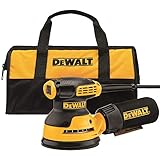

Best Budget Orbital Sanders Under $120 at a Glance
| Model | Typical market range | Pad size | Motor and speed | Weight | Dust and accessories | Best for |
|---|---|---|---|---|---|---|
| Bosch ROS20VSC | $75–$105 | 5 inches | 2.5 amp; 7,500–12,000 OPM | 3.5 lb | Microfilter canister, hose adapter, sanding disc | Best overall balance |
| Makita BO5041 | $95–$120 | 5 inches | 3 amp; 4,000–12,000 OPM | 3.1 lb | Dust bag, dust box, abrasive disc | Furniture and trim |
| DEWALT DWE6423 | $75–$100 | 5 inches | 3 amp; 8,000–12,000 OPM | 2.9 lb | Dust bag, paper punch, sanding disc | Fast general-purpose sanding |
| Milwaukee 6034-21 | $95–$120 | 5 inches | 3 amp; 7,000–12,000 OPM | 3.4 lb | Dust canister, hose adapter, abrasive disc | Frequent corded use |
| CRAFTSMAN CMEW231 | $45–$70 | 5 inches | 3 amp; up to 12,000 OPM | about 3.1 lb | Dust bag and sanding disc | Lowest-cost projects |
Prices are general market ranges and can vary by kit, retailer, and seasonal promotion. All five are corded five-inch random orbital sanders, which is the most practical format for many home workshops because five-inch hook-and-loop discs are widely available and replacement abrasives are inexpensive.
Our Top Pick: Bosch ROS20VSC
The Bosch ROS20VSC is the strongest all-rounder under this budget because it combines variable speed, a comfortable 3.5-pound body, and one of the better stock dust-collection systems in this class. Its 2.5-amp motor provides enough power for removing finish, smoothing hardwood, and preparing tabletops without making the tool unnecessarily heavy.
The microfilter dust canister is particularly useful when sanding indoors. It will not capture every particle—especially fine dust from painted or resinous surfaces—but it is more effective than a basic porous dust bag when the filter is kept clean. Bosch also includes a vacuum hose adapter, allowing the sander to connect to a shop vacuum.
Its 7,500-to-12,000 OPM range is wide enough for delicate trim and aggressive stock removal. Use the lower end with fine abrasive on edges and veneer-sensitive work; use the upper end for broad, unfinished surfaces. The main compromise is that the Bosch has slightly less motor power on paper than the 3-amp alternatives, and its dust canister must be emptied frequently during large projects.
Head-to-Head: Which Sander Fits the Job?
For furniture and visible surfaces: Makita BO5041
The Makita BO5041 is the best choice when control matters more than the lowest price. Its variable-speed dial starts at 4,000 OPM, substantially slower than most competitors. That low setting helps prevent sanding through veneer, rounding crisp corners, or overheating finishes during detail work.
A front auxiliary handle gives the user more control when leveling a tabletop or sanding along a cabinet face. It can be removed for tighter spaces. The 3-amp motor handles extended sanding well, and the 1/8-inch orbit is a good compromise between material removal and finish quality.
Choose the Makita if you regularly build cabinets, refinish furniture, or want a sander that feels easier to guide with two hands. Its dust bag is adequate, but a shop-vac connection is preferable for long sessions.
For fast sanding on large wood surfaces: DEWALT DWE6423
The DEWALT DWE6423 is a straightforward, lightweight workhorse. Its 3-amp motor and 8,000-to-12,000 OPM range make it quick on tabletops, doors, shelves, and construction lumber. At about 2.9 pounds, it creates less arm fatigue than heavier sanders during overhead or vertical work.
The DWE6423 uses a five-inch, eight-hole hook-and-loop pad. Replacement discs are easy to find, but dust collection depends heavily on matching the disc holes to the pad. A solid, nonperforated disc will sand effectively but will not allow the sander to pull dust through the pad.
This is a good pick for a user who wants speed and simplicity rather than the widest speed range or the most sophisticated filter. Connect it to a shop vacuum when possible; the included dust bag is better for small jobs than for several hours of continuous sanding.
For frequent corded use: Milwaukee 6034-21
The Milwaukee 6034-21 is worth considering when the sander will see regular workshop use. Its 3-amp motor, 7,000-to-12,000 OPM speed range, 10-foot cord, and dust-canister system make it convenient around a bench or assembly table. The longer cord reduces the need for an extension cord in a compact shop.
It is slightly heavier than the DEWALT and can feel less nimble on narrow trim. However, that extra mass can help keep the pad engaged on broad panels. A vacuum adapter improves dust control and reduces the amount of debris that reaches the canister filter.
For the smallest budget: CRAFTSMAN CMEW231
The CRAFTSMAN CMEW231 is a sensible low-cost choice for occasional projects such as repainting a dresser, smoothing pine boards, or preparing a door. Its 3-amp motor and maximum speed near 12,000 OPM provide respectable performance for substantially less than the premium options.
Its basic dust bag and less refined vibration control are the trade-offs. It is better suited to short sanding sessions than daily production work. If the savings allow you to buy better abrasives and a shop-vac adapter, it can be a practical entry point.
Decision Matrix
| Your situation | Recommended choice | Why |
|---|---|---|
| Under $70 and occasional use | CRAFTSMAN CMEW231 | Lowest entry cost with a full-size 5-inch pad and 3-amp motor |
| Refinishing furniture or trim | Makita BO5041 | Low minimum speed and auxiliary handle improve control |
| Large tabletops, doors, or panels | DEWALT DWE6423 | Light body, strong motor, and fast 8,000–12,000 OPM range |
| Indoor work with limited cleanup time | Bosch ROS20VSC | Microfilter canister and included vacuum adapter improve dust capture |
| Frequent corded workshop use | Milwaukee 6034-21 | Long cord, durable feel, and a useful speed range |
What Matters More Than the Amp Rating?
Motor amperage is only one part of sanding speed. Pad control, vibration, abrasive quality, and dust removal have just as much effect on productivity. A sander with a 3-amp motor may work more slowly than a 2.5-amp model if its pad loses contact, its filter clogs, or the user applies too much downward pressure.
For most furniture work, a five-inch pad with a 1/8-inch orbit is the best compromise. Larger six-inch sanders cover more area per pass, but their discs cost more and they can be harder to control on narrow parts. A five-inch pad covering a 24-by-36-inch panel has a theoretical pad-area coverage of approximately 19.6 square inches per pass, calculated as π × 2.5². In practice, overlap between passes means the panel will require considerably more than its 864 square inches divided by that figure.
How to Get Faster, Cleaner Results
- Start with the right abrasive. Use 80 or 100 grit to remove finish or level uneven wood, 120 or 150 grit for general smoothing, and 180 to 220 grit for final preparation. Skipping grits forces the finer disc to remove scratches it was not designed to handle.
- Let the pad float. Place the sander on the work before starting it, then keep it moving at a steady pace. Pressing down slows the motor, increases vibration, and can create swirl marks or uneven depressions.
- Overlap each pass. Move at roughly one to two inches per second on a broad panel, overlapping the previous path by about half the pad width. Slow down only enough to remove visible scratches.
- Use extraction for fine dust. Empty the canister before it becomes packed, brush or tap out the filter, and use a shop vacuum for long sessions. A clogged filter reduces airflow and can make the motor run hotter.
- Finish by hand when needed. Random orbital sanders can round edges and leave subtle circular marks. A final hand-sanding pass with the grain is worthwhile on visible furniture parts.
Ownership Costs and Common Wear Points
The first consumable to wear out is usually the hook-and-loop pad, not the motor. Repeatedly sanding with a clogged disc, overheating the pad, or pulling discs off aggressively can weaken the hooks. Replace the pad when discs stop holding securely or begin lifting at the edges.
Budget for abrasive discs in multiple grits rather than judging a sander by its included sample disc. A typical project may use two or three 80-grit discs, two 120-grit discs, and one or two 180-grit discs. Keeping a spare pad, clean filter, and vacuum adapter available prevents small accessories from stopping the job.
Corded models under $120 generally offer better sustained power than cordless tool-only alternatives once battery cost is included. For example, a $60 corded sander can be ready to use immediately, while a $90 cordless tool-only sander may require a battery and charger costing another $70 or more. Unless portability is essential, corded power delivers the better ownership value for furniture, trim, and large stationary work.
Final Recommendation
Buy the Bosch ROS20VSC if you want the best overall combination of sanding control, dust collection, speed adjustment, and included accessories. Choose the Makita BO5041 for furniture and trim, the DEWALT DWE6423 for fast work on large surfaces, the Milwaukee 6034-21 for frequent workshop use, or the CRAFTSMAN CMEW231 when keeping the initial cost as low as possible.