Best Ceiling Mounted Garage Storage Racks
What's inside
- Best Ceiling Mounted Garage Storage Racks
- Quick comparison of leading ceiling rack types
- Best for maximum capacity: a 4-by-8-foot heavy-duty rack
- Best for a smaller garage: a compact 45-by-45-inch rack
- How to choose by garage layout and stored items
- Check fit before buying
- Mounting requirements matter more than the advertised capacity
- Installation and loading practices that prevent problems
- Durability and ownership realities
- Final buying recommendation
- Related Guides
- Best Ceiling Mounted Garage Storage Racks
- Quick comparison of leading ceiling rack types
- Best for maximum capacity: a 4-by-8-foot heavy-duty rack
- Best for a smaller garage: a compact 45-by-45-inch rack
- How to choose by garage layout and stored items
- Check fit before buying
- Mounting requirements matter more than the advertised capacity
- Installation and loading practices that prevent problems
- Durability and ownership realities
- Final buying recommendation
- Related Guides
As an Amazon Associate I earn from qualifying purchases. This post may contain affiliate links at no extra cost to you.
Best Ceiling Mounted Garage Storage Racks
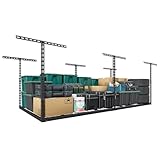
The best ceiling mounted garage storage racks for most homeowners are adjustable 4-by-8-foot platforms rated around 600 pounds, but a compact 45-by-45-inch rack is the safer choice when joist spacing, garage-door clearance, or stored-item weight limits are more important than capacity.
Ceiling storage is not a single category. A rack for seasonal tubs needs a different combination of platform size, drop height, and mounting hardware than one used for lumber, camping equipment, or bulky automotive parts. The right choice depends on four measurements: the available ceiling area, the location of joists, the height of the garage door when open, and the total weight of the load.
As an Amazon Associate we earn from qualifying purchases at no extra cost to you.


Quick comparison of leading ceiling rack types
| Rack type or example | Typical platform | Published load class | Adjustable drop | Best fit |
|---|---|---|---|---|
| SafeRacks heavy-duty grid | 4 x 8 ft | Up to 600 lb | About 22–42 in. | Several storage bins or bulky seasonal items |
| NewAge Products Bold ceiling rack | 4 x 8 ft | Up to 600 lb | About 22–42 in. | Large garages with substantial joist access |
| HyLoft ceiling storage rack | 45 x 45 in. | Up to 250 lb | About 22–33 in. | Compact garages and lighter household storage |
| Generic adjustable steel grid rack | Usually 4 x 4 ft | About 250–600 lb | Usually 22–40 in. | Budget buyers who can verify hardware and ratings |
Capacity figures are maximum ratings, not a recommendation to load every rack to its limit. Actual capacity depends on joist condition, fastener placement, the rack’s configuration, and whether the load is evenly distributed. Always follow the manufacturer’s installation instructions.
Best for maximum capacity: a 4-by-8-foot heavy-duty rack
A large rack from SafeRacks or NewAge Products is the strongest match for a garage with accessible ceiling joists and many uniform storage containers. A 4-by-8-foot platform provides 32 square feet of storage—enough for several 27-gallon totes, low-profile bins, folding chairs, or camping gear.
The advantage is not just the 600-pound rating. The broad platform lets you spread the load instead of stacking everything in one unstable column. Adjustable vertical posts, commonly offering a drop range near 22 to 42 inches, also help accommodate roof slopes, garage-door tracks, and different container heights.
There are trade-offs. A full-size rack can interfere with an overhead garage door if it is installed too close to the opener, tracks, or the door’s highest travel point. It may also require several joists and two people for assembly. Choose this format when you can reserve a clear ceiling rectangle at least slightly larger than the platform itself.
Best for a smaller garage: a compact 45-by-45-inch rack
HyLoft’s 45-by-45-inch format is easier to place above a workbench, in a corner, or between garage-door hardware and a side wall. Its roughly 250-pound capacity is adequate for seasonal decorations, empty luggage, small bins, and lightweight sports equipment.
A compact rack is often the better practical choice even when a larger model appears to offer more value. It reduces the chance of loading heavy objects beyond a convenient lifting height, leaves more ceiling area open for lighting, and is less likely to conflict with door tracks. Its shorter adjustment range—approximately 22 to 33 inches on common configurations—can also be an advantage where vertical clearance is limited.
Do not use a compact rack as a substitute for a heavy-duty platform. Toolboxes, dense boxes of books, car parts, and large quantities of hardware can exceed its rating quickly.
How to choose by garage layout and stored items
| Your situation | Recommended choice | Reason |
|---|---|---|
| Several large totes and high storage demand | 4 x 8 ft, 500–600 lb class | More floor area and better load distribution |
| One corner or a narrow bay | 45 x 45 in. or 4 x 4 ft rack | Less interference with doors, lights, and shelving |
| Low garage ceiling | Shorter drop range, installed as close to the ceiling as practical | Preserves headroom and door clearance |
| Sloped ceiling or obstructions | Rack with independently adjustable vertical posts | Allows leveling around uneven framing |
| Heavy tools or dense materials | Heavy-duty rack with a conservative working load | Dense loads stress fasteners and joists quickly |
Check fit before buying
Measure the garage door while it is fully open, not just the closed-door height. Identify the lowest point of the opener rail, tracks, springs, light fixtures, and attic access. Then measure from the ceiling to the highest point of the open door. Subtract the rack’s platform thickness and the intended storage-bin height. The remaining space is the maximum safe drop.
For example, suppose the open door reaches 83 inches above the floor and the ceiling is 108 inches high. The available vertical clearance is:
108 − 83 = 25 inches.
If the rack platform is 3 inches thick and the bins are 15 inches tall, a 22-inch drop would leave only about 7 inches between the stored load and the door. That may be workable only after checking the entire door travel path. A rack with a 42-inch maximum drop is not automatically suitable; its adjustment range describes what it can do, not what your garage can accommodate.
Mounting requirements matter more than the advertised capacity
These racks are designed to attach to structural framing, usually wood ceiling joists. The main support screws must penetrate solid wood, not drywall, thin paneling, or the unsupported space between joists. Use a stud finder, a small verification hole, or access from the attic to confirm the framing before drilling the final holes.
Many garage ceilings have joists on 16- or 24-inch centers, while rack brackets may use different hole spacing. A quality system provides multiple mounting holes or brackets that can be repositioned. If the rack’s mounting pattern does not align with the joists, do not simply substitute shorter screws or rely on drywall anchors. A properly sized structural backing board, securely attached to multiple joists, may solve the alignment problem, but it should be planned before installation.
Concrete ceilings require different anchors and installation methods. Follow the rack manufacturer’s approved anchor specification or consult a qualified installer. Never assume that hardware supplied for timber framing is suitable for concrete, masonry, engineered I-joists, or trusses.
Installation and loading practices that prevent problems
- Assemble the platform on the floor and confirm all bolts are present before lifting it.
- Install the vertical supports at equal heights, then check the platform with a level.
- Use all specified structural fasteners; do not omit holes because a joist is inconveniently positioned.
- Load the heaviest items near the joist-supported center areas and keep the total weight balanced.
- Put items in closed, labeled containers rather than loose piles that can slide through the grid.
- Keep a clear margin around the garage door, opener, sprinkler heads, lights, and attic access.
- Recheck fasteners after the first few weeks and inspect the rack at least once a year.
A 600-pound rating does not mean a single 600-pound object is appropriate. The rack may tolerate the total load when it is distributed across the platform, while a concentrated load can bend the deck or place excessive force on one bracket. Treat the published limit as an upper boundary, not a target.
Durability and ownership realities
Powder-coated steel platforms generally need little maintenance, but garage humidity can eventually cause rust at cut edges, scratched paint, and exposed fasteners. Wipe dust from the grid before it accumulates, especially if the garage is used for sanding or woodworking. Replace bent wire sections, damaged bolts, or visibly corroded hardware rather than tightening around the defect.
The items that wear first are commonly the mounting fasteners, adjustment-hole areas, and plastic bin lids—not the steel platform itself. Overloading one side, repeatedly bumping the rack with a ladder, and using it as a hanging point for a vehicle component are common causes of trouble. Keep a written inventory and approximate weight; it prevents a gradual accumulation of “just one more box” from exceeding the intended load.
Final buying recommendation
Choose a 4-by-8-foot SafeRacks or NewAge Products rack when you need maximum storage and have confirmed multiple joists plus generous door clearance. Choose a compact HyLoft rack when the garage has limited ceiling space or the load consists of lighter household items. For an unbranded budget rack, compare the actual platform dimensions, steel gauge, adjustment range, included fasteners, and joist-mounting instructions—not just the advertised weight limit.
The best ceiling mounted garage storage racks are the ones that fit the available ceiling rectangle, preserve the full movement of the garage door, and keep stored weight within a conservative limit supported by real structural framing.