Best Commercial Shawarma Machines for Busy Kitchens
What's inside
- Best Commercial Shawarma Machines for Busy Kitchens
- Quick comparison by kitchen situation
- Gas versus electric: which burner type wins?
- How much skewer capacity do you actually need?
- Burner count and heat control: the head-to-head
- Construction details that affect ownership
- Footprint and workflow: measure more than the cabinet
- Setup and daily maintenance that prevent premature failure
- Final buying recommendation
- Best Commercial Shawarma Machines for Busy Kitchens
- Quick comparison by kitchen situation
- Gas versus electric: which burner type wins?
- How much skewer capacity do you actually need?
- Burner count and heat control: the head-to-head
- Construction details that affect ownership
- Footprint and workflow: measure more than the cabinet
- Setup and daily maintenance that prevent premature failure
- Final buying recommendation
As an Amazon Associate I earn from qualifying purchases. This post may contain affiliate links at no extra cost to you.
Best Commercial Shawarma Machines for Busy Kitchens
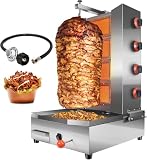
The best commercial shawarma machines for busy kitchens are usually vertical gas units with three or four independently controlled burners, a 40–60 kg skewer capacity, stainless-steel construction, and a footprint that leaves enough room for safe loading and carving.
The right choice depends less on the largest advertised capacity than on your peak service volume, available gas and ventilation, operator experience, and how close the machine will sit to the prep counter. A compact electric unit may suit a café serving occasional wraps, while a high-output gas machine is more appropriate for a takeaway line producing continuous portions throughout lunch and dinner.
As an Amazon Associate we earn from qualifying purchases at no extra cost to you.


Quick comparison by kitchen situation
| Kitchen situation | Recommended configuration | Typical capacity | Typical footprint | Main compromise |
|---|---|---|---|---|
| Small café or low-volume counter | Single or twin electric burner, manual rotation | 10–25 kg | 500–700 mm wide | Slower recovery and less browning speed |
| Busy takeaway with one main service period | Twin or three-burner gas machine | 25–45 kg | 600–800 mm wide | Requires gas installation and extraction planning |
| High-volume restaurant or late-night takeaway | Three or four independently controlled gas burners | 45–80 kg | 750–1,000 mm wide | Higher purchase, ventilation, and cleaning demands |
| Mobile or frequently rearranged kitchen | Compact electric unit with removable skewer | 10–30 kg | 450–650 mm wide | Electrical load can limit recovery performance |
Gas versus electric: which burner type wins?
Gas shawarma machines
Gas is generally the better choice for continuous commercial service. Open or shielded gas burners deliver strong heat directly toward the meat, recover quickly after a large portion is carved, and can continue operating during long service periods without adding a substantial electrical load. Three-burner and four-burner designs also let the operator heat only the upper, middle, or lower section of the skewer.
That control matters because a partially filled skewer does not need the same heat pattern as a full one. Heating the exposed section while leaving the empty lower area off can reduce scorching and unnecessary fuel use. Gas models do, however, require correctly sized gas plumbing, approved installation, adequate ventilation, and a safe clearance from combustible surfaces.
Electric shawarma machines
Electric machines are easier to position where gas service is unavailable. They are often quieter, simpler to start, and more practical for smaller operations that cook one modest skewer at a time. Infrared or tubular electric elements can produce even surface heat, but recovery varies considerably between models.
Check the electrical requirement rather than looking only at wattage. A 6 kW unit may need a dedicated 30-amp circuit depending on the local voltage, while a larger 9–12 kW model can require commercial single-phase or three-phase service. If the circuit cannot supply the machine continuously, heat output will suffer during busy periods.
How much skewer capacity do you actually need?
Capacity should be based on the amount of meat you can sell before the outer layers become dry, not simply on the largest skewer that will physically fit. A practical planning calculation is:
Required skewer capacity = peak portions per hour × raw meat per portion × holding factor.
For example, suppose a shop sells 35 shawarma portions per hour, uses 180 g of raw meat per portion, and wants a 1.25 holding factor for trimming and slower periods:
35 × 0.18 kg × 1.25 = 7.875 kg per hour.
A 30 kg skewer would provide roughly 3.8 hours of theoretical raw capacity, but that does not mean it should be loaded fully every day. If the shop’s busiest period lasts three hours, a 25–30 kg machine may be more suitable than an 80 kg model. An oversized cone can spend too long rotating, producing dry edges and excessive waste.
For a high-volume operation selling 70 portions per hour at the same portion size, the calculation becomes 15.75 kg per hour. That service pattern justifies a 45–60 kg class machine, especially if the unit has multiple heating zones and the kitchen can load a second cone during the day.
Burner count and heat control: the head-to-head
| Configuration | Best use | Heat control | Typical recovery | Watch for |
|---|---|---|---|---|
| Single burner or element | Low-volume service and small cones | One broad heat zone | Slow to moderate | Uneven results as the cone shrinks |
| Two burners or elements | Cafés and moderate takeaway volume | Usually upper/lower or left/right control | Moderate to fast | Limited fine adjustment on inexpensive units |
| Three burners | Busy takeaway kitchens | Good zone control over a medium or large cone | Fast | More valves, igniters, and parts to maintain |
| Four burners | Continuous high-volume production | Most precise control | Very fast when correctly installed | Needs more space, ventilation, and operator attention |
Independent controls are more valuable than raw burner count. A four-burner machine with one shared control may offer less practical flexibility than a well-designed three-burner unit with separate valves and reliable ignition. Look for flame-failure protection, accessible controls, and burners positioned so that the lower part of the cone is not constantly exposed to full heat.
Construction details that affect ownership
Stainless steel is the expected exterior material, but not all stainless construction is equally useful. A 304 stainless-steel food-contact area is a strong choice for surfaces exposed to meat juices and frequent cleaning. The rear panel, frame, and internal brackets may use other grades or coated steel, so inspect seams, corners, and fasteners rather than relying on the word “stainless.”
- Removable drip tray: Choose a deep tray that can be removed without lifting the skewer. A shallow tray fills quickly and increases spill risk.
- Adjustable skewer height: This allows the meat to remain aligned with the active heating zone as the cone becomes smaller.
- Sturdy bearing and drive: The motor should rotate a loaded cone smoothly without pulsing, slipping, or excessive noise.
- Counterbalanced spit: A balanced skewer reduces strain on the motor and makes loading safer.
- Accessible ignition components: Igniters, thermocouples, and gas valves eventually need service. Hidden parts increase downtime.
- Rounded internal corners: Fewer sharp ledges make degreasing faster and reduce residue buildup.
The components that commonly wear first are the skewer bearing, rotation motor, ignition electrode, thermocouple, control knobs, and drip-tray handles. These are inexpensive compared with replacing the entire machine, but only if the manufacturer or distributor can supply them. Before buying, ask for the parts diagram, replacement motor price, and expected lead time for burners and safety controls.
Footprint and workflow: measure more than the cabinet
A machine listed as 700 mm wide may need substantially more operating space. Measure the cabinet, the open door or tray, the skewer removal path, and the clearance needed for the operator to carve safely. Leave room beside the unit for a cutting board, serving containers, and a landing area for the knife. Placing the shawarma machine directly beside a sink or fryer can create congestion and increase splash or burn hazards.
Also check the vertical dimension. Tall skewers and overhead heat shields can interfere with low shelves, ventilation hoods, or pass-through windows. Gas units require the correct hood and clearances under local code; a compact footprint does not remove those requirements.
Setup and daily maintenance that prevent premature failure
- Confirm utilities before delivery. Match gas type and pressure, electrical voltage, circuit capacity, and extraction requirements to the selected model.
- Level the machine. A level cabinet helps the cone rotate evenly and keeps fat directed into the drip tray.
- Center and balance the skewer. Secure the meat tightly, keep the cone within the manufacturer’s weight limit, and verify that it rotates without contacting the heating guard.
- Preheat empty according to the manual. This confirms ignition and exposes abnormal flame patterns before food is loaded.
- Clean after every service. Turn off and cool the unit, scrape removable surfaces, wash the drip tray, and degrease the guard and carving area using approved products.
- Inspect weekly. Check burner ports, the thermocouple, motor sound, skewer bearings, fasteners, and the condition of the power cord or gas hose.
Never pour water over burners, motors, switches, or electrical elements. Grease buildup can affect flame quality and create a fire risk, while aggressive abrasives can damage stainless surfaces and leave places for residue to collect.
Final buying recommendation
Choose a compact electric machine if your operation serves occasional shawarma portions, has limited gas infrastructure, and can accept slower recovery. Choose a twin-burner gas model for a moderate takeaway workload. For continuous service, prioritize three or four independently controlled gas burners, a 45–60 kg usable skewer range, a removable deep drip tray, and readily available replacement parts.
Among otherwise similar machines, favor dependable heat zoning, balanced rotation, serviceable components, and a footprint that fits the complete carving workflow. Those details usually influence consistency, waste, and downtime more than an extra few kilograms of advertised capacity.