Best Value Compact Impact Driver for Tight Cabinet Installations
What's inside
As an Amazon Associate I earn from qualifying purchases. This post may contain affiliate links at no extra cost to you.
What matters in a tight cabinet
A compact impact driver is useful for cabinet installation when a drill or full-size driver cannot fit between a cabinet wall and the next obstacle. But “compact” covers a wide range: tool length, battery size, and the space needed to line up a long screw all matter. Check the tool’s bare length and try it with the battery you plan to use. A short body fitted with a bulky 5.0Ah pack may be less handy under a sink base than a slightly longer tool with a slim 2.0Ah pack.
For typical cabinet screws, prioritize a controllable trigger, a reliable clutch-free low-speed start, and a light battery. Impact drivers deliver rotational blows, which help drive long screws but can also strip a soft screw head or split a cabinet rail if you lean on the trigger. They are not a substitute for careful pilot holes and sound screw placement.
As an Amazon Associate we earn from qualifying purchases at no extra cost to you.

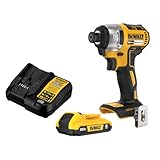

Best value: a compact 18V or 20V kit
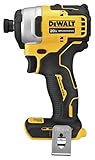
For most homeowners and installers who do occasional cabinet work, a compact 18V/20V impact driver kit from a major platform is the best value. A kit with one slim battery and a charger costs more up front than a bare tool, but avoids the trap of buying into a battery system one piece at a time. If you already own compatible batteries, a bare tool is usually the better deal.
Compare compact 18V impact driver kits by tool length, included battery capacity, warranty, and what the kit actually contains. A low advertised price can be misleading if it is for the tool alone or includes a small battery you will not use. For cabinet work, a 2.0Ah-class pack is often a sensible balance; a larger pack adds runtime but increases weight and can make overhead or corner work tiring.
Compare the options
| Option | Best for | Trade-off | Value check |
|---|---|---|---|
| Compact 18V/20V kit | First tool in a battery platform; mixed home projects | Higher initial cost and more weight than a small 12V setup | Look for a slim battery, charger, and clear warranty terms |
| Compact 12V kit | Light cabinet work and frequent tight-space use | Less reserve for long, large-diameter screws | Good value if you will also use other tools on that platform |
| Bare tool | Owners with compatible batteries and charger | Not a bargain if you need to buy batteries separately | Compare total cost against the complete kit |
| Right-angle attachment | Occasional access around a fixed obstruction | Adds length at the nose and can feel awkward under load | Useful as a workaround, not a replacement for a compact driver |
12V or 18V/20V?
A good 12V driver is often the more comfortable choice for installing cabinet hardware, assembling boxes, and driving shorter screws into predrilled rails. The smaller battery can be easier to maneuver inside a base cabinet, and lower weight matters when your wrist is twisted against a side panel. Choose a 12V compact impact driver kit if light-duty work is the bulk of your use and you are willing to accept slower progress on demanding fasteners.
Step up to 18V/20V if you regularly drive 3-inch structural or cabinet screws, work in dense material, or want one driver for deck repairs and other heavier jobs. The extra power is useful, but it is easy to mistake speed for control. For cabinet installation, the strongest driver is not automatically the best one; a powerful tool can bury a screw head before you react.
Judge value by the platform, not just the sale tag
Tool prices move around holidays, spring project season, and end-of-year clearance. Before buying, compare the kit price with the same brand’s bare-tool price and the cost of a separate battery and charger. A kit discount is worthwhile only if you will use its battery and charger. If you already own a platform, staying with it can save more than switching brands for a modestly cheaper driver.
Do not pay a premium just for a brushless motor if this is a once-a-year cabinet project. Brushless tools can offer better efficiency and useful electronic controls, but a brushed compact driver can do clean installation work when used carefully. Spend the difference on a quality bit set, a second slim battery, or a drill for pilot holes if those are the gaps in your setup.
For a budget-friendly option, compare budget compact impact driver kits from established brands with replacement batteries and service support. An off-brand tool can be fine for a few cabinets, but a proprietary battery with no dependable replacement supply can turn a cheap purchase into a disposable one.
Avoid the common installation failures
Use the driver to seat screws, not to force a bad setup. Drill a pilot hole sized for the screw’s core diameter, especially near the end of a rail or in hardwood. A screw driven too close to an edge can split the rail; a screw driven without a pilot hole may wander and pull the cabinet out of alignment. Clamp or hold adjoining boxes flush, then check level and face alignment before fastening them together.
Start slowly and stop as soon as the head seats. If the bit cams out, inspect the bit and screw head rather than pushing harder; a worn Phillips bit or a mismatched drive style is a common cause of stripped heads. Use a fresh, correctly sized bit, keep it straight, and reduce trigger pressure near the end. For delicate hardware or short screws, a drill/driver with a clutch may give better control than an impact driver.
A practical buying checklist
Before checkout, confirm the tool’s length, bare weight, battery fit, and kit contents. Check whether the manufacturer sells slim replacement packs locally and whether the warranty applies to the kit. If possible, hold the driver with its battery attached and reach the intended work area; cabinet corners often expose an awkward grip that a product photo will not show.
For most buyers, the value choice is a compact 18V/20V kit from a platform they will keep using. Choose 12V when low weight and access matter more than speed on heavy screws, and choose a bare tool only when you already have compatible batteries. Either way, pilot holes, the right bit, and a light touch will do more for clean cabinet work than an expensive jump in maximum torque.