
What's inside
- Top Picks at a Glance
- Quick Comparison of the Washers
- How Does a Pressure Washer Work?
- PSI, GPM and Cleaning Units
- Electric vs Gas Pressure Washer: PSI, GPM and Cleaning Units
- 1. Westinghouse ePX3500: Best Overall for First-Time Owners
- 2. Sun Joe SPX3000: Best Value Corded Washer
- 3. Greenworks 3000 PSI Brushless Electric: Best for Quiet Power
- 4. Westinghouse WPX3400 Gas: Best Gas Pick for Home Use
- 5. Westinghouse WPX3200 Gas: Best Mid-Range Gas Option
- 6. DeWalt DXPW3300 Gas: Best Premium Gas Pick
- 7. Simpson Clean Machine 3200 PSI Gas: Best Budget Gas Pick
- Also Consider
- How to Connect and Hook Up a Pressure Washer
- How to Start and Operate a Pressure Washer
- How to Pressure Wash a Deck and a Driveway
- How to Prevent Pressure Washer Pump Freeze Damage in Winter
- How to Repair a Pressure Washer Hose
- How We Chose
- Buying Guide
- Common Mistakes
- Frequently Asked Questions
- Which One Should You Buy?
- Sources
As an Amazon Associate I earn from qualifying purchases. This post may contain affiliate links at no extra cost to you.
A pressure washer works by using a motor or engine to drive a pump that squeezes ordinary water into a narrow, high-speed stream, and you set it up by connecting a garden hose to the inlet, the high-pressure hose to the outlet, bleeding the air out and only then starting the machine. For a first-time buyer, an electric unit such as the Westinghouse ePX3500 is the simplest to hook up and start, while a gas model such as the Westinghouse WPX3400 gives more pressure and flow for big jobs. This guide explains how the machine works, how to connect and start it step by step, how electric compares with gas, how to clean a deck or driveway, how to protect the pump from freezing and how to deal with a damaged hose.
We did not personally use these products. This guide is research-based, drawing on manufacturer listings and general operating guidance. Procedures differ by model, so your owner’s manual always comes first. We do not give model-specific start instructions for machines we have not verified, including any particular Craftsman model; check your manual for those.
As an Amazon Associate we earn from qualifying purchases at no extra cost to you.


Our Top Picks
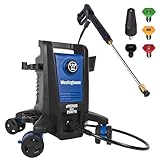
 Westinghouse ePX3500 Electric Pressure Washer2500 Max PSI13.5 x 14 x 16.5 inches19 poundsCheck on Amazon


Top Picks at a Glance
- Best Overall for Beginners: Westinghouse ePX3500 Electric Pressure Washer, 2500 max PSI and 1.76 max GPM, with an onboard soap tank and anti-tipping design per the listing.
- Best Value Electric: Sun Joe SPX3000, 2500 max PSI, listed as 2030 PSI PWMA rated.
- Best Brushless Electric: Greenworks 3000 PSI (2.0 GPM max) Brushless Electric Pressure Washer.
- Best Gas for Home Use: Westinghouse WPX3400 Gas Pressure Washer, 3400 PSI and 2.6 GPM with an onboard soap tank.
- Best Mid-Range Gas: Westinghouse WPX3200 Gas, 3200 PSI and 2.5 GPM.
- Best Premium Gas: DeWalt DXPW3300 Gas, 3300 PSI and 2.4 GPM with an axial cam pump.
- Best Budget Gas: Simpson Clean Machine 3200 PSI, 2.5 GPM, with a turbo nozzle.
Quick Comparison of the Washers
| Product | Best for | Key specs from the listing | Watch for | Price tier |
|---|---|---|---|---|
| Westinghouse ePX3500 | First-time owners, cars, patios | 2500 max PSI, 1.76 max GPM, soap tank | Needs a nearby outlet | Mid-range |
| Sun Joe SPX3000 | Small decks and fences | 2500 max PSI (2030 PWMA rated) | Moderate flow | Mid-range |
| Greenworks 3000 PSI Brushless | Quiet, low-maintenance power | 3000 PSI, 2.0 GPM max, brushless motor | Premium price for an electric | Premium |
| Westinghouse WPX3200 Gas | Driveways and large decks | 3200 PSI, 2.5 GPM, 5 nozzle set | Engine upkeep, fuel storage | Mid-range |
| Westinghouse WPX3400 Gas | Heavier homeowner use | 3400 PSI, 2.6 GPM, soap tank | Heavier and louder | Mid-range |
| DeWalt DXPW3300 Gas | Frequent use | 3300 PSI, 2.4 GPM, axial cam pump | Premium price | Premium |
| Simpson Clean Machine 3200 | Value gas power | 3200 PSI, 2.5 GPM, turbo nozzle | Check pump type in manual | Mid-range |
How Does a Pressure Washer Work?
A pressure washer takes water from your garden hose, raises its pressure with a pump and forces it through a small nozzle opening, which turns pressure into a fast, narrow jet. That is the whole idea. The jet does the cleaning by physically knocking dirt loose, with detergent doing chemical work if you use it.
The main parts
- Motor or engine: electric motor or gasoline engine that drives the pump.
- Pump: the heart of the machine. Axial cam pumps are common on home machines; triplex plunger pumps are found on more expensive units and are usually built for longer service.
- Inlet and filter: where the garden hose connects. A small screen catches debris.
- Unloader or bypass valve: when you release the trigger, this redirects water so the pump does not overheat and pressure does not spike.
- High-pressure hose, trigger gun and wand: carry and control the water.
- Nozzles or quick-connect tips: change the spray angle; colour coding varies by maker, so read the manual.
- Soap tank or injector: draws detergent into the stream at low pressure.
How does a jet wash work?
“Jet wash” is a common name for a pressure washer in the UK and some other countries, and it works the same way. A pump pressurizes water and a nozzle focuses it into a cleaning jet.
How does a power washer work, and is it different?
People use “power washer” and “pressure washer” interchangeably. Strictly, a power washer heats the water, but the term is widely used for ordinary cold-water machines. Check the listing; most home machines are cold water only, and hot water can damage them unless the manual says otherwise.
PSI, GPM and Cleaning Units
PSI (pounds per square inch) measures force. GPM (gallons per minute) measures the volume of water. Cleaning units, as sometimes quoted by makers, are PSI multiplied by GPM and give a rough comparison of cleaning speed. For example, the Westinghouse ePX3500 listing states 2500 max PSI at 1.76 max GPM, which multiplies to about 4,400 cleaning units, whereas the WPX3400 listing states 3400 PSI at 2.6 GPM, about 8,840. The gas machine therefore cleans noticeably faster, but it also hits harder. Max figures are peak numbers, so rated numbers, where given, are a better guide.
Electric vs Gas Pressure Washer: PSI, GPM and Cleaning Units
| Feature | Electric | Gas |
|---|---|---|
| Typical home PSI | About 1,500 to 3,000 max | About 2,500 to 4,400 |
| Typical GPM | About 1.2 to 2.0 | About 2.0 to 4.0 |
| Noise | Quieter | Louder |
| Upkeep | Minimal | Oil, fuel stabilizer, spark plug, winterizing |
| Portability | Lighter; tied to a cord | Heavier; free to roam |
| Best for | Cars, patios, furniture, small decks | Driveways, fences, large areas |
Are electric power washers good for home cleaning?
Yes. For cars, outdoor furniture, small decks, grills and patios, an electric washer is usually enough, easier to start and easier to store. Pick gas when you have large concrete areas or need to work away from an outlet.
1. Westinghouse ePX3500: Best Overall for First-Time Owners
- Max pressure: 2500 PSI.
- Max flow: 1.76 GPM.
- Features: anti-tipping technology and onboard soap tank, per the listing.
Best for: homeowners who want a simple plug-in machine. Skip if: your main job is a large driveway, where gas saves time.
An electric machine has no choke, no fuel and no pull cord. You connect water, squeeze the trigger to bleed air, plug in and switch on. That simplicity matters for beginners because the biggest mistakes, such as starting a pump dry, are easier to avoid when the steps are few.
Pros: simple start-up; soap tank; stable base. Cons: cord limits reach; moderate flow.
2. Sun Joe SPX3000: Best Value Corded Washer
- Max pressure: 2500 PSI, listed as 2030 PSI PWMA rated.
- Type: corded electric.
Best for: small decks, patios and fences. Skip if: you want a high-flow machine for large surfaces.
A rated figure makes comparing models easier. When a listing gives both a max and a rated PSI, expect the rated number to reflect typical use.
Pros: clear rated spec; plug-and-go; compact. Cons: moderate flow; cord limits reach.
3. Greenworks 3000 PSI Brushless Electric: Best for Quiet Power
- Pressure: 3000 PSI.
- Flow: 2.0 GPM max.
- Motor: brushless, per the listing.
Best for: people who want more power without engine upkeep. Skip if: you work far from an outlet.
Brushless motors are generally more efficient and longer-lived than brushed motors, and this one gives electric ease with gas-class pressure. Even so, higher pressure calls for a wide tip on delicate surfaces.
Pros: strong electric power; quiet; low maintenance. Cons: premium price; still corded.
4. Westinghouse WPX3400 Gas: Best Gas Pick for Home Use
- Pressure: 3400 PSI.
- Flow: 2.6 GPM.
- Includes: onboard soap tank, spray gun and wand, 5 nozzle set, per the listing.
Best for: driveways, siding, fences and decks. Skip if: you will not store and maintain a gas engine.
A gas machine adds steps: check oil and fuel, open the fuel valve, set the choke, prime or pull. Gas engines also need stabilizer if the fuel sits, and annual maintenance. Run it outdoors only because the exhaust contains carbon monoxide.
Pros: strong flow and pressure; cord-free; full nozzle set. Cons: heavy; loud; needs engine care.
5. Westinghouse WPX3200 Gas: Best Mid-Range Gas Option
- Pressure: 3200 PSI.
- Flow: 2.5 GPM.
- Includes: onboard soap tank and 5 nozzle set, per the listing.
Best for: homeowners who want gas power at a lower step. Skip if: you prefer electric.
Pros: strong cleaning units; nozzle set included. Cons: engine upkeep; weight.
6. DeWalt DXPW3300 Gas: Best Premium Gas Pick
- Pressure: 3300 PSI.
- Flow: 2.4 GPM.
- Pump: axial cam, residential model, per the listing.
Best for: frequent users who value a brand with service support. Skip if: you only wash twice a year.
Pros: strong specs; brand reputation. Cons: premium price; maintenance.
7. Simpson Clean Machine 3200 PSI Gas: Best Budget Gas Pick
- Pressure: 3200 PSI.
- Flow: 2.5 GPM.
- Features: turbo nozzle and axial cam pump, per the listing.
Best for: value-focused buyers with big areas to clean. Skip if: you want an easy-to-start electric.
Pros: strong specs for the tier; turbo nozzle included. Cons: gas upkeep; noise.
Also Consider
- Flexzilla Pressure Washer Replacement Hose, 1/4 in. by 50 ft: listed at 3100 PSI with M22 fittings and a no-kink design; useful when you need extra reach.
- Karcher Pump Guard 16 oz: an antifreeze and lubricant formula for electric and gas washers, for winter storage.
- STA-BIL Pump Protector 4 oz: a smaller pump antifreeze and lubricant protector.
- Twinkle Star Pressure Washer Hose Quick Connector, M22: a fitting for hose connections and repairs.
How to Connect and Hook Up a Pressure Washer
How do you connect a pressure washer?
Connect the garden hose to the washer’s water inlet, connect the high-pressure hose between the pump outlet and the trigger gun, and attach the wand and nozzle. Check that every connection is tight and that the O-rings are present. If you use quick-connect fittings, pull on them to make sure they have latched.
How to hook up a pressure washer, step by step
- Place the machine on level ground near a water tap and, for electric models, a GFCI outlet. Gas machines go outdoors only, away from doors and windows.
- Attach the high-pressure hose to the pump outlet and the gun, finger tight or as the manual says, and attach the wand.
- Check the inlet screen for debris and attach the garden hose. The garden hose should deliver at least the GPM the washer needs; the listing or manual gives the requirement.
- Turn on the water fully and squeeze the trigger until water flows steadily from the wand. This purges air from the pump and hose.
- Attach the nozzle you need. Start with a wide fan tip.
- Start the machine with the trigger gun’s safety lock engaged until you are ready.
How to Start and Operate a Pressure Washer
How to start a pressure washer
For electric models, connect and purge water first, then plug in and press the power switch. For gas models, check the oil and fuel, turn the fuel valve on, set the choke as the manual directs, switch the engine on and pull the cord or use the electric start, then ease the choke off as the engine warms. Never start a pump without water running through it, because running dry can damage the pump quickly.
How to start a Craftsman pressure washer
The steps differ by model, engine and year, so use your model’s owner’s manual. In general, a Craftsman gas washer follows the common sequence: connect the water, purge the hose, check oil and fuel, set the choke and start the engine. We have not verified model-specific details, so confirm them in your manual or on the maker’s support page using your model number.
How to operate a power washer or pressure washer
- Wear eye protection, closed shoes and ear protection for gas models.
- Spray a hidden spot first with a wide tip.
- Hold the wand with both hands where possible and expect recoil.
- Keep the wand 1 to 2 feet from tough surfaces, farther for delicate ones.
- Sweep in overlapping, even strokes.
- Release the trigger when not spraying. If the pump runs with the trigger released for more than a short time, it can overheat; follow the manual.
- To stop, release the trigger, shut off the machine, turn off the water, squeeze the trigger to release pressure and disconnect hoses.
How to Pressure Wash a Deck and a Driveway
How to pressure wash a deck
Sweep the deck, remove furniture and cover nearby plants. Apply a deck cleaner as its label directs, working a small area at a time. Use a wide fan tip, hold the wand at a consistent distance and move with the grain of the wood, in long overlapping passes. Avoid stopping in one spot, which leaves marks. Rinse thoroughly and let the deck dry before staining or sealing. For composite decking, follow the maker’s care guide, because limits vary by brand and line.
How to pressure wash a driveway
Sweep, pre-treat oil stains with a degreaser, and use a wider tip for the main wash. A surface cleaner attachment, such as the Westinghouse 12 inch model, gives an even finish and cuts splatter. Work from the top of the slope to the bottom in overlapping lines, keep the wand at a steady height and rinse the loosened dirt downhill, away from the house. Avoid narrow tips that can etch concrete.
How to Prevent Pressure Washer Pump Freeze Damage in Winter
Water left inside a pump freezes, expands and can crack the pump or fittings, and this damage is usually not covered by a basic warranty. To winterize, disconnect the hoses and drain as much water as you can, then squeeze the trigger to empty the gun. Following the maker’s instructions, run a pump antifreeze and lubricant product, such as Karcher Pump Guard or STA-BIL Pump Protector, through the pump, or use the method in your manual. Store the machine, hoses and wand in a space that stays above freezing. For gas units, also follow the engine’s storage guidance, such as fuel stabilizer or draining fuel. Check your manual, since some makers have a specific winterizing procedure.
How to Repair a Pressure Washer Hose
A high-pressure hose carries water at high force, so a failed hose can whip or burst. Many makers recommend replacing a damaged hose rather than repairing it, and some consider repairs unsafe. If the manual allows repairs, use fittings rated for the machine’s pressure. Small leaks at the connection are often caused by a worn O-ring or a loose quick-connect, which are cheap to replace. If the hose itself is cut, bulging, kinked beyond recovery or leaking along its length, replace it with a hose of the right pressure rating, length and fitting type, such as a 1/4 inch hose with M22 fittings where your machine uses them. Check your model’s manual for the correct fitting size. Do not tape or clamp a leaking high-pressure hose.
How We Chose
This guide is research-based. We read manufacturer listings for the washers named, compared stated PSI, GPM, motor and pump details, and used general operating guidance that matches common owner’s manuals. We did not personally use these products and do not claim measurements. We cite no model-specific procedures that we could not verify. Where a spec is not in the listing, we say it is not listed.
Buying Guide
Choose electric or gas by your biggest job
If you mostly wash cars, furniture and small decks, electric is simpler. If you regularly clean large concrete areas or need to work away from power, gas is better.
Look at GPM as well as PSI
Flow decides how quickly you rinse. Compare cleaning units where possible, but remember that more pressure is harder on delicate surfaces.
Check pump type
Axial cam pumps are common in home machines and suit occasional use; triplex plunger pumps are more durable and usually cost more. If the listing does not state the pump, it is not listed.
Check hose length and fittings
Standard hoses are often 25 to 35 feet. For more reach, use a rated extension. Check the fitting type, such as M22 or quick-connect, before buying a replacement.
Plan for storage and winter
Choose a machine you will actually store properly. Buy pump antifreeze if your winters freeze, and read the winterizing section of your manual.
Common Mistakes
- Starting the machine before water is flowing, which can damage the pump.
- Using a garden hose that cannot supply the required GPM.
- Using a narrow tip on wood, siding or concrete.
- Skipping winterizing in freezing climates.
- Running a gas washer in a garage or enclosed space.
- Taping a leaking high-pressure hose.
Frequently Asked Questions
How does a pressure washer work in simple terms?
A motor or engine drives a pump that pressurizes water, and a small nozzle turns that pressure into a fast jet that dislodges dirt.
Do I turn the water on before starting a pressure washer?
Yes. Turn the water on, squeeze the trigger until water flows steadily and only then start the machine, so the pump is never dry.
Why will my pressure washer not build pressure?
Common causes are trapped air, a clogged inlet screen, a worn nozzle or a low water supply. Check these first, then consult your manual.
Can I use an extension cord with an electric pressure washer?
Only if the maker allows it, and then with a cord of the right gauge and length. Check the manual, and use a GFCI outlet.
What should I do to winterize my pressure washer?
Drain the water, run a pump antifreeze product as directed and store the machine where it will not freeze. Check your manual for specifics.
Can I repair a leaking pressure washer hose?
Some makers allow rated repair fittings, but many recommend replacing damaged hoses. Check your manual and never use tape or hardware store clamps on a high-pressure hose.
Is a jet wash the same as a pressure washer?
Yes. Jet wash is a common name for a pressure washer in some regions, and it works the same way.
Which One Should You Buy?
If this is your first machine and you mostly clean cars, patios and small decks, choose the Westinghouse ePX3500 or Sun Joe SPX3000 and keep the setup simple. If you want electric convenience with more power, look at the Greenworks 3000 PSI brushless model. For large driveways, choose a gas machine such as the Westinghouse WPX3400 or WPX3200, or the DeWalt DXPW3300 if you use it often. Add pump antifreeze for winter and read your manual before the first start.
Sources
- Manufacturer listings for Westinghouse, Sun Joe, Greenworks, DeWalt and Simpson pressure washers
- Pump antifreeze product information from Karcher and STA-BIL
- Owner’s manual guidance common to electric and gas pressure washers
- Pressure washing basics from cleaning-industry guides
Last updated: October 2026
Related guides
More from Amazon
Programs that pair well with the guide above. Offers and eligibility are set by Amazon and may change.
A free business account with business pricing and bulk-buying tools for work, shop or home office.
Create a business accountFree shipping on eligible items, Prime Video and more. Eligible new members can start with a free trial.
Start a Prime free trialAudiobooks and podcasts to listen to on the go. Eligible new members can start with a free trial.
Try Audible freeAd-free music streaming. Eligible new subscribers can start with a free trial.
Try Music Unlimited freeAs an Amazon Associate we earn from qualifying purchases.
Write Your Review
No reviews yet. Be the first to share your experience!