Best Table Saw Under $600
Our Top Picks
What's inside
As an Amazon Associate I earn from qualifying purchases. This post may contain affiliate links at no extra cost to you.
The problem with shopping for the best table saw under 600 is that the $600 ceiling sits right on a fault line. Below it you are mostly choosing between jobsite saws with rack-and-pinion fences and a handful of compact contractor saws. Above it, you start getting cast iron tops, better trunnions, and riving knives that do not fight you. Manufacturers know exactly where that line is, and they build to it. That means the differences between two saws that both sit at $549 are often in places the spec sheet does not mention.
The second problem is that table saws are one of the most aggressively discounted categories in power tools. A saw that lists at $649 most of the year will show up at $499 during holiday promo windows, and the same saw will show up at $649 with a crossed-out $799 next to it during a fake sale. If you buy on the wrong week you can pay 25 to 30 percent more for the identical machine. Timing matters as much as picking the model.
What the price bands actually buy you
Ignore marketing tiers and think in three bands. Each one has a distinct set of compromises, and knowing which compromise you are accepting is most of the buying decision.
| Price band | What you typically get | Where it falls short | Best fit<br /> |
|---|---|---|---|
| <br /> Under $300 | Compact benchtop, aluminum top, small motor, basic fence | Fence drifts, low rip capacity, no dust control, thin blade guard | Trim work, occasional cuts, tight storage<br /> |
| <br /> $300 to $450 | Jobsite saw, better fence, foldable or wheeled stand, decent guard/riving knife | Aluminum top can flex, dust port undersized, blade quality varies | DIY remodels, hobby builds, mobile use<br /> |
| <br /> $450 to $600 | Larger rip capacity, rack-and-pinion fence, sturdier stand, better dust extraction | Still no cast iron top or belt-drive quiet running | Regular woodworking, sheet goods, small shops |
Most buyers hunting under $600 belong in the top band, and the single biggest jump in quality happens at the fence. A rack-and-pinion fence that stays parallel through its full travel is worth more than any horsepower claim on the box, because a fence that racks out of square by a sixteenth turns every rip into a guess and every glue-up into a gap.
The specs worth paying for and the ones that are noise
Rip capacity is the number to actually read. Under $600 you will see saws advertised anywhere from around 16 inches to over 30 inches of rip to the right of the blade. If you plan to break down plywood, more capacity is genuinely useful, because half of a 4×8 sheet needs at least 24 inches to make a clean cut without a track saw. If you build small furniture and cabinet parts, you may never use the extra width, and you are paying for a rail extension you will fold away.
Amperage claims deserve skepticism. Nearly every corded jobsite saw at this price runs a universal motor drawing roughly 15 amps, because that is what a household 120V circuit allows. When one brand advertises a higher peak horsepower than another at the same amperage, that is math, not engineering. Judge motors by whether they bog in thick hardwood and by whether the saw has soft start and electric brake, both of which are real features you can verify in the manual.
Also check the arbor and the throat plate. A standard 5/8 inch arbor means you can use any common 10 inch blade, and a saw with a removable, replaceable throat plate lets you make a zero-clearance insert for cleaner cuts and safer small rips. Some budget saws use a captive plastic insert that you cannot replace, which quietly limits the saw forever.
10-inch jobsite table saws under $600
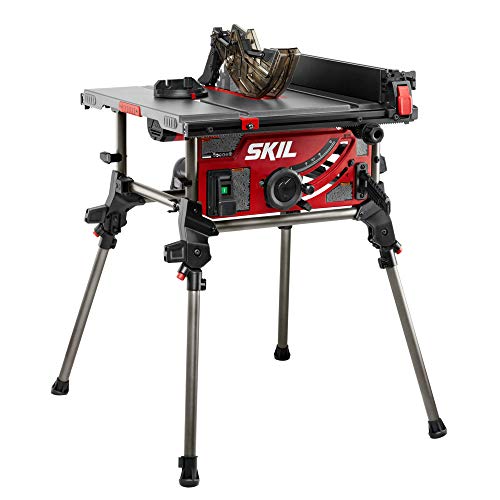
This is where the money makes sense. Filter for a rack-and-pinion fence, at least 24 inches of rip capacity, and a listed dust port diameter. Check the sale history before you buy, because saws in this band routinely swing 20 percent or more between promo windows.
Cordless versus corded at this budget
Battery table saws exist in the DeWalt XR, Milwaukee FUEL, and Makita LXT lines, and they cut well. The catch under $600 is that the tool-only price is what fits the budget, not the kit price. Add a high-capacity battery and a fast charger and you are usually well past $600, sometimes past $800. If you already own a large stack of batteries on that platform, cordless is a legitimate option and the convenience on a jobsite is real. If you are starting from zero, corded gives you far more saw per dollar.
Watch for the battery downgrade trick in kit listings. Retailers frequently pair a premium tool with the smallest battery in the lineup, then price it near the tool-only figure so it looks like a bargain. On a table saw that undersized pack is worse than on a drill, because a saw pulls hard and a small battery both sags under load and dies fast. Read the amp-hour rating in the bundle description, not the picture.
How to spot a fake table saw deal
Table saws are seasonal. The reliable discount windows in the US market are spring project season, the mid-summer sale event, Black Friday through Cyber Monday, and the post-holiday clearance in January. Outside those windows, most listings sit at or near list price, and any big crossed-out number should be treated as a marketing decoration rather than a reference point.
- ✔ Rack-and-pinion fences under $600 are genuinely good now
- ✔ Corded jobsite saws give the most cutting capability per dollar
- ✔ Discounts of 20 to 30 percent are common in known promo windows
- ✔ Replaceable throat plates and 5/8 inch arbors keep upgrades cheap
- ✘ Inflated “was” prices make off-season deals look better than they are
- ✘ Kit listings often hide a downgraded battery
- ✘ Aluminum tops in this band can flex under sheet goods
- ✘ Stands and dust collection are the first things manufacturers cut
Three checks before you click buy. First, look at how long the current price has held; a price that dropped yesterday after months of stability is a real move, while a price that oscillates weekly is theater. Second, confirm the stand is included, because some listings show a saw on a rolling stand that is sold separately. Third, confirm the blade that ships with it, since almost every saw at this price includes a thin general-purpose blade that you will want to replace with a 40 to 50 tooth combination blade for around $40 to $70.
Table saw stands and mobile bases
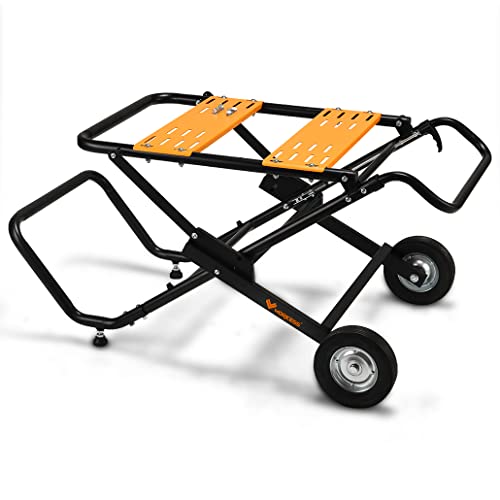
If your saw comes stand-free, price a universal rolling stand into your total before deciding what you can afford. A saw sitting on sawhorses vibrates, and vibration shows up in your cuts. Buying the stand separately sometimes beats the bundle price, sometimes does not; check both.
When to wait and when to buy the best table saw under 600
Buy now if you have a project on the calendar and the saw you want is sitting at least 15 percent below its typical price with a fence and stand you have verified. Waiting to save another $30 while a deadline slips is a bad trade.
Wait if you are shopping in a quiet month with no discount in sight, if the only thing in budget is a benchtop saw and you actually need to rip sheet goods, or if the deal in front of you is a cordless kit with a small battery. In that last case, waiting for a real bundle with a high-capacity pack is almost always the better use of the money.
Frequently asked questions
Is a jobsite saw good enough for furniture work? Yes, with two caveats. You need a fence that holds parallel and you need to accept that a lightweight saw will never feel as dead-steady as a cast iron cabinet saw. Many woodworkers build excellent furniture on jobsite saws by adding a zero-clearance insert, a quality blade, and an outfeed surface. Those three upgrades cost far less than stepping up a tier.
How much should I budget beyond the saw itself? Plan on 15 to 25 percent of the saw’s price for accessories in the first month. A better blade, a push block or two, a shop vacuum hose adapter, and possibly a stand. If you buy right at $600 with nothing left over, you will be running the saw with its stock blade and no dust control, which is the least pleasant version of owning it.
Does a riving knife really matter at this price? It matters more than almost anything else on the saw. A riving knife rises and falls with the blade and stays behind it, which keeps the kerf from closing on the back of the blade. That is the mechanism behind most kickback. Any saw in this budget should have one, along with an anti-kickback pawl assembly, and you should keep them installed for every through cut.
Shop the price bands, verify the fence and the stand, and buy inside a real discount window rather than a decorated one.
Check prices on Amazon →