How to Compare Tool Value When Retailers Offer Different Kit Configurations
What's inside
As an Amazon Associate I earn from qualifying purchases. This post may contain affiliate links at no extra cost to you.
Two kits can carry the same brand name and still offer very different value. One may include a larger battery, a charger, and a useful accessory set. Another may contain the same tool with a small battery and no charger, while the shelf price looks only slightly lower. Comparing the sticker price alone is how buyers end up paying twice for batteries, chargers, or basic accessories.
The practical question is not “Which kit is cheapest?” It is “What will this kit cost to become usable for my jobs, and how much work will it do before its limitations matter?” That means comparing the tool, battery capacity, charger, included accessories, warranty, and likely replacement prices as one package.
Start with the bare tool and the power source
First identify what is actually in the box. Retail listings often use phrases such as “tool only,” “starter kit,” “combo kit,” or “with battery.” These descriptions are not standardized across brands. A kit might include one battery and a charger, while another includes two batteries but only a basic charger.
Battery capacity is usually shown in amp-hours (Ah). A 2.0Ah battery may be adequate for an occasional drill or impact driver, but it will run down quickly in a reciprocating saw, circular saw, grinder, or leaf blower. A 5.0Ah pack generally offers roughly 2.5 times the stored energy of a 2.0Ah pack, although actual runtime varies with the tool and load.
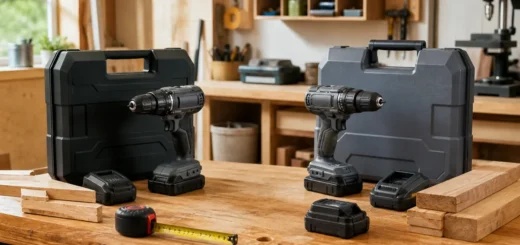
For light household work, a small battery can be the better value. Hanging shelves, assembling furniture, and driving a few dozen screws do not require the weight or cost of a high-capacity pack. For deck building or cutting sheet goods, the larger battery can prevent repeated stops and may justify a higher upfront price. Compare cordless drill kits with batteries and chargers as complete packages, not just as tool bodies.
Calculate the real kit price
Use a simple “ready-to-work” calculation:
Effective price = kit price + missing battery cost + missing charger cost + necessary accessory cost.
For example, a $99 tool-only circular saw is not cheaper than a $149 kit if you need to buy a $70 battery and a $30 charger. Its effective price is closer to $199. If you already own compatible batteries and a charger, however, the tool-only option may be the clear bargain.
| Kit type | Typical contents | Best for | Main risk |
|---|---|---|---|
| Tool only | Tool, sometimes a blade or bit | Existing users of the battery platform | Costs more than expected when starting from zero |
| Starter kit | Tool, small battery, charger | Occasional household jobs | Small battery may limit saws and outdoor tools |
| Full kit | Tool, larger battery, charger, accessories | Frequent or demanding work | Paying for accessories you will not use |
| Combo kit | Several tools, one or two batteries, charger | Building a platform quickly | One weak or unwanted tool can inflate the price |
Value the battery platform, not just today’s tool
A battery platform becomes more valuable as you add compatible tools. If you expect to buy a drill, impact driver, jigsaw, and light over several years, a kit with two batteries and a fast charger may be worthwhile even if its first-tool price is higher. You spread the cost of the batteries across future purchases.
Do not assume every battery with the same voltage performs equally. Brushless tools often make better use of high-capacity packs, and some demanding tools require batteries with higher current output. A compact 2.0Ah pack may physically fit a grinder but trigger overload protection sooner than a larger pack. That is a performance limitation, not necessarily a defect.
Also check charger speed. A basic charger may take several hours to refill a large battery. If you have only one pack and need the tool continuously, a faster charger or a second battery can be worth more than a minor difference in tool power. For occasional use, slow charging is usually fine.
Compare accessories honestly
Accessories can make a kit look generous without adding much value. A drill kit containing 30 low-quality bits is not automatically better than one with six durable bits. Cheap driver bits round off quickly, and an included circular-saw blade may be suitable only for rough construction cuts.
Assign a realistic value to each accessory. Count a blade or bit set only if you would have bought it within the next few months. A $20 case is useful if you transport the tool; it is not useful if it takes up space in a workshop drawer. Likewise, a dust bag, side handle, or depth stop can matter on a specific tool, but should not drive the comparison if you will never use it.
For drilling and driving, compare the cost of a dependable impact driver and drill bit set separately when the included set looks flimsy. Buying fewer quality bits is often cheaper than replacing a complete bargain set after one project.
Account for the job and likely failure modes
Match the kit to the hardest job you realistically expect, not the easiest one. A compact drill is fine for pilot holes and cabinet hardware, but it may overheat when boring dozens of holes through framing lumber. A small reciprocating saw battery may handle pruning branches but shut down during repeated cuts through demolition lumber.
Common value mistakes include buying a heavy 6.0Ah battery for a tool used overhead, choosing a single-battery kit for all-day work, and paying for a combo kit that contains a flashlight or low-end tool you would never purchase alone. Weight matters: a larger battery can add around 1 to 2 pounds, which is noticeable during overhead drilling or long periods of sanding.
For occasional outdoor maintenance, a cordless leaf blower kit with a smaller battery can be perfectly adequate for a driveway or small patio. For a large yard, the cheapest kit may become frustrating if runtime is only 10 to 15 minutes under heavy use.
Use seasonal pricing without chasing every sale
Kit configurations often change during spring outdoor-tool promotions, summer renovation sales, and holiday events. Compare the contents of the discounted kit with the normal contents, not just the percentage-off label. A $179 kit with two batteries may be a better deal than a $129 kit with one small battery, especially if a replacement battery normally costs $80.
Before buying, record the exact battery sizes, charger type, included accessories, and retailer return period. A sale is less useful if the kit has a shorter return window or if a missing accessory is difficult to replace. If two kits have similar effective prices, favor the one with the better warranty, easier battery availability, and the tool you will use most often.
The cheaper configuration is fine when you already own the platform, use the tool briefly, and do not need extra accessories. Starting from scratch, doing demanding work, or expanding into several cordless tools usually favors the kit with appropriately sized batteries and a charger you can live with—not necessarily the kit with the lowest shelf price.