How to Buy Used Cordless Tools Without Inheriting Battery Problems
What's inside
As an Amazon Associate I earn from qualifying purchases. This post may contain affiliate links at no extra cost to you.
A used cordless tool can be a bargain, but the battery is often where the deal falls apart. A drill that costs half its new price is poor value if its batteries are tired, discontinued or unsafe. Price the tool and its power system together: batteries, charger and the cost of replacing anything that fails.
As an Amazon Associate we earn from qualifying purchases at no extra cost to you.


Price the whole kit, not just the tool
Before meeting the seller, check what a compatible new battery costs and whether the brand still sells the same battery platform. A bare tool at $50 may look attractive, but if it needs a $70 battery and a $30 charger, a new kit on sale could be cheaper and come with a warranty.
Compare the used price with current sale prices, not the original list price. For a common drill or impact driver, a used kit with a working charger and one healthy battery might make sense at roughly 40–60% of the price of an equivalent new kit. That is a starting point, not a rule: rare platforms, worn accessories and uncertain battery history should push the price down.
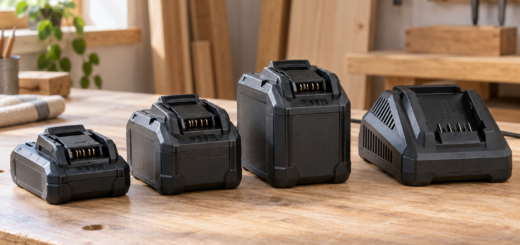
New batteries are generally the safer choice when you need dependable runtime. If the tool itself is in good condition but the battery is suspect, compare the price of a genuine replacement with a replacement battery for its brand and platform. Avoid buying a battery until you have confirmed the exact platform and voltage; similar-looking packs may not fit.
Inspect the battery before you test it
Look for a cracked case, swelling, melted plastic, corrosion around the contacts or a strong chemical smell. Any of these is a reason to walk away. Do not charge or use a battery that is swollen, leaking or visibly damaged. Lithium-ion packs contain cells and protective electronics; a damaged pack can become a fire risk.
Check the label for voltage, capacity in amp-hours (Ah), model or platform information, and a date or serial code if provided. A higher Ah rating usually means more runtime, but also more weight and expense. Capacity alone does not establish battery health, and date codes are not consistent across brands. Ask how often the pack was used and stored. A battery left fully discharged for months may be in worse shape than a regularly used pack kept indoors.
Inspect contacts for dirt or oxidation, but do not scrape them with metal. A little dry dust is ordinary; green or white corrosion, deep pitting, or loose contacts are not. Check that the latch works and the pack seats firmly. A pack that wobbles or needs pressure to maintain contact can interrupt operation or overheat.
Test under load, not just at idle
Ask to test each battery with the seller’s charger and tool. The charger should recognize the pack without repeated reseating, unusual blinking or excessive heat. Let the battery charge for several minutes, then run a drill in a piece of scrap wood or drive a few screws. A battery that shows a full charge but cuts out under modest load may have weak cells or a protection circuit that is tripping.
For a practical check, drive several 2–3 inch screws into softwood, or make repeated cuts with a saw if that is what you are buying. Compare batteries of the same age and capacity. One pack that stops much sooner than its mate is a warning, though a short test cannot measure remaining capacity precisely. Do not deliberately run a pack flat; deep discharge can damage it.
Feel for excessive heat after testing. Warm is normal; too hot to hold comfortably, a burning smell, or sudden shutdown is not. If the seller will not allow a basic test, treat the battery as unverified and price the purchase as though you will need a replacement.
Check the charger and tool separately
A good battery is no use if the charger is faulty or incompatible. Confirm the charger is intended for the same platform and voltage family, then inspect its cord, plug and housing. Stop if the cord is frayed, the case is cracked, or the unit makes unusual buzzing or smells hot during charging. Original chargers are usually the lowest-risk option; a very cheap generic charger can erase the savings.
Test the tool in forward and reverse, check the trigger for smooth speed control, and listen for grinding, heavy sparking or an uneven motor sound. On a drill, test the clutch and chuck. On a saw, check the blade guard and shoe. A worn tool can drain batteries faster or require costly repairs, so do not let a healthy battery distract from mechanical wear.
Compare the likely cost of ownership
| Used setup | What to check | When it can be good value |
|---|---|---|
| Bare tool, no battery | Platform availability; cost of battery and charger | You already own compatible packs and a charger |
| Tool with one tested battery | Charge behavior, load test, case and contacts | The battery passes testing and the tool is priced well below a new kit |
| Tool with several old batteries | Test each pack separately; check for mixed brands or capacities | Only if at least one pack is clearly sound and the others add little to the price |
| Obsolete or unfamiliar platform | Replacement pack and charger availability; genuine-pack cost | Usually only for occasional use when you can accept limited future support |
If you need to build a platform from scratch, a discounted new kit is often better value than piecing together used parts. Compare current drill kits with battery and charger against the used bundle total. For occasional household repairs, an older mainstream platform can still be a sensible buy if replacement batteries remain easy to find. For frequent work, paying more for a supported platform and a new battery is often cheaper than losing time to unreliable packs.
Avoid common battery traps
Be cautious with “new” batteries sold far below normal prices, especially if the label is blurry, the packaging is generic or the seller cannot identify the platform. Counterfeit and low-quality replacement packs may have less capacity than claimed and weaker protection. A third-party pack is not automatically bad, but buy from a seller with a clear return policy and check independent reviews for the exact product, not just the brand name.
Do not assume an adapter makes every battery safe to use on every tool. Adapters can remove communication or protection features, and some combinations are not approved by the tool maker. Avoid packs with modified wiring, taped latches or exposed terminals. For a used battery, a return window matters: test it promptly and keep the receipt.
Seasonal sales can shift the comparison quickly. Before buying used, check promotions around major holiday weekends and late-year sales, when bundled batteries and chargers may make a new kit cost less than a used one plus replacement parts. If the used seller will not lower the price to reflect an untested pack, move on. A cheap tool is only a deal when the battery system is safe, available and reliable enough for the work you actually plan to do.