How to Compare Cordless Tool Battery Prices by Watt-Hour
What's inside
As an Amazon Associate I earn from qualifying purchases. This post may contain affiliate links at no extra cost to you.
Watt-hours give you a useful way to compare cordless tool batteries of different voltages and capacities. They estimate how much energy a battery stores. They do not tell you exactly how long a tool will run, but they make price comparisons more meaningful than comparing amp-hours alone.
What watt-hours mean
To estimate a battery’s energy, multiply its nominal voltage by its amp-hour rating:
Watt-hours = volts × amp-hours
For example, a 20V-class, 5.0Ah battery is roughly 100Wh (20 × 5). A 12V, 4.0Ah battery is roughly 48Wh. The “20V” label is often a rounded marketing figure; some platforms use a 18V nominal voltage, which would put that battery at about 90Wh. Treat the result as an estimate, not a lab measurement.
More watt-hours usually mean more stored energy and, for the same tool and workload, longer runtime. Actual runtime also depends on the motor, battery condition, temperature, material, and how hard you work the tool. A circular saw cutting thick lumber may drain a pack far faster than a drill driving small screws.
Compare cost per watt-hour
Divide the price by the estimated watt-hours to get a basic value measure:
Cost per Wh = battery price ÷ estimated Wh
Suppose a 100Wh battery costs $120: that is $1.20 per Wh. A 50Wh battery at $70 costs $1.40 per Wh. The larger pack is cheaper by this measure, but only if you can use the extra capacity and the battery fits your tools.
Use the price of the battery alone, not the price of a kit that includes a tool, charger, and battery. For a kit, subtract a reasonable value for the other items only if you have a consistent way to estimate it. Otherwise, compare complete kits with complete kits.
Example comparison
These sample figures show the calculation; they are not current quotes. Check today’s listing price and the manufacturer’s stated voltage and capacity before buying.
| Battery example | Estimated energy | Example price | Cost per Wh | Best fit |
|---|---|---|---|---|
| 12V, 2.0Ah | 24Wh | $35 | $1.46 | Light drills and compact tools |
| 12V, 4.0Ah | 48Wh | $65 | $1.35 | More runtime without much added bulk |
| 18V nominal, 5.0Ah | 90Wh | $120 | $1.33 | General-purpose shop and home use |
| 18V nominal, 8.0Ah | 144Wh | $190 | $1.32 | Longer sessions and higher-demand tools |
The cost-per-Wh figures are close, so price alone would not settle this choice. A 2.0Ah pack is lighter and can be a better match for overhead drilling. An 8.0Ah pack costs more and adds weight; it may be worthwhile for repeated cutting or grinding, but excessive for occasional household repairs.
Check the platform and performance
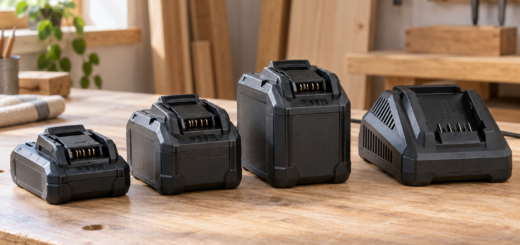
Before comparing prices, confirm that the battery fits your tool platform and charger. Batteries from different brands generally do not interchange, even when voltage labels match. Some manufacturers also divide a platform into compact, standard, and high-output packs that are not equally suited to every tool.
Capacity is not the same as power delivery. A high-draw saw or grinder may perform better with a pack designed for higher current, while a compact pack with similar watt-hours may overheat, limit output, or shut down sooner under load. Look for the manufacturer’s intended use and credible reviews that test the battery in a tool like yours. A nominal Wh calculation cannot predict peak power.
Also consider weight and balance. A large battery can make a drill tiring or awkward, especially on a ladder. For a tool used in short bursts, a smaller pack may be the better value even if its cost per Wh is higher.
When a budget battery makes sense
Lower-priced packs can be sensible for light, occasional jobs if they are compatible, backed by a usable warranty, and sold by a trustworthy source. If you mostly assemble furniture or make a few cuts on weekends, paying extra for the largest high-output pack may not save meaningful time.
Be cautious with unusually cheap third-party packs. Capacity claims can be overstated, and weak cells or electronics may cause short runtime, poor performance under load, overheating, or early failure. A low upfront price is a poor deal if the pack stops charging after a season. Avoid damaged or swollen batteries, and stop using a pack that becomes unusually hot, smells odd, or shows physical damage. Check warranty terms and seller return policies before ordering.
If you already own several batteries on one platform, another compatible pack can be more useful than switching brands for a lower cost per Wh. That avoids buying a new charger and reduces the chance that an otherwise good deal sits unused.
Timing your purchase
Battery prices often drop during major sale periods, brand promotions, and tool-kit bundles. Compare the sale price with recent prices if you can, and calculate the battery-only value when a kit is discounted. Bundles can be excellent if you need the tool; they are not automatically a bargain if the extra items duplicate what you own.
For a first battery on a platform, a cordless tool starter kit with a battery and charger may beat buying each piece separately. For an existing platform, compare a standard-capacity replacement battery against a high-capacity battery using the same cost-per-Wh calculation.
Use watt-hours to narrow the options, then choose based on compatibility, tool demand, weight, warranty, and the price you can actually buy at. The best-value battery is not always the one with the lowest cost per Wh; it is the one that supplies enough energy and power for your work without paying for capacity you will rarely use.