How to Compare Tool Prices When One Kit Has a Larger Battery
What's inside
As an Amazon Associate I earn from qualifying purchases. This post may contain affiliate links at no extra cost to you.
A tool kit with a larger battery is not automatically the better deal. A 5.0Ah battery can cost more than a basic drill kit, but the extra capacity only matters if you will use the tool long enough to drain a smaller pack. To compare prices fairly, separate the value of the tool, battery, charger, included accessories, and the battery platform itself.
Start With the Complete Kit
Compare what is in each box before comparing the sticker price. One kit may include a drill, two batteries, a charger, and a case. Another may include the same drill with one small battery, no case, and a faster charger. The second kit can look cheaper while costing more once you buy the missing parts.
Write down these items for each option:
- Tool count and tool type
- Battery quantity and capacity
- Charger type and charging time
- Included blades, bits, bags, or cases
- Warranty length and local service support
- Compatible tools you may buy later
Also check whether the advertised battery is included or merely “compatible.” Retail listings sometimes show a tool in a kit photo with a battery sold separately. The specifications and package contents matter more than the photograph.
Battery Size and Real-World Runtime
Battery capacity is usually listed in amp-hours, or Ah. A 5.0Ah battery stores roughly twice the energy of a 2.5Ah battery at the same voltage. It will not necessarily run a tool for exactly twice as long, because heavy loads create heat and the tool may reduce power before the battery is completely empty.
A rough comparison is still useful. If a compact drill runs about 30 minutes of intermittent screw-driving on a 2.0Ah pack, a 4.0Ah pack may deliver around 50 to 60 minutes in similar work. Continuous drilling in masonry, cutting thick lumber, or using a grinder can reduce those figures sharply.
The larger battery also adds weight. A 2.0Ah pack may weigh about 1.5 pounds, while a 5.0Ah pack can approach 2.5 pounds, depending on the platform. That extra pound matters when holding a drill overhead, driving cabinet screws, or using an impact driver on a ladder. For short tasks, the smaller battery may be the more comfortable and practical choice.
Compare Cost Per Usable Battery
Do not treat a large battery as free capacity. Calculate the effective price of the kit, then estimate the cost of the batteries you are actually getting. The table below shows how two common package structures can compare.
| Kit | Tools | Battery contents | Advertised price | What the price means |
|---|---|---|---|---|
| Starter kit | Drill and impact driver | Two 2.0Ah packs | $199 | Good portability and enough runtime for repairs |
| Large-battery kit | Drill and impact driver | One 5.0Ah pack | $229 | Longer runtime, but no backup while charging |
| Expanded kit | Drill, impact driver, and saw | Two 5.0Ah packs | $349 | Higher upfront cost and useful capacity for demanding work |
In this example, the $199 kit supplies 4.0Ah of total battery capacity and lets you keep working while one battery charges. The $229 kit supplies more capacity in a single pack, but it may be less convenient if charging takes an hour or more. The larger pack is more valuable for a circular saw or grinder than for occasional screw-driving.
For a homeowner doing a few shelves, a fence repair, and seasonal maintenance, the cheaper two-battery kit is often fine. For deck construction or repeated cutting, paying more for 4.0Ah or 5.0Ah batteries can prevent frequent stops and the need for a spare purchase.
Match Battery Size to the Tool
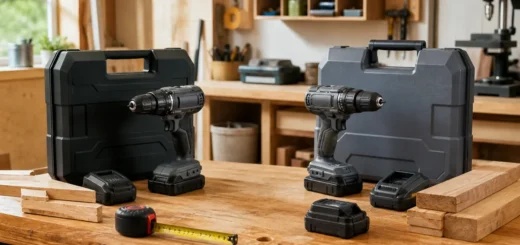
Battery size should follow the tool’s workload. A compact cordless drill kit with two batteries is usually a sensible budget choice for furniture, hardware, and light repair work. A 2.0Ah or 2.5Ah pack keeps the drill balanced and is cheaper to replace.
For a circular saw, recip saw, angle grinder, or leaf blower, a 4.0Ah or 5.0Ah pack is often a better match. These tools draw current quickly. A small battery may shut down under load, overheat, or provide only a few minutes of useful cutting. That does not make the smaller battery defective; it is simply being used outside its economical workload.
High-capacity batteries are not always the best upgrade. If the tool is used for ten minutes at a time, the battery may sit unused for weeks after the job. A second standard battery can be more useful than one oversized pack because it provides backup and spreads wear across two batteries.
Account for Charger and Replacement Cost
Charging speed changes the value of a kit. A basic charger may take roughly 60 to 120 minutes to refill a larger battery. A rapid charger may cut that time substantially, but it can cost $50 to $100 when purchased separately and may produce more heat. Check whether the larger-battery kit includes the faster charger or only a bigger battery.
Battery replacement is another hidden cost. Prices vary by brand, but a genuine 5.0Ah replacement commonly costs far more than a 2.0Ah pack. Avoid judging value by buying the cheapest compatible battery from an unknown seller. Poor-quality packs can have inaccurate capacity ratings, weak thermal protection, or fit problems. For occasional use, the lower-cost tool kit is only a bargain if replacement batteries remain available several years later.
Consider the Brand Platform
A kit is an entry point into a battery platform. Before buying, look at the tools you may need next: a trim router, oscillating tool, inflator, blower, or light. A slightly more expensive kit can be cheaper over time if it lets you buy bare tools without another charger and battery.
On the other hand, do not pay a platform premium for tools you will never use. If you need a drill twice a year, a budget budget cordless drill kit is reasonable. If you are building a collection, compare bare-tool prices and the availability of mid-size batteries before committing.
When to Buy and When to Wait
Tool kits often receive their best discounts around Memorial Day, July 4, Labor Day, Black Friday, and the weeks before Christmas. Holiday bundles frequently add a free tool rather than reducing the price directly. That extra tool is valuable only if it replaces a purchase you would otherwise make.
Watch the normal price for several weeks instead of trusting a claimed percentage discount. A kit listed at $299 and reduced to $249 may not be a real bargain if it regularly sells for $229. Price alerts and retailer comparison searches help expose those inflated reference prices.
Buy the larger-battery kit when the work is continuous, the tool is power-hungry, or the bundle includes a second useful tool at a genuine discount. Choose the cheaper kit when the jobs are short, weight matters, and you would rather have two small batteries than one large battery. The best value is the package that avoids your next purchase—not simply the one with the biggest amp-hour number.