Bosch vs Festool Routers: Is the Professional Price Premium Worth It?
What's inside
As an Amazon Associate I earn from qualifying purchases. This post may contain affiliate links at no extra cost to you.
Bosch and Festool make capable routers, but they target different buyers. Bosch routers usually deliver the best cutting performance per dollar for a home shop, remodeler, or occasional cabinet project. Festool charges more for dust control, repeatability, system integration, and refined handling. Those advantages are real—but they do not improve every routing job enough to justify the price.
The practical question is not whether Festool is better. It is whether your work is frequent, precise, and organized enough for its advantages to pay back the premium.
As an Amazon Associate we earn from qualifying purchases at no extra cost to you.


Where the Price Gap Comes From
A mainstream Bosch plunge or fixed-base router commonly costs roughly $130 to $250, depending on the kit and included bases. A comparable corded Festool router generally starts around $500 and can exceed $1,000 for a larger professional model. Batteries, guide rails, dust extractors, edge guides, and accessories can widen the gap further.
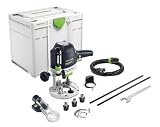
Festool is not simply charging more for a motor. Its routers are designed as part of a connected system. The dust port, guide-rail compatibility, micro-adjustments, interchangeable bases, and accessory ecosystem are central to the purchase. If you already own Festool rails and extraction equipment, the effective cost is lower because you can use what you have. Starting from zero is much more expensive.
Bosch takes a more conventional approach. Its routers use familiar collets, common accessories, and widely available replacement parts. That makes them easier to buy, repair, and replace without committing to one tool ecosystem.
Bosch vs Festool at a Glance
| Factor | Bosch | Festool |
|---|---|---|
| Typical price | About $130–$250 for common corded kits | About $500–$1,000 or more |
| Best fit | General woodworking, trim, remodeling, DIY | Production work, cabinetry, finish carpentry |
| Power | Strong performance for typical 1/4- and 1/2-inch routing | Excellent control, with larger options for demanding cuts |
| Dust collection | Useful, but varies by base and setup | Usually better integrated, especially with Festool extractors |
| Adjustment feel | Good, though some bases have more play | More precise and repeatable |
| Accessories | Broad third-party compatibility | Strong proprietary system, often expensive |
| Value for occasional use | Usually excellent | Usually poor unless system benefits matter |
Where Bosch Makes More Sense
A Bosch router is the sensible choice for common tasks such as roundovers, rabbets, dados, hinge mortises, sign work, template routing, and flattening small panels. The widely used Bosch 1617-style platform is especially practical because it is available with fixed and plunge bases, accepts common bits, and has enough power for most furniture and remodeling work.
For a first full-size router, compare Bosch router kits rather than buying a motor and bases separately. A kit can save $30 to $80, and having both bases is more useful than many beginners expect. The fixed base is lighter and easier for edge work; the plunge base is safer and more controlled for stopped cuts and template work.
Bosch’s main compromises are refinement and dust management. Depth changes can be slower, the plunge action may not feel as smooth, and visibility around the bit is not always as good as on a premium router. Some users also find that a budget edge guide flexes during long cuts. That is a setup problem more than a motor problem, but it affects accuracy.
For occasional use, those shortcomings rarely justify spending three or four times as much. A sharp bit, a stable guide, and two test cuts usually matter more than brand.
What Festool Adds
Festool’s advantage becomes clearer when the same router is used repeatedly for accurate, clean work. Depth adjustment is typically more controlled, the plunge mechanism feels smoother, and the bases are designed around repeatable positioning. On cabinet parts or built-ins, saving a minute on every setup can add up quickly.
Dust extraction is another meaningful difference. With a compatible extractor and hose, Festool routers can capture a high percentage of chips and fine dust at the source. That reduces cleanup and keeps the cut line visible. It does not eliminate dust: open-edge cuts, certain profiles, and chip ejection at high feed rates still scatter material.
Festool routers also tend to work well with guide rails and the company’s broader layout and extraction equipment. If you routinely break down sheet goods, route dados against a rail, or move between several jobsites, that integration can be worth paying for. If your router lives on a bench and runs for 20 minutes twice a month, it probably is not.
The drawbacks are substantial. Accessories can be expensive, proprietary parts may be less convenient to source, and a premium router does not make a dull or poorly chosen bit cut accurately. Festool’s smaller routers also are not automatically the best choice for heavy stock removal. Match the router to the bit diameter and cut depth rather than assuming the higher price means unlimited capacity.
Performance, Safety, and Common Failure Modes
Both brands can burn wood if the bit is dull, the cut is too deep, or the feed rate is too slow. For hardwood, remove about 1/8 inch per pass for demanding cuts instead of trying to take the full depth at once. A 1/2-inch straight bit buried deeply in oak can overload a compact router, trip its protection, or leave burn marks even when the tool is functioning correctly.
Collet engagement is a frequent cause of vibration. Insert the bit fully, then pull it back approximately 1/16 inch before tightening so the collet does not bottom out. Keep at least about 3/4 inch of shank engaged when the cut allows it. A bit that slips can ruin a workpiece and create a serious kickback hazard.
Dust extraction helps both brands, but only when the hose and port stay clear. A clogged shroud can reduce cooling and collection. On plunge routers, check that the plunge lock is actually engaged before starting a cut. On edge work, keep the router moving in the correct direction: against the bit’s rotation for a normal climb-resistant cut. A climb cut can pull the tool forward unexpectedly.
Which Router Should You Buy?
Choose Bosch if you route a few times per month, need a dependable general-purpose machine, want inexpensive replacement accessories, or are building your shop gradually. A Bosch fixed/plunge kit is usually the strongest value, and a separate compact router is useful later for laminate trimming and small roundovers. See current Bosch compact router options when lighter weight matters more than maximum power.
Choose Festool if you do cabinet installation, professional finish carpentry, or repeated production routing where dust control and fast, accurate setup directly affect billable time. It is also easier to justify if you already own a Festool extractor and guide rails. In that situation, shop for a Festool router that matches your bit sizes and typical cut depth rather than automatically buying the largest model.
Timing and Seasonal Value
Router discounts are usually strongest during major holiday sales, Father’s Day promotions, Black Friday, and year-end tool clearances. Bosch kits often see meaningful temporary discounts because retailers bundle bases or bits. Festool pricing is less aggressive, although refurbished tools, authorized-bundle promotions, and used professional equipment can reduce the gap.
Do not buy a cheaper router only because it is on sale. A $160 router that lacks the base, guide, or dust setup you need can become a $250 project. Conversely, do not pay $700 for a premium router to make three shelves. For most buyers, the professional price premium is worth it only when reduced cleanup, faster setup, and repeatable results will be used weekly—not merely admired in the tool cabinet.