Best Value Cordless Planer for Smoothing Reclaimed Lumber
What's inside
As an Amazon Associate I earn from qualifying purchases. This post may contain affiliate links at no extra cost to you.
Choosing a value cordless planer for reclaimed lumber
A cordless hand planer is useful for trimming a sticking door, flattening a proud edge, or taking down a small high spot in salvaged boards. It is not a shortcut to turning rough, twisted lumber into flat stock: a planer follows the surface beneath it, and a benchtop thickness planer also won’t flatten a twisted board without first establishing a reference face.
For reclaimed lumber, the best value is usually a mainstream 18V-class planer sold as a bare tool if you already own that battery platform. Expect a cutting width around 3-1/4 inches and a maximum cut near 1/16 inch per pass on common models. Those figures describe capacity, not a sensible starting setting. Begin around 1/64 inch, then increase only if the wood cuts cleanly and the tool stays under control. A lighter pass reduces tear-out and leaves fewer deep ridges to sand away.
As an Amazon Associate we earn from qualifying purchases at no extra cost to you.

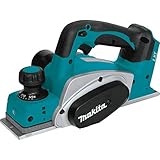
If you need the battery and charger too, compare the complete kit price against a corded planer. A cordless tool may cost more upfront, but it avoids a cord snagging on rough stock or an improvised work area. For occasional shop use near an outlet, a corded tool can be the better buy.
Compare the total cost, not just the tool price
Prices move with promotions and vary by battery platform. These are practical buying bands rather than live quotes; check current listings and count batteries, charger, blades, and case where relevant.
| Option | Typical cost position | Best for | Main trade-off |
|---|---|---|---|
| Bare-tool cordless planer | Lower upfront cost if you own compatible batteries | Platform owners who need occasional trimming | Battery and charger can erase the savings |
| Cordless kit with battery and charger | Higher initial cost | First tool on a battery platform | Paying for a battery system may not make sense for one tool |
| Budget corded planer | Often the lowest complete-tool cost | Stationary work near reliable power | Cord management and less freedom around long boards |
| Premium cordless planer | Highest purchase price | Frequent work, existing premium platform, or stronger service support | Extra features may not improve occasional reclaimed-wood jobs |
For a fair comparison, price a second battery if you plan to work through a stack of boards. A compact battery keeps the tool lighter, but heavy cuts drain it faster; a larger pack adds runtime and weight. If you own tools from one brand, staying on that battery platform is often worth more than chasing a small discount on another brand’s bare tool.
Start by comparing 18V cordless hand planer bare tools on your current platform. If you need a complete setup, compare cordless planer kits with battery and charger against the price of a corded alternative.
Reclaimed lumber changes the buying decision
Old boards can hide nails, screws, staples, and grit. A planer blade striking metal can be nicked in an instant; even a small nick leaves a repeating line in every pass. Before planing, remove hardware and inspect both faces and edges with a metal detector. Brush off dirt and grit, then check for embedded fasteners again after cutting or scraping. Don’t plane painted or treated stock unless you have confirmed its coating and dust risks are safe to machine.
Most hand planers use paired, replaceable blades. Many common blades are reversible, so a clean edge may be available by turning them around, but confirm the blade type and price before buying. Replacement blades are a recurring cost, not a minor detail with reclaimed wood. Check whether the tool accepts widely available blades, whether adjustment is straightforward, and whether the package includes a useful spare set.
Blades won’t fix bad technique. Feed steadily, support the board close to the cut, and keep the tool’s front shoe flat as it enters and leaves the work. A heavy cut, a knot, or a sudden change in grain direction can cause tear-out or make the planer dig in. For figured or reversing grain, use very shallow cuts and test on an offcut. A hand plane or sander may be the better finishing tool for a small area.
Features worth paying for—and those you can skip
A dust bag or vacuum adapter is useful, but plan on chips escaping: hand planers produce a surprising volume of curly shavings. A directional chip outlet helps keep debris away from your face and work area. A parking stand that lifts the blade clear when you set the tool down is a practical safety feature. A depth-adjustment knob with clear increments matters more than a high maximum-cut specification.
Look for a comfortable grip, a visible cutting-depth scale, and a fence if you need repeatable edge work. A fence helps guide the tool but does not make it a jointer. If you need to remove material evenly across a board face, mark high spots and work them down in controlled passes; don’t expect a narrow planer shoe to establish a reliably flat reference plane over a wide, warped board.
Before checkout, search for replacement blades for the planer’s cutting width. Compare the price of a matched pair and make sure the listing identifies the compatible blade style. Cheap, poorly matched blades can be more trouble than a modest saving on the tool.
When to buy, and when to choose cheaper
Battery-platform sales commonly appear around major holiday shopping periods and during brand promotions. Bundles can be good value when they include a battery you will use on other tools; a free or discounted battery is less compelling if it is the wrong capacity or you have no other tool on that platform. Compare the bundle with the bare-tool price plus a battery you actually want, and check the return window before opening the kit.
Choose a basic corded planer if you have only a few boards to flatten, work near an outlet, and don’t expect to use the tool away from the shop. Choose a bare cordless tool if you already own compatible batteries and need mobility. Pay extra for a full cordless kit only when you need the battery system, and for a higher-priced planer only if you will use it often enough to value its handling, support, or platform fit. For occasional reclaimed-lumber smoothing, careful inspection, sharp blades, and light passes usually matter more than buying the most powerful tool.