Best Budget Tools for Preparing a Garage Workshop
What's inside
As an Amazon Associate I earn from qualifying purchases. This post may contain affiliate links at no extra cost to you.
Building a useful garage workshop does not require a premium tool collection. A careful starter setup can cover furniture repairs, basic vehicle work, shelving, home maintenance, and small fabrication jobs for roughly $300 to $700. The best budget strategy is to spend on tools that affect accuracy and safety, then save on items where a cheaper version performs nearly as well.
As an Amazon Associate we earn from qualifying purchases at no extra cost to you.


What to Buy First
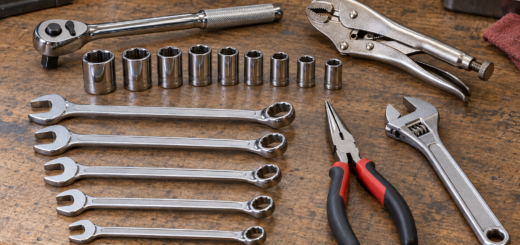
Start with tools that let you measure, hold, cut, drill, and fasten. A 16-foot tape measure, combination square, utility knife, pencils, level, and a set of screwdrivers are inexpensive but used constantly. Add a pair of locking pliers, slip-joint pliers, diagonal cutters, an adjustable wrench, and a claw hammer.
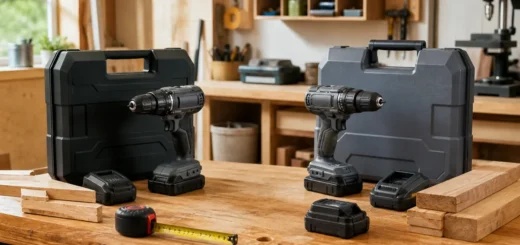
For most garages, a cordless drill is the first powered tool worth buying. An 18V or 20V drill/driver with a two-speed gearbox handles pilot holes, screws, light sanding, and assembling benches. A compact drill is easier to control, while a heavier model is better for long holes and masonry bits. If you already own batteries in a cordless platform, stay with that brand unless its tools are poor value; batteries and chargers are a major part of the long-term cost.
A basic cordless drill driver kit is usually a better first purchase than a bare tool. Look for two batteries, a charger, a belt hook, and a clutch with at least 15 settings. Very cheap kits may work for occasional assembly, but their batteries often lose useful runtime after a few years.
Budget Starter Tools Compared
| Tool | Budget price range | Spend more when | Cheap is fine when |
|---|---|---|---|
| Cordless drill kit | $70–$160 | You drill frequently or use large bits | You mainly assemble furniture and drill small holes |
| Random-orbit sander | $35–$90 | You sand hardwood or large surfaces | You do occasional paint preparation |
| Circular saw | $50–$140 | You cut sheet goods or framing lumber often | You make only a few rough cuts each year |
| Bench vise | $35–$120 | You bend, press, or hold metal | You only need light clamping |
| Shop vacuum | $60–$180 | You use sanders or generate fine dust | You mainly clean coarse chips and dirt |
Choose a Battery Platform Carefully
Battery platforms are where a low initial price can become expensive. A $90 drill kit may look cheaper than a $150 kit, but adding a second battery, charger, impact driver, and light can erase the difference. Compare the price of a bare drill, a replacement battery, and a charger before buying.
For occasional work, a budget consumer platform is usually adequate. For frequent construction, automotive repairs, or outdoor work, a midrange platform with a broad lineup and readily available batteries is safer. Brushless motors generally run cooler and provide longer runtime, but a brushed drill is not automatically a bad buy for light use. Do not pay extra for brushless technology if the tool will drill ten holes a month.
An impact driver is useful for long screws and stubborn fasteners, but it is not a replacement for a drill. It can split softwood, strip small screws, and over-tighten bolts. Buy one after the drill unless your work regularly involves deck screws, lag screws, or vehicle fasteners.
Hand Tools and Workholding
Do not buy a large socket set just because it contains hundreds of pieces. A compact 3/8-inch drive set with metric sockets from 8 to 19 mm, plus common SAE sizes if needed, covers many household and automotive jobs. Look for a ratchet with a fine tooth count and sockets that are clearly marked. A cheap set is acceptable for occasional repairs, but soft ratchets and poorly fitting sockets fail when a fastener is seized.
Workholding improves both results and safety. Two sturdy sawhorses and a sheet of 3/4-inch plywood make a useful temporary bench. A pair of 24-inch or 36-inch bar clamps is more versatile than a box of tiny clamps. A 6-inch bench vise is a worthwhile upgrade if it can be bolted securely to a bench. Avoid ultra-light vises with thin jaws; they flex when filing or bending metal.
Cutting, Sanding, and Dust Control
A circular saw is the cheapest practical way to break down plywood and lumber. Add a straightedge guide or clamp a level to the workpiece; freehand cuts are faster only until you ruin material. A budget saw is fine for rough framing, but check that the base stays square at 90 degrees and that the blade guard returns smoothly. A dull or warped blade causes more trouble than a modest motor.
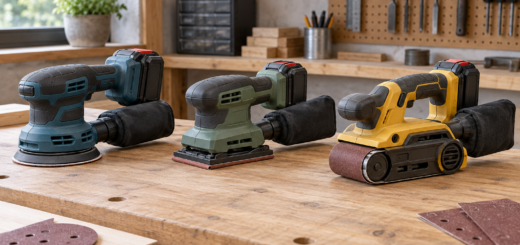
For a first sander, choose a 5-inch random-orbit model. It removes scratches more evenly than a sheet sander and is less likely to leave visible sanding patterns. Use 80-grit paper for material removal, 120 grit for general smoothing, and 180 to 220 grit before finish. Connect it to a wet-dry shop vacuum with a fine-dust filter. A vacuum without the right filter can simply blow fine dust back into the garage.
For occasional cutting, a corded jigsaw is often better value than a cordless one because it avoids battery costs. It handles plywood, plastic, and thin metal with the correct blade, but it is slow and less accurate than a circular saw on long straight cuts. Buy a reciprocating saw only if demolition, pruning, or cutting embedded nails is part of the plan.
Safety and When to Buy
Budget at least $50 for safety: impact-rated eye protection, hearing protection, a dust mask or properly fitted respirator, and a small fire extinguisher. Do not use ordinary shop glasses for grinding; sparks and fragments can enter from the sides. Keep cords, batteries, and oily rags away from heaters and welding equipment. Never remove a saw’s guard to make an awkward cut.
Seasonal sales are most useful when they reduce the cost of a complete kit. Cordless tools often see strong discounts around major holiday weekends, Father’s Day, and late November. Shop vacuums and storage go on sale during spring cleaning periods, while outdoor power tools are commonly discounted after summer. Compare the sale price with the cost of extra batteries and accessories, and avoid buying a tool merely because a bundle includes several items you will not use.
The lowest-cost workshop is not the one with the cheapest individual tools. It is the one that avoids duplicate batteries, disposable accessories, inaccurate measuring tools, and replacements caused by overloading. Buy a reliable drill, solid clamps, accurate measuring tools, and proper dust and eye protection first. Add specialty tools only when renting one repeatedly costs more than owning it.