Best Budget Tool Cabinet for a Compact Garage Workshop
What's inside
As an Amazon Associate I earn from qualifying purchases. This post may contain affiliate links at no extra cost to you.
A compact garage workshop needs storage that uses wall space well without blocking the car, workbench, or walking path. For most buyers on a budget, the best fit is a rolling cabinet about 26–30 inches wide, with a locking drawer bank and a top that can double as a temporary work surface. It will not hold every power tool, but it offers a better balance of footprint, access, and price than a tall, deep tool chest.
As an Amazon Associate we earn from qualifying purchases at no extra cost to you.



Start with the footprint
Measure the spot before shopping, including the room needed to open drawers. A cabinet listed as 28 inches wide may need another 18–22 inches in front for a drawer to extend and for you to stand comfortably. If it will sit beside a parked car, leave a buffer: doors and drawers compete for the same space.
Depth matters just as much. A 16–18-inch-deep cabinet can fit against a wall in a narrow garage; a 20-inch-deep unit may hold more but eat into the aisle. Check the cabinet’s assembled dimensions, not only the shipping-box size. Also measure garage-door tracks, wall outlets, and baseboard obstructions if the cabinet is going under a shelf.
Before picking a layout, sort tools into three groups: items used every week, heavy or bulky tools, and occasional-use gear. A compact cabinet works best for the first group. Large saws, compressors, and seasonal equipment may be better on a separate shelf or rack.
What to buy for the money
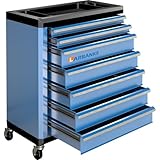
For a small shop, start by comparing 26-inch rolling tool cabinets. The useful budget range is often a basic steel cabinet with several drawers, ball-bearing slides, and locking casters. Pricing changes with sales and shipping, so compare the delivered cost rather than the headline price.
Thin-gauge cabinets can be perfectly adequate for hand tools and small cordless tools. They are less forgiving if overloaded, dragged over a rough floor, or used as a step. A sturdier cabinet costs more, but the extra metal and better drawer slides matter most when drawers carry sockets, wrenches, or other dense tools. Avoid treating a posted total weight capacity as a per-drawer rating; those are different limits.
If the budget is tight, a small steel tool chest on a bench can be a sensible alternative. It uses no floor area and is easy to move, but it does not provide a rolling work surface and can crowd a bench. Choose this format when you already have a sturdy bench and need organized storage more than mobility.
Compare cabinet types
| Type | Typical footprint | Best for | Main trade-off |
|---|---|---|---|
| Rolling cabinet | About 26–30 in. wide, 16–20 in. deep | Hand tools, cordless tools, mobile storage | Uses floor space; casters need a reasonably flat floor |
| Bench-top chest | About 20–26 in. wide | Small tools in a shop with an existing bench | Consumes bench area and offers no mobility |
| Tall cabinet | Often 18–24 in. wide and 18–24 in. deep | Long tools and gear that need vertical storage | Can be awkward to access and less stable if poorly loaded |
| Wall cabinet | Varies; little floor footprint | Light, frequently used items | Requires secure mounting into studs or masonry |
Do not buy a tall cabinet just because it claims more storage. High shelves are inconvenient for heavy items, and a narrow freestanding unit can tip if drawers are opened while it is unevenly loaded. If you choose one, follow its anchoring instructions and put heavy gear low.
Features worth paying for
Drawer slides are the first feature to test. A loaded drawer should move smoothly without binding or dropping at the front. Ball-bearing slides are generally preferable for drawers holding heavy metal tools, but their quality varies. If you can inspect a cabinet in person, open every drawer, check for side-to-side play, and look for sharp edges or drawers that sit crooked.
Locking casters are useful for moving a cabinet across a workshop, not for hauling it across gravel or a broken driveway. Small wheels can snag on floor joints, and thin casters may bend under a heavy load. Check caster diameter and the manufacturer’s total load limit. If the cabinet will stay in one spot, locking wheels are still convenient, but they are not a substitute for a stable, level floor.
A wood or composite top is handy for sorting parts and setting down a drill. It is not automatically a reliable workbench: budget cabinet tops may flex, and the cabinet can roll under pressure. For vise work or hammering, bolt the cabinet in place if its design permits, or use a separate bench. Drawer liners are inexpensive and help stop tools sliding around; heavy-duty liners are not necessary for most home shops.
Avoid budget-buying mistakes
Check whether the price includes delivery to your door. A heavy cabinet can incur a substantial freight charge, and some sellers deliver only to the curb. Read the return policy before ordering: assembling or repacking a dented steel cabinet is a nuisance, and return freight can wipe out a bargain.
Inspect the cabinet when it arrives, before loading it. Look at corners, drawer alignment, caster plates, and the lock. A small cosmetic dent may be harmless; a bent frame can make drawers stick and often is not worth keeping. Keep the packaging until you have checked every drawer and wheel.
Load dense tools into the bottom drawers and avoid filling one drawer to its limit. Overloading can pull slides out of alignment, make the cabinet tip when opened, or leave wheels carrying too much weight. If a drawer starts to sag or bind, move some weight before forcing it. Also check drawer depth against your tools: a cabinet can have many drawers yet still be too shallow for a long ratchet or bulky drill.
When to buy
Compare prices during major holiday sales and end-of-season promotions, but do not assume a marked-down cabinet is a good deal. Track the delivered price for a few weeks and compare the same width, slide type, and capacity. A cheaper unit with weak casters or no locking drawers may cost more in frustration than a modestly better cabinet.
For occasional DIY work, a basic steel cabinet is fine if it fits the space and you keep the load reasonable. Spend extra only for a real need: heavier tools, frequent movement, better slides, or a cabinet that will serve as daily-use storage. In a compact garage, a well-measured 26–30-inch rolling unit usually beats a larger chest that blocks the aisle.