Best Budget Tool Backpack for Mobile Maintenance Work
What's inside
As an Amazon Associate I earn from qualifying purchases. This post may contain affiliate links at no extra cost to you.
A good tool backpack for mobile maintenance work does not need to be expensive. It needs to carry the tools you actually use, survive being set down on concrete, and keep small parts from disappearing into one deep compartment. For most building maintenance, facilities, appliance, and light service work, a sensible budget is $50 to $100. Below that, you can find workable bags, but zippers, stitching, and shoulder straps become more of a gamble.
As an Amazon Associate we earn from qualifying purchases at no extra cost to you.


What matters in a budget tool backpack
Start with capacity. A 20- to 25-liter backpack is usually enough for a multimeter, pliers, screwdrivers, nut drivers, a compact drill, bits, fasteners, gloves, and a small flashlight. A 30-liter bag gives you room for a hammer, electrical tester, charger, and spare parts, but it also becomes easier to overfill. An overloaded backpack is harder on your shoulders than a heavier open tool bag because the weight sits higher and pulls backward.
Look for a molded or reinforced base that keeps the bag upright and protects tools from wet floors. A fabric bottom is acceptable for indoor work, but it will eventually absorb water and grit. The most common budget failure is not a torn body; it is a zipper that separates after being forced around an overstuffed compartment. Leave roughly 10 percent of the main compartment empty so the zipper closes without strain.
Tool organization is more important than a long feature list. A bag with 20 to 30 usable pockets is often better than one advertising 50 pockets that are too narrow for modern handles. Check pocket depth before buying. Screwdriver pockets should hold at least 6-inch shafts without the handles sitting above the bag’s rim, while deep pockets are useful for pliers and electrical testers.
The best budget backpack types
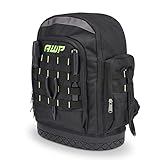
For general maintenance, choose a structured backpack with a wide opening, a hard or semi-rigid base, and separate storage for a drill or battery. This is the best all-around format if you move between rooms, climb stairs, or need both hands free. A typical budget tool backpack with a hard bottom costs about $50 to $90.
If your work is mostly electrical or low-voltage service, a smaller soft-sided backpack can be the better value. It weighs less, carries testers and hand tools efficiently, and is easier to fit in a vehicle. It is not the right choice for carrying heavy cordless tools or sharp metal parts without additional cases.
For HVAC, appliance, or mixed mechanical work, consider a larger 30-liter backpack or a backpack with a removable tool panel. These designs handle bulky meters, inspection cameras, adapters, and spare fittings better. The trade-off is weight: once loaded with a drill, batteries, and hand tools, a large pack can exceed 25 pounds quickly.
| Backpack type | Typical price | Best use | Main compromise |
|---|---|---|---|
| Soft-sided compact | $30–$55 | Light electrical and inspection work | Less protection and fewer load-bearing features |
| Structured 20–25 liter | $50–$100 | General building maintenance | Can become uncomfortable when overloaded |
| Large 28–35 liter | $75–$140 | HVAC, appliance, and mixed mechanical service | Heavier and easier to overpack |
| Premium molded-base pack | $130 and up | Daily professional use and rough sites | Higher price; unnecessary for occasional work |
Brand value and where to spend money
Established tool brands generally charge more for stronger stitching, better foam, and replacement availability. Their mid-priced backpacks can make sense for technicians carrying tools every day, especially when the bag is opened and closed dozens of times per shift. However, a recognizable logo does not guarantee better organization. Some brand-name bags have shallow pockets or a narrow opening that makes the lower compartment difficult to reach.
Generic backpacks are often fine for occasional maintenance, property inspections, and a second vehicle kit. A $40 to $60 bag can provide good value if it has reinforced shoulder-strap anchors, a waterproof base, and a reliable zipper. The failure risk is higher, so inspect it immediately. Pull firmly on each strap, load it with 15 to 20 pounds, and check whether the seams gape. Return it if the zipper catches on the fabric or the base flexes heavily.
For a daily-use bag, spending an extra $30 to $60 is usually more sensible than replacing a cheap backpack twice. Prioritize the shoulder harness and base before extras such as USB charging ports, bright trim, or a built-in tape measure clip. If you need a backpack that can tolerate wet sites and repeated drops, compare professional waterproof tool backpacks rather than the lowest-priced listings.
How to pack it without making it miserable
Put the heaviest items against your back and near the bottom: batteries, a compact drill, and dense metal tools. Keep frequently used screwdrivers, pliers, and a meter in the front or upper pockets. Store bits, wire nuts, screws, and fuses in small labeled cases instead of loose pockets. Loose hardware migrates to the bottom and can jam zippers.
Use a separate pouch for dirty or sharp tools. A utility knife left blade-down in a soft pocket can cut the lining and eventually damage the main compartment. Keep batteries in their cases or cover exposed terminals; a loose battery contacting metal tools can short, heat up, and become a fire risk.
Do not use the backpack as a substitute for a ladder or step. Even a reinforced base can crack when the loaded bag is dropped from shoulder height. Set it down rather than throwing it, and wipe grit from the zipper at the end of the week. A small brush and occasional zipper lubricant can add months of service.
When to buy and when cheap is enough
Tool backpacks are commonly discounted during spring hardware promotions, Father’s Day sales, and the November holiday period. Compare the actual price over several weeks; a large percentage discount on a permanently inflated list price is not a bargain. Look for free returns, since comfort and pocket layout cannot be judged reliably from photos.
Choose the cheaper option when you carry fewer than 15 hand tools, work indoors, and use the bag once or twice a week. Move up to a structured or premium pack when you carry power-tool batteries daily, work outdoors, or depend on the bag for every service call. In those conditions, better straps, a stable base, and durable zippers are practical equipment—not cosmetic upgrades.
If you need a low-cost starting point, search for small electrician tool backpacks and compare dimensions, not just pocket counts. For a larger mixed kit, large HVAC and maintenance tool backpacks are worth considering, but only if you can keep the loaded weight under control.