Best Budget Router Table for Occasional Woodworking Projects
What's inside
As an Amazon Associate I earn from qualifying purchases. This post may contain affiliate links at no extra cost to you.
Who needs a router table?
A router table holds a handheld router upside down under a flat top, so you guide the workpiece past the bit. It is handy for repeatable edge profiles, small parts that are awkward to hold against a router base, and grooves that need a consistent fence setting. For occasional work—rounding over shelves, making a few cabinet doors, or cutting a short run of trim—a basic table can be a sensible buy.
It is not essential for every router job. If you mainly round edges on large panels, a handheld router with an edge guide may be cheaper and easier to store. A table earns its space when you need repeatability or better control over small stock. It does not turn an underpowered router into a production machine, and it is not a substitute for safe workholding.
As an Amazon Associate we earn from qualifying purchases at no extra cost to you.


What to look for on a budget
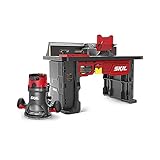
Start with the router you already own. Check its base diameter, mounting-hole pattern, and whether the table accepts that brand or includes an adapter plate. A table that does not fit your router is a poor bargain, even if the top and fence look substantial. If you are buying both pieces, compare the combined price of a table and a compatible fixed-base router against a router-table package.
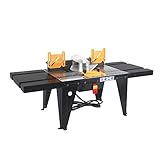
For occasional projects, prioritize a flat, stable top, a fence that locks square, and a throat opening that accepts the bits you expect to use. A small benchtop table is easier to store, but its limited work surface can make long boards harder to control. A larger top is more supportive, though it costs more and takes up space. The fence should have adjustable faces that can close around a bit; a wide gap leaves less support close to the cut.
Check how the table attaches to a bench. Clamps are convenient, but a light table that shifts during a cut is frustrating and potentially unsafe. Some inexpensive tables have plastic tops or thin fences. These can work for light routing if they stay flat and locked, but they are less forgiving of rough handling and long, heavy workpieces. Look for replacement throat plates and compatible inserts before buying if you expect to use several bit sizes.
Budget setups compared
| Setup | Best for | Main trade-off |
|---|---|---|
| Compact benchtop table | Occasional edge work and small parts | Limited support for long boards; check clamping stability |
| Table with a separate router | Matching a table to a router you already own | Fit and mounting compatibility require checking |
| Basic DIY insert and bench top | Woodworkers who have a sturdy bench and basic tools | More setup work; flatness and guarding are your responsibility |
| Full-size cabinet-style table | Frequent use and larger workpieces | Higher cost and much less convenient storage |
For a first purchase, a compact benchtop router table is usually the simplest route if it fits your router and can be secured firmly. If you already own a compatible router, a router-table insert or plate can be a lower-cost alternative for a homemade setup, but only if you can cut and support a flat opening accurately.
Where cheap tables save—and cost—money
Budget tables save money through smaller tops, simpler fences, and fewer adjustment features. That is fine for a few short cuts at a time. It becomes a problem when the fence bows, the table rocks, or the workpiece loses support before the bit has finished cutting. Those issues can spoil an edge or pull the stock off line. Check the top with a straightedge and test the fence lock before putting a valuable board on the table.
Do not judge value by accessories alone. A miter gauge may be included, but a loose-fitting gauge can be less useful than a simple shop-made sled. A featherboard can help keep stock against the fence, but it must not force the workpiece into the bit in a way that causes binding. A dust port is helpful, though small routers and open tables still tend to leave chips around the work area.
If your router is not included, a corded fixed-base router is often a straightforward choice for a basic table setup. Confirm that it can be mounted securely and that bit changes are practical from above or below. A lift makes height adjustment easier, but it can cost more than the table itself; occasional users can adjust from underneath if the design allows it.
Setup, safety, and common failures
Before routing, unplug the tool while changing bits or adjusting the fence. Check that the bit is fully seated according to the router manual, the collet is tight, and the workpiece is free of nails or loose knots. Use eye and hearing protection, connect dust collection if available, and keep hands away from the bit. For small parts, use a push block or a purpose-made holding jig instead of trying to pinch the piece close to the cutter.
Feed direction matters: on a typical table setup, move stock against the bit’s rotation so the cutter pulls it into the fence rather than grabbing it and driving it forward. Avoid climb cuts, which can snatch the workpiece from your hands. Make deeper profiles in multiple shallow passes instead of trying to remove the full depth at once. A heavy cut can bog down a modest router, leave a rough edge, or cause the stock to kick back.
Common warning signs include a fence that moves under pressure, a table that lifts from the bench, a bit that vibrates, or a burning smell. Stop and correct the cause rather than pushing through. Burning can come from a dull or dirty bit, slow feed, or too deep a cut; a loose setup can make the cut unsafe. Also inspect the fence faces for gaps and keep the bit opening as small as practical for the cutter in use.
When to buy
Router tables often see discounts during major holiday sales and broader tool promotions, but a lower sticker price matters only if the table fits your router and has the features your work needs. Compare the current price with the cost of a compatible router, mounting plate, and any clamps or inserts you will need. If the table is for one short project, borrowing one or using a handheld router may cost less overall.
Choose a compact table for occasional, light work if it clamps securely and supports your typical stock. Spend more when you regularly route long boards, need frequent height changes, or want a heavier, flatter platform that stays put. For a once-in-a-while round-over or groove, the cheaper option is fine—provided it is compatible, stable, and used with sensible feed passes and workholding.