Best Budget Mechanics Tool Set for a First Home Garage
What's inside
As an Amazon Associate I earn from qualifying purchases. This post may contain affiliate links at no extra cost to you.
What a first garage set needs
A useful starter set handles routine jobs such as changing a battery, removing a mower blade, working on a bike, and doing basic car maintenance. For those jobs, prioritize a complete range of common metric sockets, a ratchet, a few extensions, and combination wrenches over a huge piece count padded with bits you may never use.
For a first set, look for 1/4-inch and 3/8-inch drive sockets, roughly 8–19 mm in metric, plus a 1/2-inch drive if you expect to work on lug nuts or suspension hardware. A practical kit should include both shallow and deep sockets in the smaller drives, a 3/8-inch extension, and a spark-plug socket if you plan to service engines. Check whether the listed sizes are metric, SAE, or both: a large count does not help if it omits the sizes your equipment uses.
As an Amazon Associate we earn from qualifying purchases at no extra cost to you.
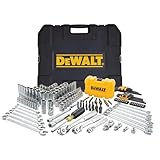


A metric mechanics tool set with 3/8-inch drive is a sensible starting point for many home garages. If you work on older American vehicles, confirm whether SAE sizes are included before buying.
What to pay for—and what to skip
Budget sets often make their savings in the case, the number of accessories, and the finish on the tools. Those compromises are not automatically a problem. A ratchet with a little more handle play can still be fine for occasional work; a socket that rounds a fastener or splits under ordinary hand pressure is not.
Look for clear size markings, sockets that stay attached to the ratchet, and a case that keeps the pieces in place when stored upright. Read the return policy and inspect the set when it arrives. Check each socket against a fastener you own, and operate the ratchet in both directions. If the selector slips or the socket fit is visibly loose, return the set rather than finding out under load.
Do not use a standard chrome socket with an impact wrench. Impact tools need impact-rated sockets, which are usually darker and thicker. Likewise, a long breaker bar is the better tool for stubborn bolts; using a small ratchet as a cheater-bar extension can damage the mechanism. For high-torque or safety-critical work, use a torque wrench and follow the vehicle or equipment specifications.
Budget set comparison
| Option | Typical price range | Best for | Main trade-off |
|---|---|---|---|
| Compact 3/8-inch metric set | $25–$50 | Small repairs, bikes, appliances, basic car work | Usually lacks large sockets and a 1/2-inch drive |
| Mixed-drive mechanics set | $50–$100 | One-box starting kit for a home garage | May include filler bits or duplicate sizes |
| Large-piece-count set | $80–$150 | Buyers who need both metric and SAE coverage | More pieces do not necessarily mean better ratchets |
| Separate impact socket set | $25–$60 | Use with an impact wrench for wheel or suspension work | Does not replace a complete hand-tool set |
These are broad U.S. street-price ranges, not fixed prices; promotions and piece counts vary. Compare the included socket sizes and drives, not just the headline count. A smaller set with a useful 3/8-inch ratchet and well-marked sockets can be better value than a larger assortment whose extra pieces are mostly screwdriver bits.
Brand value and sensible upgrades
At the budget end, brand names can be less informative than warranty terms, replacement availability, and the exact contents of the kit. A lifetime hand-tool warranty is useful only if it is straightforward to make a claim and the size you break can be replaced. Save the receipt and packaging details until you have checked the kit, and verify the current warranty before purchase; policies can differ by product line and seller.
For occasional household work, an inexpensive set from a retailer with a decent return policy may be enough. If you expect weekly automotive use, frequent ratchet use, or repairs where tool failure could damage an expensive part, spending more on a better ratchet or buying a stronger ratchet separately can make sense. Keep the original sockets if they fit accurately; upgrade the part that wears or disappoints instead of replacing everything.
A metric 1/2-inch impact socket set is a useful addition if you already own an impact wrench. For occasional wheel changes with a hand tool, a breaker bar and the correct socket are usually a more economical first purchase.
When to buy, and a final checklist
Tool sets are often discounted around major holiday promotions, Black Friday, and Father’s Day, but a sale is only worthwhile if the kit suits your needs. Compare the current price with the same set’s recent prices where possible, and check whether a cheaper listing comes from an authorized or reputable seller. Avoid paying extra for a dramatic piece count if the set lacks deep sockets, extensions, or the drive size you need.
Before checkout, ask: Does it include the sizes used on my car or equipment? Are the sockets 6-point or 12-point? Does the case have labeled slots? Is there a return window and a usable warranty? For stubborn or rusted fasteners, a 6-point socket is generally less likely to slip on the flats than a 12-point one, though access and fastener shape can affect the choice.
If you are starting from nothing, buy a solid basic set first, then add tools based on actual jobs: pliers, screwdrivers, a torque wrench, or impact sockets. A metric-and-SAE mechanics set for a home garage can be worthwhile when you regularly work on mixed equipment, but it is unnecessary if nearly everything you maintain uses one measurement system.