Best Value Drill Press for Accurate Holes in Wood and Metal
What's inside
As an Amazon Associate I earn from qualifying purchases. This post may contain affiliate links at no extra cost to you.
A drill press earns its keep when a handheld drill cannot hold a consistent angle, depth, or hole position. For most home shops, the best value is not the cheapest machine. It is a compact benchtop press with a rigid column, a useful speed range, and enough throat depth for the parts you actually make.
Expect to spend roughly $150 to $300 for a capable benchtop drill press, and $400 or more for a heavier machine with better fit and finish. The low-cost option is fine for occasional shelf brackets, hinges, dowels, and light metalwork. It becomes frustrating when you need repeatable hole locations, large bits, or low-speed drilling in steel.
As an Amazon Associate we earn from qualifying purchases at no extra cost to you.
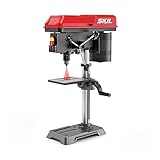
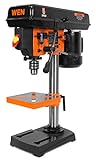

What Makes a Drill Press Good Value?
Start with rigidity rather than motor horsepower. A flexible column or loose quill lets the bit wander, especially with larger bits. Look for a cast-iron table and base, a quill with minimal side play, and a column that is at least reasonably thick for the machine’s size. A press that weighs 70 to 100 pounds is generally more stable than an ultralight model, although weight alone does not guarantee accuracy.
Key specifications deserve practical interpretation:
- Swing: A 10-inch press can drill roughly 5 inches from the edge of a workpiece to the center of the bit. That is enough for most small woodworking and repair jobs.
- Spindle travel: About 2 to 3 inches is useful for general work. Less travel may require repositioning the table or workpiece.
- Speed range: Five or more belt speeds are preferable. Wood tolerates higher speeds; steel generally needs lower speeds.
- Chuck capacity: A 1/2-inch chuck accepts common twist drills and many woodworking accessories. A 5/8-inch chuck is useful but not essential for most owners.
- Table adjustment: A table that tilts and rotates is convenient, but a solid, square table is more valuable than a complicated table that slips.
A laser guide is a convenience, not an accuracy system. It can help locate the approximate center of a hole, but it does not correct for a loose chuck, a bent bit, or a table that is not square. A depth stop and a reliable quill scale are more useful for repeat work.
Best-Value Drill Press Categories
| Category | Typical price | Best for | Main compromise |
|---|---|---|---|
| Compact benchtop, 8 to 10 inches | $120–$220 | Wood, plastics, small metal parts | Limited throat depth and lighter construction |
| Mid-size benchtop, 10 to 12 inches | $200–$350 | General home-shop work | Often needs a stand or sturdy bench |
| Floor-standing, 13 to 15 inches | $400–$800 | Larger stock and frequent metalwork | Higher cost and substantial floor space |
| Radial-arm or specialty press | $500 and up | Deep reach and unusual setups | More adjustment points and more ways to lose alignment |
For most buyers, a 10-inch benchtop drill press is the value sweet spot. It is usually compact enough for a garage bench but has more usable capacity than the smallest presses. Choose an 8-inch model only when storage space and price matter more than reach.
Using a Drill Press in Wood
In wood, accuracy depends on supporting the work and controlling tear-out. Clamp the stock to the table whenever possible. A fence helps with repeated holes, while a sacrificial board beneath the workpiece reduces blowout as the bit exits. Forstner bits produce clean, flat-bottomed holes, but they create considerable resistance; use a lower speed for larger diameters and feed steadily rather than forcing the lever.
A typical benchtop press handles twist bits and brad-point bits easily. Large Forstner bits expose the limitations of inexpensive machines. A 2-inch Forstner bit may stall a small motor if you run it too fast or push too aggressively. That is not necessarily a defect; it is a reason to use the correct pulley setting and let the bit cut at its own rate.
If you make rows of shelf-pin holes, check that the quill returns to the same position and that the table does not shift under pressure. A simple stop block and a quality drill-bit guide can sometimes produce more consistent results than paying extra for a laser.
Using a Drill Press in Metal
Metalworking places greater demands on speed control and rigidity. Steel should usually be drilled at much lower speed than wood, often several hundred revolutions per minute for larger bits. Use cutting fluid, a sharp bit, and firm clamping. Never hold a metal workpiece by hand when a bit can catch it and spin it around the column.
The cheapest presses often have a top speed that is acceptable for wood but a bottom speed around 600 to 800 rpm. That is too fast for many larger holes in steel. A press with a low setting near 200 to 300 rpm is more versatile. Variable-speed electronic controls are convenient, but a pulley-driven machine can deliver strong low-speed performance for less money.
For occasional holes in thin aluminum, mild steel, or angle iron, a budget benchtop press is usually adequate. For repeated work in thick plate, stainless steel, or large diameters, buy the heaviest rigid machine your space and budget allow. A 12-inch benchtop drill press for metal offers a useful step up without requiring a full-size floor model.
Where Cheap Presses Fail
The common failure is not that the motor burns out immediately. It is accumulated slop. A loose quill, poorly seated chuck, or table that moves when clamped can turn a nominally accurate press into a hole-making machine with inconsistent results. Belts may also vibrate, and inexpensive depth stops can slip during a long drilling session.
Before buying, read owner reports for chuck runout, table movement, and replacement belts—not just motor power. If possible, test the quill with the power disconnected: lower it, hold the chuck carefully, and check for noticeable side-to-side movement. A small amount of visible movement under light hand pressure is a warning sign.
Replacing a cheap chuck can improve performance, but it may cost $40 to $100 and does not fix a flexible column or loose quill bearings. That is why a slightly more expensive machine from a tool-focused brand can be better value than the lowest advertised price.
When to Buy and What to Budget
Drill presses are commonly discounted around major holiday sales, late spring garage-shop promotions, and end-of-year inventory clearances. Compare the sale price with the machine’s normal price; a large “discount” is not useful if the same model is frequently marked down. Also price the stand, shipping, chuck key, clamps, and a basic bit set. A $180 press can become a $260 setup before it reaches the bench.
For a first machine, budget $200 to $300 for a mid-size benchtop press and another $30 to $75 for hold-down clamps and suitable bits. If you mostly drill wood and only occasionally drill small metal, the cheaper 8-inch benchtop drill press is a sensible purchase. If you regularly drill steel or need repeatable production-like accuracy, spend more on low-speed control and rigidity rather than decorative features.