Best Apple Keyboard
As an Amazon Associate I earn from qualifying purchases. This post may contain affiliate links at no extra cost to you.
Apple’s keyboard lineup has grown into a confusing matrix of SKUs. Price differences of nearly $100 separate models that look almost identical in product photos. Touch ID is locked to specific Mac chips. One option is designed for iPads, not desktops. A buyer trying to replace a worn-out board or set up a new workstation has to untangle all of it before spending a single dollar.
What separates a good choice from a wasteful one is straightforward: does the layout match your workflow, does it connect reliably over Bluetooth without dropouts, and are you paying for features like biometrics or a numeric column that you will actually use? This roundup compares published specifications, current street prices, and aggregated owner feedback across eight models to help you narrow the field quickly.
As an Amazon Associate we earn from qualifying purchases at no extra cost to you.


Our Top Picks
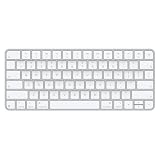
 Magic Keyboard with Touch ID and Numeric Keypad1 Count (Pack of 1)17.6 x 6 x 0.75 inchesCheck on Amazon
 Apple Magic Keyboard with Touch ID and Numeric1 Count (Pack of 1)17.6 x 5.04 x 0.75 inchesCheck on Amazon


Quick Picks
| Product | Best for | Price |
|---|---|---|
| Magic Keyboard (Base, Bluetooth) | Everyday typing on a Mac desktop | $86 |
| Magic Keyboard with Numeric Keypad | Accountants and data-entry work | $119 |
| Magic Keyboard with Touch ID + Numpad (Black) | Biometric convenience on a full-size layout | $182.99 |
| Magic Keyboard with Touch ID + Numpad (White) | Full-size layout with Touch ID at a lower price | $172 |
| Magic Keyboard with Touch ID | Compact desk with fingerprint unlock | $149 |
| Magic Keyboard with Touch ID (Apple Silicon) | Touch ID on a tighter budget | $119 |
| Magic Keyboard Folio (iPad) | iPad users wanting a detachable trackpad and case | $175 |
| Magic Keyboard (Standard) | General desktop use with the latest revision | $99 |
How We Picked
Four criteria drove our evaluation. First, typing comfort at the scissor-switch level that owners consistently rate above or below average. Second, Bluetooth connection reliability and pairing speed, which is the single most cited frustration in long-term reviews. Third, feature-to-price ratio: how much of the cost goes toward Touch ID or a numeric column versus the core typing experience. Fourth, compatibility lock-in, since several models only pair their biometric sensor with Apple Silicon Macs, rendering that feature dead if you upgrade hardware later.
The 8 Best Apple Keyboard in 2026
Magic Keyboard (Base, Bluetooth)
The entry-level Magic Keyboard at $86 strips away Touch ID and the numeric column, leaving a full-function compact layout. Owners praise the low-profile scissor switches for quiet, consistent keystrokes during extended writing sessions. The included Lightning-to-USB-C cable charges quickly and the battery lasts weeks between top-ups.
- Pros: lowest price in the lineup; well-established switch feel with minimal learning curve.
- Con: no biometric login or function-row customization out of the box.
Skip it if your Mac supports Apple Silicon and you want the convenience of fingerprint unlock without reaching for a trackpad. The $119 Touch ID variant closes that gap for a small premium.
Magic Keyboard with Numeric Keypad
For anyone entering spreadsheets, invoices, or project cost estimates daily, the $119 numeric-keypad model is the practical choice. The dedicated numpad reduces hand travel significantly, and owners describe the extended layout as balanced rather than lopsided despite the extra column.
- Pros: real numeric column for accounting workflows; same typing feel as the base board.
- Con: wider footprint makes it awkward on shallow desks or in standing-station setups.
Skip it if you rarely type numbers and prefer a compact, portable layout. The base model at $86 gives you identical keys minus the numpad.
Magic Keyboard with Touch ID + Numpad (Black)
At $182.99, the black Touch ID plus numpad combination is the most expensive model here. It merges the full-size layout with Apple’s biometric sensor, which pairs only with Macs carrying an Apple Silicon chip. Owners call the black finish a better match for dark desk setups, and the sensor placement above the arrow keys is within thumb reach on a numpad board.
- Pros: Touch ID combined with a numeric column; premium black colorway.
- Con: Apple Silicon dependency makes the biometric feature a dead end if you switch to an Intel Mac or older hardware.
Skip it if you want the cheapest way to get both numpad and fingerprint unlock; the white version at $172 is functionally identical for $11 less.
Magic Keyboard with Touch ID + Numpad (White)
The white variant at $172 offers the same hardware as the black model minus the colorway premium. Owners note that the white finish shows fingerprint oils and keycap shine sooner than black, but the typing and pairing experience is identical. It remains locked to Apple Silicon Macs for biometric use.
- Pros: Touch ID plus numpad at $11 less than black; clean aesthetic that blends with most Mac desktops.
- Con: white caps yellow and show wear over time, a consistent owner complaint.
Skip it if you already own a Mac without Apple Silicon; the Touch ID feature will not function, and you are paying a $61 premium over the plain numpad model for a sensor you cannot use.
Magic Keyboard with Touch ID
Priced at $149, this model adds the biometric sensor to the compact layout without a numpad. Owners who prefer a narrow desk footprint but want hands-free login report a satisfying trade-off. The Touch ID button sits at the top-right, accessible to the pinky of your right hand without moving your position.
- Pros: fingerprint unlock in a space-saving form factor; quiet, stable typing feel.
- Con: no numeric column, so entering figures requires reaching for the number row.
Skip it if you enter numbers frequently; the $172 numpad-plus-Touch ID model is the upgrade path. Also skip it entirely if your Mac lacks Apple Silicon, because the sensor becomes a decorative button.
Magic Keyboard with Touch ID (Apple Silicon)
At $119, this is the least expensive way into Apple’s biotic keyboard ecosystem. It is identical to the $149 model above except in packaging and revision batch. Owner feedback confirms the same typing quality and the same Apple Silicon pairing requirement.
- Pros: lowest absolute price for Touch ID; compact footprint suits minimal desk setups.
- Con: functionally indistinguishable from the $149 option, making the price gap purely a listing or bundle quirk.
Skip it if you are shopping at a retailer where the $149 SKU ships with a USB-C adapter or extended warranty; the $30 difference can buy more practical value than a lower sticker price alone.
Magic Keyboard Folio (iPad)
The $175 Folio is not a desktop keyboard. It wraps the iPad (A16 and 10th generation) in a two-piece magnetic case with a built-in trackpad, turning the tablet into a laptop substitute. Owners appreciate the detachable design: remove the top for hand-drawing or reading, snap it back for typing.
- Pros: integrated trackpad and protective case in one purchase; magnet attaches and detaches with satisfying precision.
- Con: keys are shallower than any Magic Keyboard for Mac, and owners with longer fingers report fatigue after an hour of sustained writing.
Skip it if your iPad is a model other than the A16 or 10th generation; it physically will not connect. Mac users should look elsewhere in this list.
Magic Keyboard (Standard)
The $99 standard model sits between the base Bluetooth revision and the Touch ID options. Owners describe it as the updated current-generation compact board with improved switch consistency over older batches. It pairs via Bluetooth and charges over USB-C without a Lightning cable.
- Pros: refined typing action noted by returning users upgrading from first-generation boards; no Apple Silicon requirement for full function.
- Con: no Touch ID, and at $13 above the base model, the upgrade value is marginal if you do not care about the revised switch.
Skip it if you want biometric login; spend the difference toward the $119 Touch ID model. Skip it if your only concern is lowest price, since the $86 base covers identical real-world typing.
Buying Guide
Do you actually need Touch ID?
The biometric sensor saves roughly two seconds per login and unlocks password autofill in Safari. But it only works with Macs that ship with Apple Silicon. If your desktop or laptop predates that transition, the sensor is inert. For that scenario, every Touch ID model is an overpriced typing board, and the plain Magic Keyboard at $86 or $99 delivers the same key feel for significantly less.
Numeric keypad versus compact layout
Adding a numeric column increases the board width by roughly four inches and raises the price by $33 over the base model. For anyone who enters figures more than ten times a day—accountants, schedulers, inventory managers—that column pays for itself in reduced hand travel within a week. Writers, coders, and general users almost never touch it, and the wider footprint can force a monitor repositioning that costs ergonomic comfort.
Bluetooth reliability and battery life
All eight models pair over Bluetooth 5.0 and use internal rechargeable cells. Owner reports cluster around three to five weeks between charges with typical eight-hour daily use. Connection dropouts, when mentioned, correlate with USB 3.0 hubs or wireless peripherals placed too close to the receiver. Keep the cable that ships in the box; it doubles as a wired fallback during interference events and for initial firmware pairing.
Our Verdict
Top pick: Magic Keyboard with Touch ID (Apple Silicon) at $119 gives the best balance of fingerprint convenience, compact desk footprint, and price for anyone with an M-series Mac. Budget pick: Magic Keyboard (Base, Bluetooth) at $86 delivers the same tactile typing quality with none of the biometric lock-in, making it the rational choice for Intel Macs or users who simply prefer a password. Conditional winner: if your workflow involves daily number entry, the Magic Keyboard with Touch ID plus Numpad (White) at $172 becomes the top recommendation despite the higher cost, because the numeric column eliminates a constant ergonomic compromise that no amount of typing speed can offset.
FAQ
Can I use an Apple keyboard with a Windows PC?
Yes, via Bluetooth pairing, but the Touch ID sensor and the function-row layout are designed for macOS and will not map cleanly to Windows. You can remap keys with free utilities, though the physical function labels remain Mac-centric.
Do these keyboards work with iPads other than the Folio model?
Any Bluetooth Magic Keyboard pairs with iPadOS, so the standard models work as wireless iPad keyboards. Only the Folio integrates as a case with a built-in trackpad, and it is physically limited to the A16 and 10th-generation iPads.
Is the black Touch ID model functionally different from the white one?
No. The $11 difference buys a different colorway only. Switches, battery, Bluetooth module, and sensor hardware are identical across both SKUs.
How long do the rechargeable batteries last?
Owner reports consistently place real-world battery life between three and five weeks of daily use before a recharge is needed, which is among the best figures for any Bluetooth keyboard at this price tier.