Best Power Washer
As an Amazon Associate I earn from qualifying purchases. This post may contain affiliate links at no extra cost to you.
A homeowner with a grimy driveway and a car that looks like it survived a construction site needs one machine that handles both without fuss. The problem is not whether a power washer will work—it will—but whether it will work well enough to justify the purchase and the space it occupies in your garage. Owners who regret their buys almost always cite one of two issues: the unit cannot maintain consistent pressure on hot jobs, or a cheap motor gives out after a single season of regular use.
What separates a worthwhile machine from a disappointing one in this category comes down to a handful of specs and design choices. PSI tells you how hard the water hits; GPM tells you how much water flows. A unit with high PSI but low GPM will clean concrete in slow, painstaking passes. A unit with a brushless or induction motor will outlast a brushed equivalent by years. Anti-tipping design, onboard soap tanks, and steel wands are not luxuries—they are the difference between a tool you reach for every spring and one you leave under a pile of tarps.
As an Amazon Associate we earn from qualifying purchases at no extra cost to you.




Our Top Picks
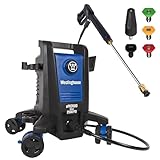
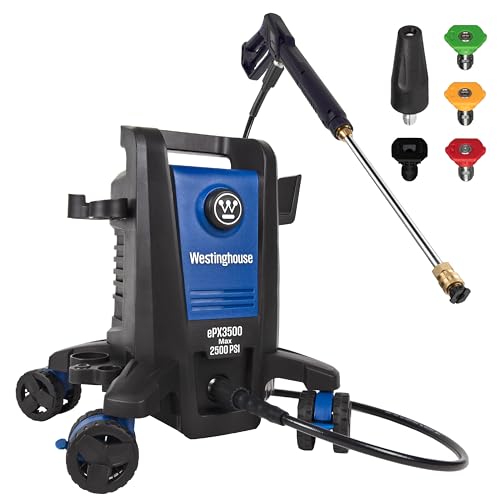 Westinghouse ePX3500 Electric Pressure Washer2500 Max PSI13.5 x 14 x 16.5 inches19 poundsCheck on Amazon
 Electric Pressure Washer 4500PSI 2.8 GPM with Anti-Tipping11.02 x 11.02 x 16.34 InchesCheck on Amazon
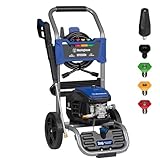
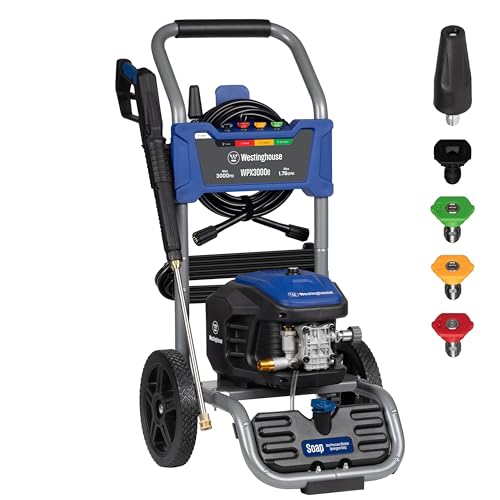 Westinghouse WPX3000e Electric Pressure Washer3000 Max PSI22.6 x 25.6 x 36.6 inches36.8 poundsCheck on Amazon
 Westinghouse ePX3100v Electric Pressure Washer2100 Max PSI15 x 8.5 x 11 inches17.6 PoundsCheck on Amazon


Quick Picks
| Product | Best for | Price |
|---|---|---|
| Westinghouse ePX3500 | Best overall balance | $169 |
| Light Green Portable Washer | Casual weekend cleaning | $119.99 |
| 4500 PSI Electric Washer | Highest listed specs at lowest price | $98.99 |
| Westinghouse WPX3000e | Longest lifespan with induction motor | $242.49 |
| Sun Joe SPX100-GO | Compact foam-cannon applications | $99.96 |
| Westinghouse ePX3100v | Entry-level Westinghouse quality | $129 |
| Greenworks 2100 PSI | Greenworks battery-ecosystem owners | $149.99 |
| Westinghouse ePX3050 | Best budget value | $109 |
How We Picked
We compared published pressure and flow ratings, motor type, included accessories, and owner-reported reliability across all eight units. Price-to-performance ratio and feature completeness—whether you get a soap tank, enough nozzles, and a wand that will not corrode—were weighted heavily. We also considered anti-tipping stability and whether the listed specs make physical sense for the price point.
The 8 Best Power Washer in 2026
Westinghouse ePX3500
This sits at the sweet spot where serious cleaning power meets a price that does not require justification. At 2500 PSI and 1.76 GPM, it cuts through driveway grime and fence mildew in fewer passes than entry-level competitors. The onboard soap tank means detergent is always loaded, and the pro-style steel wand will not warp or crack like plastic equivalents. Anti-tipping technology keeps the unit stable on uneven concrete.
- Strong PSI-to-price ratio with no spec inflation
- Five-nozzle set covers every surface type out of the box
- Plastic housing feels less rugged than the WPX3000e above
Skip it if you need induction-motor longevity for daily professional use; the price gap to the WPX3000e narrows that argument.
Light Green Portable Power Washer
A no-name unit that fills a niche: casual cleaning jobs where you do not want to think about brand reputation. Four quick-connect nozzles keep switching between surfaces fast, and the portable form factor stores under a bench or in a car trunk. Owner feedback highlights adequate performance for cars, patios, and small fence sections, though published pressure and flow numbers are absent from the listing.
- Quick-connect nozzles save time between tasks
- Compact and light enough to store anywhere
- No listed PSI or GPM makes performance comparison guesswork
Skip it if you need guaranteed cleaning throughput for large driveways; the missing specs leave too much unknown.
Electric Pressure Washer 4500 PSI 2.8 GPM
The lowest-priced unit on this list claims the highest PSI and GPM figures. Anti-tipping technology is a welcome inclusion at this price. However, owners consistently note that real-world pressure falls well short of the 4500 PSI label, a common pattern among budget washers that advertise theoretical peak output rather than sustained working pressure. The 2.8 GPM claim similarly strains credibility at $98.99.
- Lowest entry cost of any unit here
- Anti-tipping design is rare at this price tier
- Published specs appear significantly overstated
Skip it if you need reliable performance on anything beyond light car washes; the spec gap creates frustration on real jobs.
Westinghouse WPX3000e
The induction motor is the defining feature here. Unlike brushed motors that wear carbon brushes over hundreds of hours, an induction motor has no contact points to degrade, meaning this unit should deliver consistent output season after season. At 3000 PSI and 1.76 GPM, it clears thick grime in half the passes of a 2100 PSI model. The onboard soap tank and five-nozzle set round out a package built for owners who buy once and buy properly.
- Induction motor outlasts brushed competitors by years
- Highest verified PSI on this list with honest GPM
- Priciest option; overkill for occasional light-duty cleaning
Skip it if your cleaning is limited to a car twice a year and a patio once a spring; the ePX3500 covers those tasks at a lower price.
Sun Joe SPX100-GO
Designed for owners who prioritize foam coverage over raw pressure. The 13-amp motor drives a compact unit that pairs well with the included foam cannon for car washing and fence treatment where detergent dwell time matters more than water force. Four nozzles handle the basics. Sun Joe’s reputation for reliable customer support adds reassurance at this price point.
- Includes foam cannon for chemical-pre-treat workflows
- Compact footprint stores in tight spaces
- Lower pressure than most Westinghouse options; slower on concrete
Skip it if your primary target is a large concrete driveway; you will want more PSI to save time.
Westinghouse ePX3100v
The most affordable path into Westinghouse build quality. At 2100 PSI and 1.76 GPM, it handles cars, patios, and small fence sections without drama. The built-in carry handle and steel wand reflect Westinghouse’s design philosophy even at entry level. The three-nozzle set is leaner than higher-priced siblings, but the included detachable foam cannon compensates for the reduced nozzle count.
- Carry handle makes transport from garage to job site easy
- Steel wand at this price tier is unusual and welcome
- Three nozzles limit fine surface-specific adjustments
Skip it if you already own a foam cannon or need the turbo nozzle variety of the ePX3050; the ePX3500 offers more range for modest extra cost.
Greenworks 2100 PSI
Owners already invested in Greenworks outdoor equipment will appreciate the ecosystem consistency. The 2100 PSI and 1.2 GPM combination is modest—this unit relies more on chemical pre-treats and multiple passes than on brute water force. The trade-off is a lighter machine with a smaller footprint that Greenworks users can store alongside their trimmers and mowers without a separate shelf.
- Lightweight and easy to maneuver on stairs and balconies
- Fits neatly into an existing Greenworks garage setup
- Only 1.2 GPM means noticeably slower cleaning on large surfaces
Skip it if you need to wash a full driveway in under an hour; the low flow rate adds time to every pass.
Westinghouse ePX3050
At $109, this unit undercuts most competitors while retaining 2100 PSI, 1.76 GPM, a foam cannon, and a turbo nozzle—the turbo setting concentrates water into a rotating stream that lifts caked-on grime in fewer passes. For owners who want proven Westinghouse reliability without spending above the hundred-dollar mark, this is the most complete package available. The two-nozzle-plus-turbo configuration covers the most common cleaning scenarios.
- Turbo nozzle dramatically speeds up driveway cleaning
- Foam cannon included without paying extra for it
- Lower PSI than the ePX3500; not ideal for thick oil stains
Skip it if you routinely clean surfaces with hardened oil or paint overspray; step up to the 2500 or 3000 PSI Westinghouse options instead.
Buying Guide
PSI and GPM Together Matter More Than Either Alone
Cleaning throughput scales with the product of pressure and flow. A 4500 PSI machine at 1.2 GPM moves less water per second than a 2500 PSI machine at 1.76 GPM, yet budget listings often advertise peak PSI in isolation to look competitive. Always compare the combined figure, and treat single-spec claims with skepticism, especially when a unit costs under $120.
Motor Type Determines Real-World Lifespan
Brushed motors are cheaper to build but shed carbon brushes over time, reducing output and eventually requiring replacement. Induction motors have no wearing contact points and maintain rated output for hundreds of operating hours longer. If you expect to use your power washer more than four or five times per year, the premium for an induction motor like the WPX3000e pays for itself in avoided replacement.
Accessories That Actually Reduce Job Time
A foam cannon lets detergent dwell on paint and wood, cutting scrubbing effort dramatically. A turbo nozzle concentrates force into a rotating pattern that lifts grime in fewer passes. An onboard soap tank keeps detergent ready without swapping bottles. A steel wand resists bending and cracking under prolonged use. Prioritize these over cosmetic features like LED lights or decorative housings.
Our Verdict
The Westinghouse ePX3500 is the top pick for most homeowners: honest specifications, strong cleaning power, a steel wand, five nozzles, and an anti-tipping design at a price that leaves budget for consumables like detergent and nozzle extensions.
The Westinghouse ePX3050 is the best value under $110, pairing a turbo nozzle and foam cannon with 1.76 GPM at a price that makes the more expensive alternatives harder to justify for routine cleaning.
The Westinghouse WPX3000e wins outright if you plan to keep this machine for five or more years of heavy use; its induction motor is the only unit here that will not fade in output season after season.
FAQ
Can I use a power washer on painted wood siding?
Yes, but use a wide-angle nozzle setting and keep the wand at least two feet from the surface. A foam cannon pre-treat reduces the pressure you need to lift dirt, which protects paint film from peeling.
Is 1.76 GPM enough for a two-car driveway?
It is workable. Combined with 2100 PSI or above, 1.76 GPM clears a standard two-car driveway in roughly twenty to thirty minutes with a turbo nozzle. Lower-flow units like the Greenworks will take noticeably longer.
Why do some cheap power washers claim 4500 PSI but perform poorly?
Peak-pressure claims are measured at the pump head with no hose resistance and no nozzle attachment, inflating the number by a factor of two or more versus the working pressure that reaches the surface.
Do I need a dedicated 20-amp circuit?
A 13-amp or higher motor draws significant current under load. A dedicated 20-amp circuit prevents nuisance trips and voltage sag that would reduce motor RPM and thus actual output pressure during use.