Ryobi vs Craftsman Power Tools: Which Budget-Friendly System Is Worth Building?
What's inside
As an Amazon Associate I earn from qualifying purchases. This post may contain affiliate links at no extra cost to you.
Ryobi and Craftsman both target homeowners and DIYers who want cordless tools without paying professional-tool prices. The better system depends less on the logo than on what you already own, which tools you need next, and whether you’ll use them often enough to notice differences in durability or performance.
For occasional repairs, yardwork, and weekend projects, either platform can make sense. Ryobi generally has the broader range of home-and-garden tools, while Craftsman offers a straightforward lineup for common workshop and construction jobs. Prices and bundles change frequently, so compare the bare-tool cost as well as the kit price before choosing.
As an Amazon Associate we earn from qualifying purchases at no extra cost to you.


Start with the battery platform
A cordless tool is only part of the purchase. Batteries and chargers are platform-specific, and adding tools within one system is usually cheaper than mixing brands. A starter kit with two batteries and a charger can be a good value if you need those items; it is poor value if you already have compatible batteries and will pay for duplicates.
Ryobi’s 18V ONE+ platform covers a particularly wide range of home, workshop, and outdoor tools. Craftsman’s V20 system handles the familiar core—drills, impact drivers, saws, sanders, and other jobsite tools—with some outdoor equipment as well. Neither battery platform is interchangeable with the other. Check compatibility on the tool listing: a battery from one brand will not fit the other without an adapter, and adapters can add bulk or create reliability issues.
If you already own several working batteries, that usually settles the comparison. A discounted bare tool in your existing system is often a better buy than a cheap kit that starts a second battery collection.
Ryobi vs Craftsman at a glance
| Factor | Ryobi | Craftsman |
|---|---|---|
| Best fit | Homeowners who want many tool and yard-care options on one platform | DIYers focused on common workshop and construction tools |
| Battery system | 18V ONE+ | V20 |
| Range | Broad selection across household, workshop, and outdoor categories | Solid core selection; check current availability for less-common tools |
| Typical value play | Promotional kits and broad platform expansion | Sale-priced kits and bare tools for common jobs |
| Main trade-off | Some tools are aimed at light or intermittent use, not sustained heavy work | Fewer options may be available in a specialty category you later want |
These are broad platform differences, not a guarantee that every Ryobi tool outperforms or underperforms its Craftsman counterpart. Compare the specific tool, battery included, warranty terms, and current price. A kit with a small battery can also feel less capable than the same tool paired with a higher-capacity pack.
Performance and durability: buy for the workload
For hanging shelves, assembling furniture, drilling occasional holes, or making a few cuts a month, entry-level cordless tools from either brand are usually adequate. The limitations show up under repeated heavy use: driving long structural screws, cutting thick stock all afternoon, or running a tool continuously. Expect more heat, slower work, and shorter battery life than with higher-priced professional systems.
That does not make a budget tool a bad buy. It means you should match the tool and battery to the job. A compact battery is convenient for a drill used overhead; a larger-capacity pack can be more practical for a circular saw or outdoor tool. If you use a saw for long cuts in thick lumber, a weak or undersized battery may bog down, and forcing the cut can overheat the tool or blade. Let the saw work, use a sharp blade suited to the material, and pause if the tool gets hot.
Durability depends on care as well as price. Keep batteries out of extreme heat, clear dust from vents, and avoid using a light-duty drill as a high-torque fastening tool. For a single deck or renovation, renting a heavy-duty tool—or buying a more robust model for that particular job—may cost less than upgrading an entire system you rarely use.
What to buy first
For most households, a drill/driver is the useful starting point. Add an impact driver if you regularly drive many screws or fasteners; it is less of a necessity for occasional furniture assembly. Compare Ryobi 18V drill kits and Craftsman V20 drill kits by checking the number and capacity of batteries, charger type, and whether the case is included.
Don’t pay extra for a large bundle just because it lists more tools. A five-tool kit can be a poor bargain if three tools will sit unused and the included batteries are too small for your main task. For a planned project, buy the tool that solves the immediate problem, then add to the platform when a real need comes up.
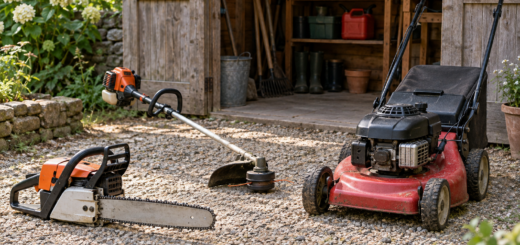
Homeowners who want cordless yard equipment as well as workshop tools should look closely at Ryobi 18V ONE+ outdoor tools. Confirm that the tool is designed for the workload: trimming a small lawn is different from clearing a large property, and runtime can be the limiting factor before cutting power is.
How to judge the deal
Compare like with like: tool, battery capacity, charger, and warranty. A bare tool priced at $79 is not cheaper than a $99 kit if you still need a battery and charger; conversely, a kit is not a bargain if its battery does not suit the tool. Write down what you need before shopping and compare the total cost of getting that setup working.
Seasonal sales can make either brand the better value. Watch for starter-kit discounts around major holiday promotions and spring, when retailers often feature outdoor equipment. Also check whether the sale is on a current platform tool or an older item with limited availability. Don’t assume the crossed-out list price reflects a normal selling price; compare several current listings and the recent price if you can.
Which system is worth building?
Choose Ryobi if you want a broad selection of homeowner-oriented tools and may expand into yard care, specialty tasks, or workshop projects. Choose Craftsman if its V20 kits and the particular tools you need are less expensive, and its available lineup covers your foreseeable work.
If both systems cost about the same for equivalent kits, decide based on the next three tools you are likely to buy—not on one drill sale. If your use is light, either brand is a sensible budget choice. If you expect daily professional use, frequent heavy cutting, or long stretches of high-torque work, compare higher-duty options before committing to a budget platform.