
Key takeaways
- Learn how to choose a first circular saw and the supporting workshop gear that helps a beginner make straight, clean, safe cuts with confidence.
What's inside
- Quick Answer
- POWERTEC 71358 Track Saw Guide Rail Connector Set for Festool, Makita, DeWalt
- Wooster Brush Q3211-2 Shortcut Angle Sash Paintbrush, 2-Inch
- Jeanerlor Cotton Tool Denim Work Apron with Convenient Pockets
- Nalgene 32 oz Wide Mouth Water Bottle
- 3 Pair Motorcycle Riding Glasses Padding Goggles
- How to Choose
- Who Should Skip
- FAQ
- Final Verdict
As an Amazon Associate I earn from qualifying purchases. This post may contain affiliate links at no extra cost to you.
A circular saw is often the first large power saw a home woodworker brings into the workshop. It can break down full sheets of plywood, trim boards to length, cut framing lumber, and handle many of the straight cuts that appear in shelves, workbenches, garden planters, and simple furniture. For a beginner, that range matters, because one capable saw can cover a wide set of early projects without a room full of specialised machines.
Learning to use a circular saw well is less about owning the most elaborate machine and more about building good habits around it. A guide rail helps keep long cuts true. Eye protection keeps sawdust and small chips away from the eyes. An apron keeps a pencil, a tape measure, and a square within easy reach. A brush helps finish raw cut edges so a project looks complete. This guide explains how to choose a first saw and looks at five pieces of supporting gear that help a beginner work with greater control and confidence.
As an Amazon Associate, we earn from qualifying purchases.
Quick Answer
Choose a light, easy-to-handle circular saw with a clear blade guard, a simple depth adjustment, and a bevel adjustment that locks firmly. Pair it with a guide rail or a straight edge for long cuts, wear eye protection, and keep the work firmly supported on both sides of the cut line. The five supporting items below help a beginner cut straighter, stay organised, and finish each project cleanly.
POWERTEC 71358 Track Saw Guide Rail Connector Set for Festool, Makita, DeWalt

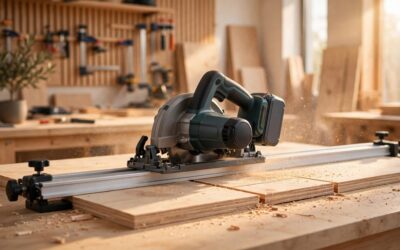
Long, straight cuts are among the hardest tasks for a beginner, because a small wobble at the beginning of a cut grows into a visible curve by the end of a long board. The POWERTEC 71358 Track Saw Guide Rail Connector Set for Festool, Makita, DeWalt helps by joining two shorter guide rails into one long, continuous rail, so a circular saw can travel along a fixed path from one end of a plywood sheet to the other. This connector set is not a circular saw itself, and it does not cut anything on its own. Its job is to hold guide rails in alignment so the saw base has a true edge to follow. When the rails are joined well and clamped to the work, the cut line stays where it was marked. The set suits people who plan to break down sheet goods for shelves, cabinets, and workbench tops.
Wooster Brush Q3211-2 Shortcut Angle Sash Paintbrush, 2-Inch

A clean cut deserves a clean finish, and the Wooster Brush Q3211-2 Shortcut Angle Sash Paintbrush, 2-Inch is a practical tool for that final part of a project. After a circular saw has shaped a board, the raw edge often needs a coat of paint, stain, or sealer to look finished and to hold up in daily use. The angled sash shape reaches into corners and along edges with control, while the two-inch width covers a board edge in a few smooth passes, and the short handle suits tight spaces such as the inside of a shelf unit. This brush is not a circular saw, and it plays no part in the cut itself. Its value appears after the saw work is done, when a beginner wants a project to look like a finished piece rather than a pile of cut boards.
Jeanerlor Cotton Tool Denim Work Apron with Convenient Pockets

A workshop apron may seem like a small detail, but it changes how smoothly a beginner moves through a project. The Jeanerlor Cotton Tool Denim Work Apron with Convenient Pockets gives a new woodworker a place to keep a pencil, a tape measure, a square, and a few screws close at hand. When those items are in a pocket rather than scattered across a bench, marking and measuring take less time, and there is less need to set a saw down and walk across the room in search of a tool. Denim holds up well to sawdust and glue, and it helps keep clothing clean. This apron is not a circular saw, and it does not improve a cut directly. Its benefit is organisation and protection, and a beginner who can reach a pencil at once is more likely to mark a cut line carefully, double-check a measurement, and pause before cutting.
Nalgene 32 oz Wide Mouth Water Bottle
Workshop sessions often run longer than planned, and a beginner who is focused on a cut can easily forget to drink. The Nalgene 32 oz Wide Mouth Water Bottle holds enough water for a long stretch of measuring, cutting, and assembly without frequent trips back to the kitchen. The wide mouth makes it easy to fill, easy to add ice on a warm day, and easy to clean after a dusty session. This bottle is not a circular saw, and it has nothing to do with the blade or the cut. Its role is simple: it keeps water within reach so a woodworker can stay comfortable and alert while learning a new skill. Keep it away from the cutting area, on a stable surface where it cannot be knocked into the work.
3 Pair Motorcycle Riding Glasses Padding Goggles

Eye protection is one of the most important habits a beginner can build, because a circular saw throws sawdust and small chips into the air with every cut. The 3 Pair Motorcycle Riding Glasses Padding Goggles offer padded eye protection that helps shield the eyes from that debris. The padding around the frame helps the glasses sit comfortably against the face and helps block dust that might otherwise drift in from the sides. Having three pairs means a spare can stay in the workshop and one can live in a tool bag. These goggles are not a circular saw, and they do not change how the saw cuts. Their job is to protect the eyes so a beginner can watch the cut line clearly and keep full attention on the work. Wear eye protection for every cut, even a short one, and keep the lenses clean so the line stays easy to see.
How to Choose
Blade size is a good place to begin. A common seven and one quarter inch saw handles plywood, framing lumber, and many general tasks, while a smaller saw may suit lighter work and feel easier to control for a person with smaller hands. Depth adjustment matters because the blade should extend only a little beyond the thickness of the board, which keeps the cut clean and the saw easier to manage. A bevel adjustment that locks firmly lets a beginner make angled cuts without the setting drifting during the cut.
Corded and cordless saws each have a place in a beginner workshop. A corded saw suits long sessions at a fixed bench, while a cordless saw offers freedom to move around a driveway or a job site without a cord to manage. Weight and balance deserve attention, because a saw that feels heavy at the handle will feel heavier still after several cuts. Check that the grip feels secure, the cut line is easy to see, and the blade guard moves smoothly and returns to cover the blade when the cut ends.
A guide rail is worth planning for at the same time as the saw, because it removes much of the guesswork from holding a line on long cuts. Check whether the saw works with a rail system or a clamped straight edge, and make sure the rail length suits the boards that will be cut most often. A sharp blade suited to the material also matters: a general purpose blade works for framing and plywood, while a fine tooth blade gives a cleaner edge on veneered sheet goods. Learn how to change a blade safely, and replace a dull blade rather than forcing it through the work.
Who Should Skip
A circular saw is a versatile tool, but it is not the right choice for every person or every project. Someone who only needs a few short, precise cuts in thin material may be better served by a hand saw or a smaller powered saw that offers finer control. A person who works mainly with curved shapes, detailed joinery, or very small parts will also find that a circular saw, which excels at straight cuts, is not the best match for that work.
A beginner who is not ready to learn safe handling should also pause before buying. A circular saw demands respect: the work must be supported, the cord or battery must be managed, the blade guard must be in place, and the hands must stay clear of the cutting path. If a person has limited space, no stable work surface, and no place to support a full sheet safely, it is wise to sort out the workspace first and practice with guidance before buying.
FAQ
What size circular saw should a beginner choose?
A seven and one quarter inch saw is a common first choice because it handles plywood and framing lumber with ease, and blades for that size are widely available. A smaller saw can feel lighter and easier to control, but it may struggle with thick boards. Match the size to the material cut most often.
Do beginners need a guide rail for straight cuts?
A guide rail is not required for every cut, but it helps a great deal with long cuts in sheet goods. A clamped straight edge can serve the same purpose for shorter cuts. Either option gives the saw a fixed edge to follow, which reduces wandering and improves the finished edge.
What safety gear should a beginner wear with a circular saw?
Eye protection is essential for every cut. A work apron keeps clothing and tools organised, and sturdy closed shoes protect the feet from dropped boards. Keep loose clothing and long hair away from the blade, and always let the blade come to a full stop before setting the saw down.
Can a circular saw cut plywood without splintering the edge?
Yes, with the right setup. Use a sharp fine tooth blade, mark the cut line clearly, and place the good face of the plywood down when the saw cuts from above. A guide rail helps keep the saw moving steadily, and a slow, even feed gives the blade time to cut cleanly rather than tearing the surface.
Final Verdict
A beginner does not need the most elaborate circular saw to do good work. A light, well balanced saw with clear adjustments, a sharp blade, and a guide rail will handle most early projects, from shelves to workbenches to garden builds. The supporting gear in this guide makes that learning process smoother: the connector set keeps long cuts true, the apron keeps tools at hand, the goggles protect the eyes, the brush finishes cut edges, and the bottle keeps water close during long sessions. Set up each cut with care, wear protection, and let steady habits build skill one project at a time.
Related guides
More from Amazon
Programs that pair well with the guide above. Offers and eligibility are set by Amazon and may change.
A free business account with business pricing and bulk-buying tools for work, shop or home office.
Create a business accountFree shipping on eligible items, Prime Video and more. Eligible new members can start with a free trial.
Start a Prime free trialAudiobooks and podcasts to listen to on the go. Eligible new members can start with a free trial.
Try Audible freeAd-free music streaming. Eligible new subscribers can start with a free trial.
Try Music Unlimited freeAs an Amazon Associate we earn from qualifying purchases.


Write Your Review
No reviews yet. Be the first to share your experience!