Best Cymbal Stands for Stability and Easy Setup
What's inside
- Quick picks by playing situation
- Straight, boom, or convertible: the head-to-head
- How to match a stand to cymbal size and weight
- Stability features that matter more than appearance
- Portability: calculate the real carrying cost
- Brands and product lines worth comparing
- Setup steps that prevent wobble
- Durability and maintenance realities
- Final buying recommendation
- Quick picks by playing situation
- Straight, boom, or convertible: the head-to-head
- How to match a stand to cymbal size and weight
- Stability features that matter more than appearance
- Portability: calculate the real carrying cost
- Brands and product lines worth comparing
- Setup steps that prevent wobble
- Durability and maintenance realities
- Final buying recommendation
As an Amazon Associate I earn from qualifying purchases. This post may contain affiliate links at no extra cost to you.
The best cymbal stands depend on your cymbal size, playing style, available space, and how often you move your kit: choose a straight stand for compact stability, a boom stand for positioning flexibility, or a convertible stand when you need both.
As an Amazon Associate we earn from qualifying purchases at no extra cost to you.

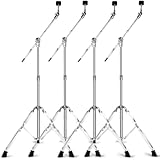


Quick picks by playing situation
| Drummer or setup | Best stand type | What to prioritize | Useful target specifications |
|---|---|---|---|
| Beginner, small kit, limited budget | Lightweight straight | Simple adjustment and low replacement cost | 2.0–3.0 kg, double-braced legs, 16–18 mm tubing |
| Frequent gigging or rehearsals | Convertible boom | Fast setup, compact folding, dependable memory locks | 2.5–4.0 kg, 600–1,300 mm height range |
| Large or heavy ride cymbal | Heavy-duty boom or straight | Wide footprint and thick tubing | 3.5–5.5 kg, 18–25 mm tubing, 1,000–1,400 mm height range |
| Small stage or crowded drum riser | Short straight or retractable boom | Small footprint and minimal reach | 450–1,000 mm height range, boom under 500 mm when extended |
| Multiple cymbals around one bass drum | Convertible boom with counterweight | Reach without tipping and independent angle control | Base footprint at least 500 mm, adjustable boom 300–600 mm |
Straight, boom, or convertible: the head-to-head
Straight cymbal stands
A straight stand places the cymbal directly above its tripod. That simple geometry gives it a stability advantage: there is little leverage pulling the stand sideways, even when the cymbal is relatively large. Straight stands also fold quickly and generally weigh less than comparable boom models.
Choose a straight stand when your cymbal positions are close to the kit, especially for a hi-hat-adjacent crash, splash, or small effects cymbal. They are also a sensible choice for beginners because there are fewer clamps to tighten and fewer parts to rattle loose.
The limitation is reach. If you need to place a crash over a tom, around a bass drum, or well to the drummer’s side, a straight stand may force you to spread the legs into an awkward position or place the cymbal too close to another piece of hardware.
Boom cymbal stands
A boom stand adds a horizontal arm, allowing the cymbal to sit away from the tripod. This makes it easier to position cymbals around deep toms, double-bass pedals, or a wide acoustic kit. A boom is usually the best choice for a drummer who values positioning more than minimum weight.
Its trade-off is leverage. The farther the boom extends, the more force it applies to the stand. A heavy ride mounted at the end of a long boom can cause wobble or tipping if the legs are narrow, the height is excessive, or the boom is not balanced with a counterweight. For large cymbals, choose a robust double-braced model and keep the boom as short as the position allows.
Convertible stands
A convertible stand can function as either a straight stand or a boom stand, usually by sliding the boom arm into the main tube or folding it alongside the shaft. It is the most versatile option for a changing kit, but the extra joints add weight, cost, and potential adjustment points.
Convertible stands suit gigging drummers who do not want to carry separate straight and boom hardware. They are also useful when you are still experimenting with cymbal placement. For the most secure setup, retract the boom fully when you do not need it; this gives you the stability and compact footprint of a straight stand.
How to match a stand to cymbal size and weight
Cymbal diameter matters, but weight and playing force matter just as much. A thin 20-inch crash may place less strain on a stand than a thick 18-inch ride. If you play hard, use large cymbals, or mount an auxiliary cymbal high, select the next heavier stand class rather than relying on the minimum published capacity.
- 8–14-inch splashes and small effects cymbals: lightweight single-braced or compact double-braced stands are usually adequate.
- 16–18-inch crashes: medium-duty double-braced stands provide a useful balance of weight and stability.
- 19–22-inch rides and crashes: favor heavy-duty tubing, a broad tripod, and a strong tilting mechanism.
- 24-inch or unusually heavy cymbals: use a heavy-duty stand, minimize boom extension, and verify the manufacturer’s load guidance.
Do not clamp a cymbal tightly between the wing nut and felt. The cymbal should move slightly and should never be immobilized. A sleeve protects the mounting hole from the metal post, while upper and lower felts control movement and reduce metal-to-metal contact.
Stability features that matter more than appearance
Tripod design
Double-braced legs add rigidity and resist twisting, but they increase weight. Single-braced legs can be perfectly suitable for a small kit and make transport easier. Look for rubber feet that remain flexible and grip the floor; hardened or cracked feet can make a stable stand slide.
Tube diameter and adjustment range
Thicker tubing usually resists bending and vibration better. A stand with a very tall maximum height is not automatically better: raising the center of gravity can reduce stability. Check that the lowest setting places the cymbal where you need it, rather than buying excess height you will not use.
Tilting mechanism
Gearless tilters offer rapid, continuous angle adjustment. Geared tilters provide indexed positioning and can hold an angle securely under heavier cymbals, although their teeth and moving parts need occasional cleaning. Either type should tighten without forcing the wing nut or clamp.
Memory locks
Memory locks are valuable for regular setup because they let you return a stand to a repeatable height. They do not replace proper tightening: a lock preserves a position, but it cannot compensate for a loose wing bolt or an overloaded boom.
Portability: calculate the real carrying cost
Weight adds up quickly. Suppose a drummer carries four stands: two 3.5 kg boom stands and two 2.3 kg straight stands. The hardware alone weighs 11.6 kg before adding cymbals, pedals, and a drum throne. Replacing two boom stands with 2.3 kg straight stands reduces that load by 2.4 kg, but may eliminate useful placement options.
A practical compromise is to use one heavy-duty boom for the ride or far-side crash and lighter straight stands for cymbals positioned close to the kit. When comparing models, also measure folded length. A stand that is 850 mm long when folded may not fit easily in a compact hardware bag, even if its weight looks reasonable.
Brands and product lines worth comparing
Established manufacturers such as Yamaha, Tama, Pearl, Gibraltar, Mapex, and DW offer straight, boom, and convertible stands across light, medium, and heavy-duty ranges. Their product families typically differ more by tubing, bracing, tilter design, and weight than by basic function.
For a first kit, compare the light or medium-duty ranges from Yamaha, Tama, Pearl, Gibraltar, or Mapex. For demanding touring use, examine heavier lines from those brands and DW, paying particular attention to folded size, clamp construction, and replacement parts. General market pricing is approximately $35–$80 for a basic stand, $70–$160 for a medium-duty convertible or boom stand, and $150–$300 or more for heavy-duty hardware. Prices vary by region and finish.
Setup steps that prevent wobble
- Open the tripod evenly. Extend the legs until the braces are level and the feet sit flat. A partially opened tripod is unstable even if every knob is tight.
- Set height before adding the cymbal. Keep the upper tube as low as practical. This lowers the center of gravity and reduces vibration.
- Position the heaviest cymbal first. Place the ride or largest crash, then arrange lighter cymbals around it. This helps you discover whether the layout needs a heavier stand.
- Keep boom extension minimal. Slide the boom inward until the cymbal reaches its position. If the stand tips when you lightly press the cymbal edge, shorten the boom or spread the legs farther.
- Install the sleeve and felts correctly. Use the plastic sleeve on the post, a lower felt beneath the cymbal, and an upper felt above it. Leave enough movement for the cymbal to swing.
- Tighten clamps by hand. Firm pressure is enough. Over-tightening can damage threads, crush tubing, or make later adjustments difficult.
Durability and maintenance realities
The parts that usually wear first are rubber feet, plastic cymbal sleeves, felts, wing bolts, and clamp threads. These are inexpensive consumables, so inspect them before replacing an otherwise sound stand. Replace a sleeve when the metal post can touch the cymbal hole, and replace a cracked foot when the tripod begins sliding.
Wipe sweat, dust, and spilled drinks from tubes and clamps after use. Keep threaded parts free of grit, and occasionally apply a very small amount of suitable lubricant to metal threads—not to rubber feet or cymbal contact surfaces. Do not store a stand with its clamps fully crushed; loosen them slightly before folding to reduce unnecessary stress.
Common mistakes include using a lightweight stand for a heavy ride, extending a boom farther than necessary, placing all three feet on an uneven cable-covered floor, and tightening a cymbal so much that it cannot move. Correcting those habits often improves stability more than buying a more expensive stand.
Final buying recommendation
Choose the best cymbal stands as a matched set rather than automatically buying the heaviest models available. Use straight stands for close, compact placements; boom stands for reach and complex layouts; and convertible stands when portability and flexibility must coexist. Put your heaviest cymbal on the most substantial stand, keep the center of gravity low, and spend part of the budget on replacement sleeves, felts, and quality clamps. That combination delivers a quieter, safer, and more repeatable setup than weight or price alone.