Best Digital Calipers
As an Amazon Associate I earn from qualifying purchases. This post may contain affiliate links at no extra cost to you.
A digital caliper is one of those tools that starts simple and quickly becomes a source of frustration if you pick the wrong one. We have all experienced the one that reads 0.003″ higher when you squeeze the jaws versus when you let them float, or the one whose LCD is impossible to read in a half-lit garage, forcing you to angle it toward the overhead fluorescent and guess. Another common failure is zero drift after a single bump on the bench — something that never happens with a quality vernier but can quietly ruin your project when your caliper tells you a tenon is 3/8″ thick and your mortise is actually 0.371″.
The calipers that hold up in daily use share a few traits: consistent jaw action with no lateral play, a large high-contrast display you can read at a glance, a locking thumb screw that actually locks, and a unit-switch mechanism that does not require you to squint at a button legend while holding the tool with one hand. Below we compare eight options across those criteria to help you find the right one for your shop.
As an Amazon Associate we earn from qualifying purchases at no extra cost to you.


Our Top Picks



Quick Picks
| Product | Best for | Price |
|---|---|---|
| Generic 6″ Stainless Caliper | First digital caliper on a tight budget | n/a |
| Multi-Mode Inch/Metric/Fraction Caliper | Household projects that mix unit systems | n/a |
| HARDELL Rechargeable 6″ | Tight-tolerance 3D printing and jewelry | n/a |
| HARDELL 12″ Caliper | Automotive work and large woodworking panels | n/a |
| NEIKO 01407A | Contractors who want brand-name reliability | n/a |
| Adoric 6″ 4-Mode Caliper | Inside, outside, depth, and step measurements in one tool | n/a |
| HARDELL 6″ with Sturdy Case | DIY and 3D printing with portable storage | n/a |
| Starrett EC799A-6/150 | Precision woodworking and metalwork | n/a |
How We Picked
We evaluated these calipers on four criteria that matter most in a shop environment. First is repeatability — does the tool give the same reading when you measure the same object five times in a row, or does it wander? Second is usability, which covers display size and contrast, the clarity of the mode-switch buttons, and whether the thumb wheel or lock feels natural when your hands are gloved or dusty. Third is build quality, including jaw alignment out of the box and whether a case or protective sleeve is included. Fourth is whether the resolution and stated accuracy match what woodworkers actually need versus what is marketing padding.
The 8 Best Digital Calipers in 2026
Generic 6″ Stainless Caliper
This is the entry point most people start with, and for basic household measurements it does the job. The large LCD is easy to read, the stainless steel jaws resist rust if you wipe them down after working, and the auto-off feature means you will not come back to a dead battery after a week. The inch-to-millimeter conversion is a single button press, which covers most woodworking tasks. The main weakness is quality control inconsistency between units. Zero drift after a drop is a common complaint, and jaw alignment on the cheaper batches can be slightly off, which shows up when you measure something round. Skip it if your projects demand repeatable accuracy under a couple thousandths.
Multi-Mode Inch/Metric/Fraction Caliper
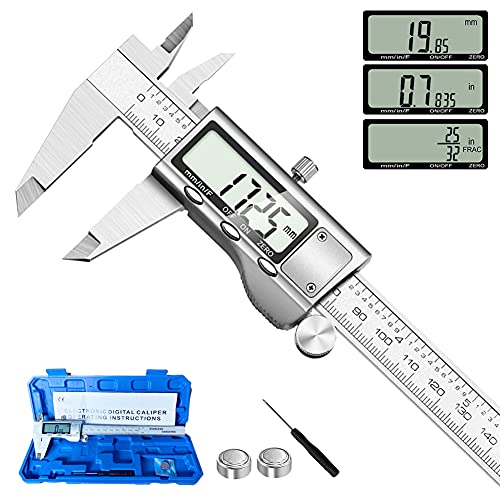
Designed for DIYers who bounce between blueprint fractions and shop tapes in inches, this model lets you switch between metric, imperial, and fraction display without doing mental math. The stainless steel construction and large LCD follow the same formula as the basic caliper but add versatility. The easy-switch layout is genuinely helpful when you are measuring a 1-1/2″ dado width and want the caliper to confirm in fractions rather than decimal inches. The downside is that fraction mode rounds to the nearest 1/32″ or 1/64″, which hides small discrepancies that a decimal display would reveal. Skip it if you are doing fine joinery where seeing 0.0312″ versus 0.03″ actually matters.
HARDELL Rechargeable 6″ Caliper
The rechargeable battery is the headline here, and the stated accuracy of plus or minus 0.001″ makes it one of the more precise options in this price bracket. The upgraded chip presumably improves sampling speed and reduces the flicker you see on lesser units when the jaws are closing. Large LCD, auto-off, and three-mode unit switching round out the feature set. It suits anyone who measures frequently enough that swapping button cells becomes annoying. The charging port is a concern in a woodworking environment because fine dust settles into any opening, potentially corroding the contact over time. Skip it if your shop is extremely dusty or you only pull the caliper out occasionally and prefer a battery that lasts years in standby.
HARDELL 12″ Caliper
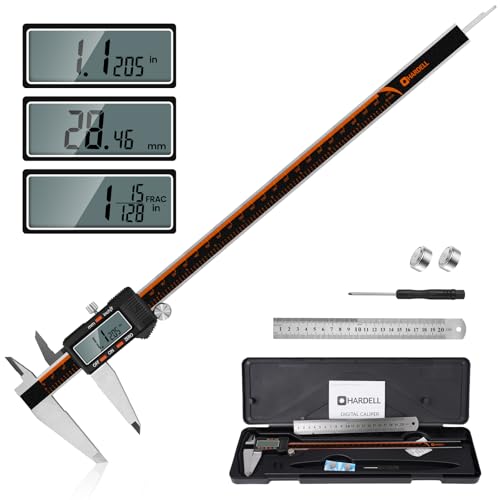
Twelve inches of reach is the reason to buy this caliper, and it handles tasks that a 6-inch model physically cannot: measuring door width, checking the depth of a router table fence offset, or sizing automotive components. It includes a sturdy case, which is smart because a longer beam is more likely to get knocked off a bench. Inch, millimeter, and fraction modes are all available, and the auto-off preserves battery life. The trade-off is that longer jaws flex more under hand pressure, so readings on small objects lose accuracy compared to a shorter caliper. If most of your measurements are under 6 inches, skip this and save the money for a dedicated precision tool instead.
NEIKO 01407A
NEIKO has built a reputation on tool-crib quality, and this electronic caliper carries that association. The 0-to-6-inch range with stainless steel construction covers standard woodworking needs. The quick-change button for switching between inch, fraction, and millimeter is tactile and does not require menu navigation, which is a real advantage when your hands are in the way. The large LCD is legible without tilting the tool toward a light source. It lacks a carrying case, which means you should supply your own if the caliper lives in a toolbox with chisels. Skip it if you need depth measurement features not clearly indicated in its naming, or if the brand premium pushes it past what you want to spend on a consumable-accuracy tool.
Adoric 6″ 4-Mode Caliper
Four measurement modes — outside, inside, depth, and step — make this caliper genuinely multi-purpose for hobbyists and small-shop woodworkers. The step function, in particular, is useful when you need to check the difference between two tenon cheeks or confirm a rabbet depth without moving to a different tool. The large LCD and auto-off follow the same user-friendly pattern as the rest of the category. Inch-to-millimeter conversion is single-button. The limitation is that at 6 inches, you lose reach for panel-scale work. Skip it if your projects regularly exceed 150 mm in any single measurement or you need the absolute lowest variance for metalwork.
HARDELL 6″ with Sturdy Case
This model bundles the 4-mode measurement set with a protective case, which matters more than it sounds. A caliper thrown loose in a drawer picks up jaw nicks and dust that compromise the slide. The large LCD and auto-off are consistent with the rest of the HARDELL line. For 3D printing, the depth and step modes let you verify layer height and feature dimensions without a second instrument. The battery is not rechargeable, so you are replacing button cells periodically. Skip it if you already own a padded tool tray or if you want the longer reach that the 12-inch HARDELL provides.
Starrett EC799A-6/150
Starrett is the name machinists and precision woodworkers respect, and the EC799A delivers on that reputation. The stated resolution of 0.0005″ is two times finer than anything else on this list, and the fine-adjustment thumb wheel gives you tactile control that cheaper calipers simply do not. The in-to-mm conversion is handled electronically, and the LCD is bright with high contrast. This is the caliper you buy when your dovetails need to fit in a 0.001″ window or you are making a tenon that has to seat in a mortise milled on a CNC router with tight tolerances. It lacks a case and commands premium pricing relative to the others here. Skip it if your tolerance target is 0.010″ or looser — you will not use the resolution.
Buying Guide
Resolution vs. Accuracy: Know What You Need
Resolution tells you the smallest increment the display can show; accuracy tells you how close the reading is to the true value. A caliper with 0.001″ resolution might be accurate only to plus or minus 0.003″. For most woodworking, a resolution of 0.001″ with accuracy within 0.002″ is plenty. If you are fitting brass bushings or checking router bit runout, the Starrett’s 0.0005″ resolution earns its place. For household shelf projects, any of the 6-inch models here will not embarrass you.
Jaw Action and Ergonomics
Close the jaws on a 1-inch block and lock them. The reading should not change when you release pressure. If it drifts, the slide has play or the jaw faces are misaligned. A thumb wheel for fine adjustment, like the one on the Starrett, lets you close the jaws gently on thin or fragile objects without overshooting. On a dusty shop, calipers without a wheel rely on your grip strength alone, and a sweaty palm can push the jaws past the target.
Display Readability and Protection
Look for a large, high-contrast LCD you can read from a normal working angle without tilting the tool. Backlit displays are rare in this category but worth seeking if you work in dim spaces. In a woodworking shop, a caliper without a case will collect dust in the slide and eventually bind. The models that include a case — both HARDELL options and the Adoric if you store it properly — save you a month of frustration.
Our Verdict
For woodworkers who demand precision and will keep the tool for decades, the Starrett EC799A-6/150 is the clear top pick — its resolution and build quality put it in a different class. The budget-conscious choice is the generic 6-inch stainless caliper, which handles household tasks at minimal cost. The condition under which another wins: if your work regularly involves panels, door jambs, or automotive parts exceeding 6 inches, the HARDELL 12-inch is the only reasonable option in this lineup and it should replace your shorter caliper entirely for those tasks.
FAQ
Are digital calipers better than analog vernier calipers for woodworking?
Digital calipers reduce reading errors because you do not have to interpret a scale. For a dusty shop where visibility is imperfect, this matters. Analog verniers are more resistant to battery issues and moisture, but most woodworkers find the digital readout more practical day to day.
What accuracy do I need for woodworking?
A tolerance of plus or minus 0.002″ handles virtually all joinery, cabinet work, and pattern making. Metalworking or precision jigs benefit from 0.001″ or better. Any of the calipers here meet the woodworking standard.
Can I use a digital caliper to measure metal parts?
Yes, and stainless steel jaws resist marking from harder materials. Just wipe the caliper after measuring greasy or abrasive metals, since residue on the slide will cause drift in all your subsequent readings.
How do I protect my calipers from sawdust and drops?
Store the caliper in its case when not in use and wipe the beams with a dry cloth after each session. If it lacks a case, a padded slot in your tool tray is the minimum safe storage.