Best Budget Digital Caliper for Workshop Measuring Tasks
What's inside
As an Amazon Associate I earn from qualifying purchases. This post may contain affiliate links at no extra cost to you.
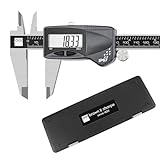
A good budget digital caliper is one of the most useful measuring tools in a workshop. It can check bolt diameters, washer thickness, hole sizes, stock dimensions, and machining work far faster than a ruler. The best value is usually a basic 6-inch stainless-steel caliper with a clear LCD, a thumb roller, and a standard inch/millimeter switch.
You do not need laboratory equipment for woodworking, home repair, 3D printer work, bicycle maintenance, or general fabrication. You do need a caliper that closes squarely, repeats the same reading, and does not lose its zero every few minutes. That is where the cheapest options start to separate from sensible budget buys.
As an Amazon Associate we earn from qualifying purchases at no extra cost to you.


What to Look for in a Budget Digital Caliper
Most useful workshop calipers have a 6-inch measuring range, covering roughly 0 to 6 inches or 0 to 150 mm. That size is compact enough for a toolbox but large enough for most fasteners and small parts. A 4-inch caliper is easier to carry but has limited jaw reach. An 8-inch version offers more capacity, but it costs more and is less convenient for fine work.
Resolution is commonly listed as 0.0005 inch or 0.01 mm. Resolution is not the same as accuracy. A display may show measurements to four decimal places while the actual reading is only accurate to around ±0.001 inch. For routine workshop tasks, that level is generally adequate. It is not a substitute for a micrometer when you need reliable measurements within a few ten-thousandths of an inch.
Look for hardened or reasonably finished stainless-steel jaws, a smooth thumbwheel, a firm locking screw, and a display that remains readable at different angles. A metal body usually costs more than a plastic or carbon-fiber body, but it resists flexing and damage when used around oily benches and metal parts. For occasional household work, a composite 6-inch budget digital caliper can be perfectly serviceable.
Features Worth Paying For
Auto shutoff is convenient, but it can be irritating if the caliper turns off while you are comparing several parts. More important is a dependable zero button and a display that does not flicker when the slide moves. Some inexpensive calipers drain batteries quickly because of poor power management. A replaceable LR44 or SR44-style button cell is preferable to a sealed rechargeable system on a low-cost tool.
Ingress protection is another useful distinction. An IP54-rated caliper offers some protection against dust and splashing, but it is not waterproof. Many low-cost calipers have no meaningful sealing at all. Keep any digital caliper away from cutting fluid, coolant spray, rain, and piles of metal chips. Wipe the beam after use and store it with the jaws slightly open.
Do not pay extra for data output unless you know you need it. USB or wireless connectivity can help with repeated inspection records, but it adds cost and another failure point. For measuring a replacement bolt or checking a turned part, a plain display is the better value.
Budget Digital Caliper Comparison
| Type | Typical price | Best use | Main compromise |
|---|---|---|---|
| Plastic or composite 6-inch | $10–$18 | Household repairs, 3D printing, woodworking | More flex and faster wear |
| Stainless 6-inch, basic display | $18–$35 | General workshop measuring | Battery and sealing quality vary |
| Stainless 6-inch, better-finished brand | $35–$60 | Frequent fabrication and maintenance | Costs more without micrometer-level accuracy |
| Stainless 8-inch | $35–$75 | Larger parts and deeper reach | Heavier, less nimble, higher price |
For most buyers, the middle row is the sweet spot. A basic stainless model from a reputable tool brand is usually worth the extra $10 to $20 over an anonymous bargain caliper. Brand value here is less about prestige and more about quality control, replacement support, and a realistic specification. If the tool arrives with jaws that do not meet evenly, a known seller is more likely to replace it.
When the Cheapest Option Is Fine
A $10 to $15 caliper is reasonable for checking whether a bolt is 8 mm or 5/16 inch, measuring filament spools, setting a saw fence, or comparing the thickness of sheet goods. It is also a good backup tool for a toolbox or vehicle. These tasks do not demand certified accuracy, and the low purchase price makes battery or durability problems less painful.
Cheap calipers become a poor choice when you measure hot parts, clamp the jaws forcefully, or use them in abrasive environments. The thin beam can flex, the jaw edges can become burred, and the slider may develop inconsistent spots. A common failure is a reading that changes by 0.002 to 0.005 inch when the jaws are closed repeatedly. That is too much for bearing fits, precision spacers, or machining tolerances below about 0.003 inch.
For those jobs, consider a better stainless-steel workshop caliper, then confirm critical dimensions with a micrometer or a calibrated reference. Even an expensive digital caliper should not be treated as a precision standard without checking it.
How to Check a New Caliper
Before relying on a new caliper, clean the jaws and close them gently. Press zero and reopen the jaws several times. The display should return to zero each time. Check the inside and outside jaws for gaps by holding them against a bright light. A tiny visible mismatch is a warning sign, especially if it affects repeatability.
Test the caliper with objects of known size. A quality 1-2-3 block, a marked gauge pin, or a drill bit with a verified diameter is better than relying on a random bolt. Measure near the front and rear of the jaws, rotate the test piece, and repeat the reading. Differences larger than about 0.001 to 0.002 inch on a budget tool justify returning it for another unit.
Use light, consistent pressure. Digital calipers measure contact position, not force, so squeezing harder can flex the tool or deform soft material. For outside measurements, wipe oil from both the part and jaws. For inside measurements, rock the caliper slightly to find the widest reading. Depth measurements require keeping the base flat; otherwise the displayed number can look precise while being wrong.
Buying Timing and Seasonal Pricing
Digital calipers are often cheapest during major holiday sales, back-to-school promotions, and tool-focused events in late spring and autumn. Discounts of 10% to 25% are common, but a low advertised price is not always a bargain if the listing has poor reviews about battery drain or jaw alignment. Compare the delivered price, return policy, and included case.
If you need one now, buy a basic stainless 6-inch tool rather than waiting months to save $5. If you are outfitting a workshop, seasonal sales are a good time to buy two: keep one clean for inspection and use the cheaper backup near the grinder, lathe, or workbench. For a broader selection, compare current professional-style digital calipers by return ratings and specifications, not just the largest number on the display.