Ryobi vs Hart Combo Kits: Which Entry-Level Platform Offers More Useful Tools?
What's inside
As an Amazon Associate I earn from qualifying purchases. This post may contain affiliate links at no extra cost to you.
Ryobi and Hart both target homeowners who want cordless tools without paying contractor-platform prices. Their combo kits can look similar on a shelf: a drill, an impact driver, a battery or two, and a charger. The useful difference is what each battery system can support after that first purchase—and whether the kit’s tools match jobs you actually do.
Ryobi is the broader platform, with a long-running 18V ONE+ lineup that includes ordinary power tools and many household, yard, and specialty products. Hart’s 20V system covers common DIY tools and outdoor equipment, but its range is narrower. Hart can be a sensible lower-cost entry point; Ryobi is usually the safer choice if you expect to add tools over time.
As an Amazon Associate we earn from qualifying purchases at no extra cost to you.


Quick comparison
| Factor | Ryobi 18V ONE+ | Hart 20V |
|---|---|---|
| Best fit | Homeowners who want a platform for varied jobs | Occasional DIYers focused on basic tools |
| Tool selection | Broader power-tool, yard, and specialty range | Common DIY and outdoor tools, with fewer niche options |
| Battery compatibility | 18V ONE+ batteries work across the ONE+ tool family | 20V batteries work with compatible Hart 20V tools |
| Typical trade-off | Paying more for access to a larger ecosystem | Saving upfront, with fewer options for future expansion |
| Worth checking before buying | Battery capacity, included tools, and current sale price | Exact kit contents, battery capacity, and tool availability |
What the kit contents actually tell you
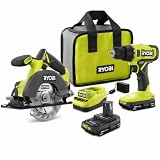
A drill and impact-driver combo is the most useful starting point for many households. The drill handles holes and light fastening; the impact driver is better for driving longer screws, though it is louder and less suited to delicate work. For shelves, flat-pack furniture, and occasional repairs, either brand can do the job. If you need only these two tools, compare the Ryobi drill-and-impact combo kits and the current Hart offer rather than assuming the bigger kit is better value.
Count the batteries, then check their amp-hour (Ah) rating. A compact 1.5Ah or 2.0Ah pack keeps a drill light but may need recharging during a long project. A 4.0Ah battery generally runs longer, at the cost of more weight and bulk. A kit with two small batteries can be more convenient than one large battery: use one while the other charges. Battery capacity does not make a tool more powerful by itself, but a low-capacity pack can become frustrating in saws and other demanding tools.
Also check the charger and included accessories. A basic charger may take several hours to refill a depleted pack, while a faster charger can reduce downtime. Bits and blades included in a kit are often starter-grade; budget to replace them if they strip screws, wander in wood, or dull quickly.
Where Ryobi pulls ahead
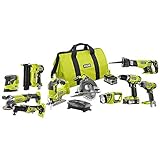
The main Ryobi advantage is choice after the first kit. The ONE+ lineup reaches beyond drilling and cutting into tools such as lights, inflators, fans, glue guns, and yard equipment. That range matters if a battery you already own can power a tool you need later. It also makes it easier to keep one battery system for occasional house and garden jobs.
That breadth is useful, not automatically economical. A platform can tempt you into buying tools you would rarely use. For a homeowner who needs a drill, a small saw, and a leaf blower, it is worth checking whether ONE+ has the right tools and whether they are available at reasonable prices. A Ryobi ONE+ bare tool can be a good buy when you already have compatible batteries, but it is poor value if you need to add a battery and charger at full price.
For frequent heavy use, neither entry-level platform should be judged by the kit price alone. Repeated cutting, drilling large holes, or driving fasteners all day puts more heat and load on batteries and tools than weekend maintenance does. A higher-capacity battery helps runtime, but it cannot turn a compact homeowner tool into a heavy-duty model.
When Hart is enough
Hart makes sense when the price is clearly lower and the kit covers your immediate jobs. If you expect to assemble furniture, hang curtains, patch a fence, and use a drill a few weekends a year, a basic Hart kit can be perfectly adequate. The cheaper choice is especially attractive if you do not plan to build a large cordless collection and can find replacement batteries or the next tool you need locally.
The risk is not that Hart tools cannot handle ordinary DIY work. It is that a future need may be harder to meet within the same battery family. Before buying, look up the specific Hart tools you are likely to want next—perhaps a circular saw, oscillating tool, or string trimmer—and confirm that they are sold where you shop. A platform is less useful if the one tool you need is unavailable or costs enough to erase the initial savings.
Do not compare “20V” and “18V” as though those labels alone show that Hart is more powerful. Battery marketing conventions differ; tool design, battery capacity, and the job matter more. For occasional work, fit, control, runtime, and a comfortable grip are better deciding points than the voltage printed on the box.
How to choose without overbuying
Write down the next three tools you are likely to need, not every tool that might someday be useful. Compare the price of the starter kit plus those tools, including batteries if sold separately. Then check battery warranty terms and the availability of replacement packs. A low kit price can be a false bargain if a replacement battery is difficult to find or costs nearly as much as a new kit.
Buy Ryobi if a wider range of compatible tools is worth paying for and you expect the system to grow. Choose Hart if its current kit is substantially cheaper, covers your likely jobs, and you are comfortable with a smaller selection. For a drill-and-driver kit used only for light household work, either platform can be fine; focus on having two batteries and a price that leaves money for good bits. For a longer-term household collection, Ryobi’s broader lineup is the more useful bet, while Hart remains a reasonable way to keep the first purchase inexpensive.