Best Affordable Flooring Installation Tools for DIY Renovations
What's inside
As an Amazon Associate I earn from qualifying purchases. This post may contain affiliate links at no extra cost to you.
Flooring installation does not require a shop full of professional equipment. For most bedrooms, hallways, and small living rooms, the best value comes from buying a few accurate hand tools and renting the expensive specialty tool for one day. The right setup depends on the flooring: laminate and click-lock vinyl need different cutting methods than nail-down hardwood, while sheet vinyl demands careful measuring and adhesive work.
As an Amazon Associate we earn from qualifying purchases at no extra cost to you.


Buy the tools you will use on every floor
A 25-foot tape measure, sharp utility knife, carpenter’s square, pencil, and a reliable tapping block are the basic kit. Spend a little more on the tape and square; inaccurate layout creates more waste than a cheap cutter saves.
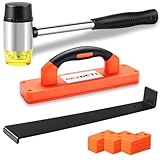
For click-lock laminate and luxury vinyl plank (LVP), add a pair of knee pads and a pull bar. The pull bar closes the final joints near walls where a tapping block cannot be struck. A flooring installation kit is usually cheaper than buying these pieces separately, but inspect the tapping block before use. Some thin plastic blocks deform or chip after a few rows. A dense nylon or hardwood-faced block is safer.
A sharp utility knife works well on many LVP products. Score the wear layer several times, bend the plank away from the cut, and finish the backing if necessary. Do not force a dull blade. It can slip across the plank and cut your hand, or leave a ragged edge that remains visible at a doorway. Budget utility knives are fine if you buy replacement blades and change them frequently.
Choose cutting equipment by flooring type
Laminate is hard on blades and produces fine dust. A dedicated laminate shear cuts quietly and avoids most dust, but inexpensive shears can crush the locking edge or leave a slightly angled cut. They are useful for repeated straight cuts, not for every notch. A jigsaw with a fine-tooth laminate blade handles curves and vents, although the cut side may splinter. Put painter’s tape over the cut line and support the plank fully.
For LVP, a guillotine-style vinyl cutter is fast on straight cuts and often cleaner than a saw. It becomes less attractive when the floor has thick attached underlayment or rigid stone-plastic construction. In that case, a jigsaw or miter saw may be more versatile. A vinyl plank cutter is worth buying for a large room with many straight cuts; for one small room, a utility knife is usually enough.
Engineered hardwood and solid hardwood generally need a miter saw or circular saw. A basic 10-inch compound miter saw is adequate for crosscuts, but it does not replace a table saw for ripping the final row. A circular saw with a straightedge can do the same work at lower cost, though it requires more setup and leaves less predictable edges. For a single project, renting a saw is often better than buying the cheapest unit, whose fence may shift during a cut.
| Flooring | Best budget cutting method | When to upgrade or rent | Main failure mode |
|---|---|---|---|
| Click-lock LVP | Utility knife and square | Buy a cutter for large rooms or thick planks | Chipped locking edges or over-bent joints |
| Laminate | Jigsaw with fine blade or laminate shear | Use a miter saw for repeated crosscuts | Splintered decorative surface |
| Engineered hardwood | Circular saw and guide | Rent a miter saw and table saw for larger jobs | Burn marks, tear-out, or inaccurate rips |
| Sheet vinyl | Sharp knife, straightedge, and seam roller | Buy a better roller for seams and adhesive work | Visible seams and cuts that run off-line |
Tools that prevent expensive mistakes
Buy or rent a moisture meter when installing wood, laminate, or LVP over a concrete slab. The exact acceptable reading depends on the flooring and manufacturer, so use the product instructions rather than a generic internet limit. Installing over a damp slab can cause cupping, swelling, adhesive failure, or mold beneath an impermeable floor. A $25 to $50 meter is cheaper than replacing a room, but very cheap meters may be inconsistent. Treat them as screening tools, not laboratory instruments.
For floating floors, use spacers that match the specified expansion gap, commonly around 1/4 inch to 3/8 inch. Do not assume a coin or scrap of wood is accurate. Gaps that are too small can cause buckling when the floor expands; gaps that are too large may show beneath the baseboard. A flooring spacer set costs little and is more consistent than improvised wedges.
For nail-down hardwood, the critical tool is a flooring nailer, not a bargain hammer. A pneumatic nailer drives fasteners at the correct angle and protects the tongue. Renting one for a weekend commonly costs less than buying a low-use tool, and the rental counter can provide the correct cleats or staples. A standard finish nailer is not a substitute; it may not hold the boards securely and can damage the tongue.
Where brand value matters
For measuring and layout tools, mid-priced brands are usually the value point. The cheapest tape may have a loose hook, while an expensive professional tape adds little for occasional flooring work. For power tools, reliability and blade compatibility matter more than extra features. A basic saw from a reputable tool line is preferable to an unknown brand with a nominally higher motor rating.
Spend on blades before spending on electronics. A fresh fine-tooth blade can improve a modest saw more than a premium saw fitted with a general-purpose blade. Keep one blade for clean finish cuts and another for rough underlayment or demolition. Never use a flooring blade after it has hit hidden nails; damaged teeth can throw fragments or pull the workpiece.
Use seasonal pricing and rentals intelligently
Tool prices often soften around major holiday sales, spring renovation promotions, and late-year clearance periods. Flooring cutters and installation kits are commonly discounted when retailers promote remodeling supplies, while rental rates may be better during weekday periods than on a Saturday morning. Compare the complete cost: tool, blade, shipping, and replacement parts.
Before buying, measure the room and estimate cuts. A 100-square-foot room with simple rectangles may justify only hand tools. A 500-square-foot installation with closets, door jambs, and angled walls can justify a cutter, oscillating tool, and saw rental. Buy tools that solve repeated problems; rent tools that perform one specialized operation. That approach keeps the budget controlled without forcing inaccurate cuts or shortcuts that become visible after the furniture is back in place.