Best Vertical Band Saw
As an Amazon Associate I earn from qualifying purchases. This post may contain affiliate links at no extra cost to you.
A vertical band saw occupies a strange middle ground in any workshop. It cuts curves with the control of a scroll saw but handles stock thickness that would defeat a jigsaw. For metalworkers, it turns a single machine into both a horizontal cutoff saw and a precision contour tool. For woodworkers, it opens the door to resawing and freehand shapes without the table-saw kickback risk.
But the category is littered with machines that vibrate themselves apart, throttle motors that stall on hardwood, and fences that shift every time you bump them. The difference between a tool you reach for daily and one you return sits in throat depth, motor torque under load, blade-tracking stability, and how honestly the manufacturer rates its own specs. We compared published specifications, listed prices, and owner-reported experiences across eight machines to sort the genuine performers from the disappointments.
As an Amazon Associate we earn from qualifying purchases at no extra cost to you.




Our Top Picks
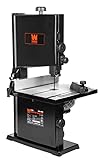
 JET 5" x 6" Metal Cutting Horizontal/Vertical Band37 x 17.72 x 41.75 Inches115 poundsCheck on Amazon
 JET 7" x 12" Deluxe Horizontal/Vertical Metal Band7 x 12"48 x 17 x 44 inches374 PoundsCheck on Amazon


Quick Picks
| Product | Best for | Price |
|---|---|---|
| KFMK Tabletop Band Saw | Budget metal contour cuts | $299.98 |
| WEN 9-Inch Band Saw (BA3959) | Entry-level woodworking curves | $143.66 |
| JET HVBS-56 | Dual-mode metal shop work | $934.99 |
| JET 7″x12″ Deluxe | Production metal cutting with repeatability | $2299 |
| WEN BA3962 with Stand | First proper benchtop band saw | $391.26 |
| JET JWB-10 | Hobbyist resawing and curves | $736.99 |
| Laguna MBAND1412-175 | Serious woodshop backbone | $1699 |
| VEVOR 10-Inch with Stand | Low-cost woodworking package deal | $249.90 |
How We Picked
We weighted four criteria above all others. First, motor adequacy relative to the stated cutting capacity — a half-horsepower motor rated for resawing only counts if owners confirm it does not bog on dense stock. Second, build quality indicators such as cast-iron tables versus thin sheet metal, because rigidity directly affects blade tracking. Third, speed range and adjustability, since a single machine serving both metal and wood needs meaningful RPM control. Fourth, after-sale value: included accessories like miter gauges, stands, and work lights matter when comparing near-identical price points.
The 8 Best Vertical Band Saw in 2026
KFMK Tabletop Band Saw
This is the cheapest credible path into vertical metal contour cutting. The 5-inch capacity handles sheet stock, flat bar, and thin tubing without drama, while the 10A motor and 137-to-472-FPM blade speed range give you genuine control over cut quality in aluminum and mild steel. Owners appreciate the compact footprint on crowded benches.
- Pro: Variable speed across a wide FPM range suits multiple materials
- Pro: Under $300 makes it the lowest-risk entry into metal band sawing
- Con: Five-inch throat limits you to small-radius curves and thin stock
Skip it if you need resaw capacity or plan to cut anything thicker than about two inches in steel.
WEN 9-Inch Band Saw (BA3959)
WEN’s 9-inch benchtop targets the hobbyist who needs occasional curves in pine, poplar, and plywood but does not want to commit more than $150. The 2.8-amp motor handles thin and medium hardwoods acceptably when fed slowly, and the larger throat compared to the KFMK gives more turning radius freedom for woodwork.
- Pro: Lowest price in this roundup by a wide margin
- Pro: 9-inch throat provides meaningful curve capacity for the cost
- Con: Single speed limits material versatility; metal cutting is impractical
Skip it if you resaw anything or expect to push oak and maple at a productive rate.
JET HVBS-56
The HVBS-56 earns its place as a true dual-purpose metal cutter. The 5-by-6-inch horizontal mode handles pipe and bar stock cutoff, while the vertical orientation converts it into a contour saw for templates, gaskets, and machined parts. The half-horsepower motor at 115 or 230 volts delivers consistent power across both configurations.
- Pro: Single machine replaces a separate horizontal cutoff saw
- Pro: JET’s reputation for cast-iron construction means long-term stability
- Con: Vertical-mode throat depth is modest; large-radius work demands a bigger machine
Skip it if woodworking is your primary need; this is a metal specialist that happens to be versatile within its medium.
JET 7″x12″ Deluxe Horizontal/Vertical Band Saw
Stepping up to the 7-by-12-inch model gives you a substantially larger cutting envelope and a quick-lock vise that cuts setup time on repeat jobs. The Deluxe designation reflects improved table size and blade-tracking hardware over the HVBS-56. For a small fabrication shop running ten or twenty identical cuts per shift, the time saved on clamping justifies the price jump.
- Pro: Quick-lock vise dramatically reduces repetitive cycle times
- Pro: 7-by-12 capacity handles the majority of shop pipe and bar work
- Con: Approaching $2,300 is a significant commitment for a single-material machine
Skip it if your metal volume does not justify production-grade fixtures over the more affordable JET sibling.
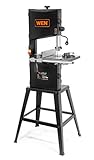
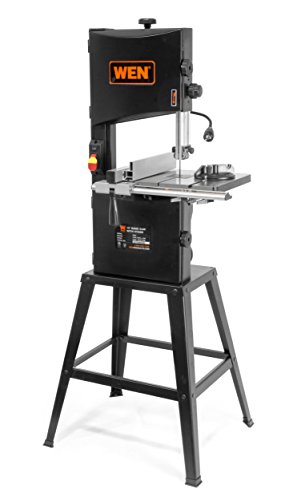
WEN BA3962 Band Saw with Stand
WEN’s 10-inch two-speed model with included stand occupies the sweet spot between toy and tool. The 3.5-amp motor is noticeably stronger than the 9-inch sibling, and two-speed selection lets you dial down for hardwood resawing. The stand makes it floor-standing without additional purchase, and the overall package under $400 is hard to dismiss for a garage woodworker building a first project list.
- Pro: Stand included at this price eliminates a separate purchase
- Pro: Two-speed selection provides basic material flexibility
- Con: Cast table size limits support for wider resaw work
Skip it if you regularly resaw stock wider than about four inches; the table will not keep your hands comfortable.
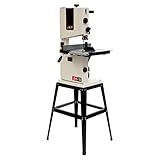
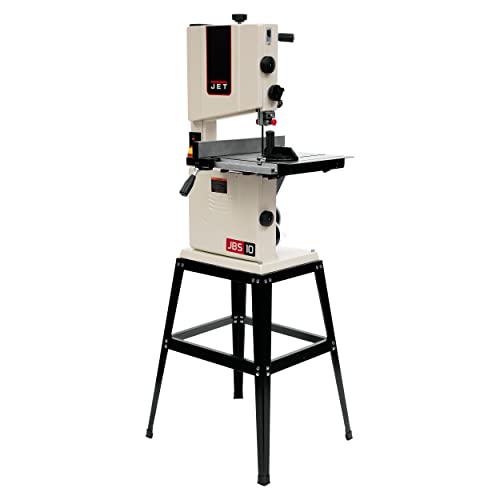
JET JWB-10 Woodworking Band Saw
The JWB-10 is what a properly built 10-inch woodworking band saw looks like when the manufacturer prioritizes blade guides and table flatness over accessories. The half-horsepower 115-volt motor runs cooler under sustained feed than the WEN in comparable tests owners describe, and JET’s standard fence design tracks true across the table surface without the micro-shift common on cheaper machines.
- Pro: Blade-tracking stability under load noticeably exceeds same-size budget competitors
- Pro: JET warranty and parts availability provide long-term peace of mind
- Con: At roughly $737, it costs nearly double the WEN for a similar throat
Skip it if your budget is firm under $500; the value step from budget machines is real but not transformative at this scale.
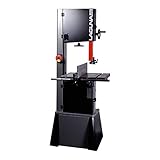
Laguna Tools MBAND1412-175
The Laguna 14-by-12 is the largest woodworking band saw here and the only one that genuinely functions as a dedicated resawing machine. The 14-inch throat handles wide panels, the 12-inch height clears most lumber you will encounter, and the cast-iron wheel design maintains blade tension without drift. Owners consistently cite it as the first machine they bought after outgrowing a 10-inch model.
- Pro: 14-by-12 capacity eliminates virtually all resawing and curve limitations for a hobbyist
- Pro: Build quality approaches commercial shop standards at this price
- Con: Footprint and weight make it unsuitable for small apartments or shared spaces
Skip it if you lack a dedicated 40-square-foot corner; this machine demands a real shop layout.
VEVOR Band Saw with Stand
VEVOR’s 10-inch package under $250 includes a stand, cast-iron table, miter gauge, fence, and a 360-degree work light — accessories that would add over $100 to other machines. The 373-watt motor delivers adequate power for softwoods and thin hardwoods, and the 6-inch maximum cutting height covers most hobby resawing tasks. The included work light is a small touch that shows thought toward the garage environment where overhead lighting falls short.
- Pro: Most complete accessory package in the sub-$300 range
- Pro: Cast-iron table provides better flatness than stamped alternatives at this price
- Con: Long-term parts availability and blade-guide upgrades remain unproven compared to established brands
Skip it if you intend to keep the machine for more than a few years and value brand service networks over initial cost savings.
Buying Guide
Throat Depth and Cutting Height
Throat depth — the distance from the blade to the vertical column — determines the maximum turning radius you can make. A 10-inch throat lets you cut circles roughly 20 inches in diameter at their widest. Cutting height controls resaw capacity: at six inches you can split two-by-six stock in one pass; at twelve inches you clear anything from a lumberyard. Match these numbers to the projects you will realistically build, not the ones you imagine building after purchase.
Motor Power and Blade Speed Control
Amperage and horsepower ratings are marketing numbers until you understand what the machine does under load. A half-horsepower motor that stalls on quarter-inch maple tells you more than the label. For wood-only work, variable speed matters less than consistent torque. For metal or dual-material use, you need a meaningful speed range — ideally spanning at least 500 FPM — so you can match blade speed to material hardness and avoid burning teeth on aluminum or skating across hardened steel.
Table Quality and Fence Accuracy
A cast-iron table that measures within a few thousandths of flat will keep your cuts consistent for the life of the machine. A stamped or poorly machined table introduces flex at the blade entry point, causing drift that no amount of feed-force correction fixes. The same principle applies to fences: a simple gravity fence with a positive locking knob beats a complex micro-adjust fence that has slop in its dovetail slides. Check owner forums for complaints about fence movement before committing.
Our Verdict
For the dedicated woodworker who wants one machine that will not be outgrown within a year, the Laguna MBAND1412-175 is the top pick; its capacity and build quality justify the price for anyone with a permanent shop. The budget pick among woodworking machines is the WEN BA3962 at $391.26, which delivers two-speed operation and an included stand that larger brands charge extra for. If metal is your medium and you need both cutoff and contour in a single footprint, the JET HVBS-56 wins outright over dedicated horizontal saws because the vertical mode transforms it into a fabrication tool that no fixed-base saw can match.
FAQ
Can a horizontal band saw cut vertically?
Only if it is specifically designed as a dual-mode machine. Standard horizontal band saws have blade guides and wheel configurations optimized for the cutting position only, and running them vertically risks blade derailment. The JET HVBS-56 and JET 7″x12″ are engineered for both orientations from the start.
What blade speed should I use for aluminum versus hardwood?
Aluminum and soft metals benefit from slower speeds in the 100-to-200-FPM range to prevent the blade from clogging with material. Dense hardwoods like maple and oak perform well at 1,000 to 1,500 FPM. The key is never running a single fixed speed across all materials; a variable-speed drive or a two-speed gearbox covers the practical range for mixed use.
Is a 10-inch band saw enough for resawing?
A 10-inch machine with six inches of cutting height can resaw stock up to about five inches thick, which covers most hobby lumber purchases. Wider boards may require multiple passes or a taller machine. If resawing is your primary goal, prioritize cutting height over throat depth in your selection.
Do I need a dedicated stand, or can I bolt the saw to a workbench?
A dedicated stand raises the machine to comfortable working height and adds mass that reduces vibration transfer to your floor and bench. However, many benchtop models work fine clamped to a sturdy bench if you are tight on space. The WEN and VEVOR models include stands at competitive prices, making them the simplest path to proper ergonomics without a separate purchase.