Best Value Portable Band Saw for Plumbing and Metalwork
What's inside
As an Amazon Associate I earn from qualifying purchases. This post may contain affiliate links at no extra cost to you.
What counts as value in a portable band saw?
For plumbing and metalwork, the best-value saw is not necessarily the cheapest one on the shelf. It is the one that cuts the stock you actually use, fits where you need to work, and does not burn through blades or batteries. A budget corded saw can be the sensible choice for occasional shop cuts; a cordless compact saw can earn its higher price on service calls where an extension cord is a nuisance.
Portable band saws are useful for cutting threaded rod, copper and steel pipe, conduit, angle iron, and strut. Their narrow blade makes less mess than an abrasive cutoff wheel, and the cut is often easier to control in a crowded mechanical room. They are not substitutes for a chop saw when you need fast, repeatable cuts on a bench, or for a hacksaw when you only have to make one short cut in an awkward spot.
As an Amazon Associate we earn from qualifying purchases at no extra cost to you.


Choose capacity before comparing brands
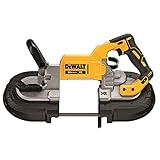
Standard portable saws commonly offer roughly 4-3/4 inches of cutting capacity, while compact saws are often around 2-1/2 inches. Check the stated capacity against the outside diameter of your largest pipe or the width of your largest piece of stock—not just the nominal pipe size. A 4-inch nominal pipe has an outside diameter greater than 4 inches, so a saw with a 4-inch opening will not clear it.
Compact saws are lighter and easier to maneuver overhead or between existing lines. Their limit is real: they cannot handle larger pipe or wide stock, and forcing material into the opening invites a crooked cut or a pinched blade. If your work regularly includes 3-inch or 4-inch pipe, look at full-size saws. For 1/2- to 2-inch pipe, conduit, and rod, a compact model may be easier to justify.
Value comparison by saw type
| Saw type | Typical capacity | Best use | Main cost trade-off |
|---|---|---|---|
| Compact cordless | About 2-1/2 in. | Service work and tight spaces | Lower weight, but limited capacity and battery cost |
| Full-size cordless | About 4-3/4 in. | Regular field work across mixed stock | More versatile, but heavier and often sold as a bare tool |
| Corded portable | Often about 4-3/4 in. | Shop use near an outlet | Lower entry cost, with cord management and less mobility |
| Deep-cut cordless | Often around 5 in. or more | Large stock and frequent heavy cuts | High purchase price and more weight than many plumbers need |
Capacities vary by design, so verify the manufacturer’s specification before ordering. For most plumbers, a compact cordless saw is a good value only if its opening covers the largest pipe they routinely cut. Metalworkers who cut broad flat bar or angle should pay attention to throat capacity and blade length, not just pipe diameter.
Corded or cordless: price the whole setup
A corded saw usually has the lowest buy-in if you already have a suitable outlet and extension cord. It is a reasonable choice for a home shop, occasional fabrication, or a contractor’s bench where the saw stays in one place. The drawbacks show up on ladders and service calls: the cord can snag on pipe, and a long extension cord is one more thing to manage.
Cordless is worth paying for when the saw moves around the jobsite or you already own batteries from the same tool platform. Compare the bare-tool price with the cost of a kit, then count the batteries and charger you actually need. A low bare-tool price is not a bargain if it forces you into an unfamiliar battery system. Start with a compact cordless portable band saw search if you want to compare smaller field-ready options.
Do not buy a large, expensive deep-cut saw just because it has the biggest capacity. If most of your cuts are 1-inch conduit and threaded rod, that extra opening adds weight and cost without improving the result. Conversely, repeatedly cutting stock at the very edge of a compact saw’s capacity is a false economy; a full-size saw is less frustrating and less likely to bind.
Blades matter as much as the saw
For general metal cutting, a bi-metal blade is a useful starting point. Tooth count is a trade-off: finer teeth generally suit thin-wall tubing and sheet, while coarser teeth clear chips better in thicker stock. As a practical guide, around 14–18 teeth per inch can suit thicker steel sections, while 18–24 TPI is often more appropriate for thinner-wall pipe and tubing. Follow the saw maker’s blade-length specification; blades that are too long or short will not fit, and the wrong width may not track correctly.
A common failure is using a dull or too-coarse blade on thin tubing. It can catch, chatter, and leave a ragged edge. Too-fine a blade in thick stock cuts slowly and can pack with chips. Let the saw do the work: keep the shoe steady, avoid twisting the frame during the cut, and do not push hard enough to stall the blade. For pipe, secure the work so it cannot roll, and leave room for the cutoff to fall without pinching the blade.
Where to save—and where not to
For occasional DIY cuts, a lower-priced corded saw is fine if it has enough capacity, a stable blade guide, and readily available replacement blades. Search corded portable band saws for metal cutting and compare the included blade, warranty, and service availability rather than choosing by price alone. A flimsy guide or hard-to-source blade can erase the initial savings.
For daily trade use, favor a platform you already own, a trigger you can control, and a blade change system you can operate without a struggle. A full-size cordless option is a sensible middle ground for mixed plumbing and fabrication work; compare full-size cordless portable band saws against kits on your battery platform. If you regularly cut large structural stock, a larger-capacity saw may be justified, but its extra weight is noticeable during overhead work.
Seasonal promotions can make kits better value, particularly around major tool sales and holiday periods. Compare the sale price with the bare tool plus a battery and charger, and check whether the kit includes a useful battery size rather than a small one that limits runtime. Replacement blades are an ongoing cost; keeping a spare on hand is cheap insurance when a blade breaks or becomes dull mid-job.