Best Affordable Benchtop Bandsaw for Small Woodworking Projects
What's inside
As an Amazon Associate I earn from qualifying purchases. This post may contain affiliate links at no extra cost to you.
What an affordable benchtop bandsaw can—and cannot—do
For small woodworking projects, a benchtop bandsaw is useful for cutting curves, trimming small parts, and resawing thin stock. It takes up less space and usually costs less than a floor-standing saw. The trade-off is capacity: most compact machines have a cutting height around 3 to 4 inches and a throat depth of roughly 9 to 10 inches. Those limits matter more than the color of the frame or a long accessory list.
Expect to spend about $150 to $300 for a basic new benchtop saw, with prices shifting during sales. At the lower end, the saw may need careful setup and a better blade to cut cleanly. That is acceptable for occasional work in pine or other modest stock; it is less appealing if you need dependable resawing or make curved cuts every week.
As an Amazon Associate we earn from qualifying purchases at no extra cost to you.

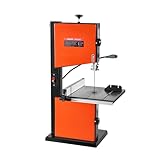

The features worth paying for
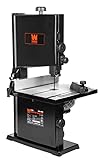
Start with cutting capacity. A 9-inch throat is enough for many small toys, brackets, boxes, and decorative pieces, but it will not let you cut a curve farther than that distance from the board’s edge. Check maximum cutting height, too. A nominal 3-inch capacity is not the same as being able to resaw a straight, useful 3-inch board: blade drift, motor power, and your fence all affect the result.
Look for a table that tilts and locks securely, guides that can be adjusted without fuss, and a blade-tension system that is practical to use. A sturdy fence is helpful for straight cuts, though an inexpensive fence may need squaring or a small shim. A work light, dust port, and quick-release tension lever are conveniences, not reasons to accept a weak frame or poor tracking.
Motor ratings are difficult to compare across budget brands, and they do not tell you how well a saw handles a demanding cut. A small saw bogs down when you force thick hardwood through it. Feed slowly, use a sharp blade, and let the machine do the work. If the motor stalls repeatedly, stop; pushing harder can produce crooked cuts and overheat the motor.
How the main budget choices compare
| Option | Typical price range | Best for | Main compromise |
|---|---|---|---|
| Entry-level benchtop saw | $150–$220 | Occasional curves in thin, soft stock | More setup work; limited power and capacity |
| Better-equipped benchtop saw | $220–$350 | Regular small-project use and varied cuts | Still not a substitute for a larger resawing saw |
| Used floor-standing saw | Varies widely | More capacity for a shop that can fit it | Condition, tuning, and missing parts can add cost |
These are broad shopping ranges, not guaranteed current prices. A sale can make a better-equipped benchtop saw cost only slightly more than a basic one, while a used machine may need a new blade, tires, or bearings before it is ready to work.
Where the best value usually sits
For a first bandsaw used on small projects, the best value is usually a solid midrange benchtop model rather than the very cheapest machine. You are paying for easier adjustment and a more usable working setup, not professional-grade capacity. Compare benchtop bandsaws for woodworking by capacity, guide design, blade availability, and return terms—not just advertised horsepower.
The entry-level option is fine if you will cut thin stock occasionally, have patience for setup, and do not expect fast resawing. Put some of the saved money toward a quality blade suited to the job. A narrow blade is easier to steer around tight curves; a wider blade is generally better for straighter cuts. Check the saw’s manual for compatible blade lengths and widths before ordering.
If you routinely need to cut stock thicker than the saw’s stated capacity, or want to resaw boards several inches high, skip the compact machine. A larger saw is safer and more capable for that job. A benchtop model forced beyond its limits can wander, burn the wood, or stall, even if the cut eventually goes through.
Setup matters as much as the price
Before the first cut, mount the saw on a stable bench, install the blade with its teeth pointing down toward the table, and follow the manual to set tension and tracking. Adjust the upper and lower guides so they support the blade close behind and beside it without rubbing during normal operation. Unplug the saw before reaching near the blade to make adjustments. Then check that the table is square to the blade for a 90-degree cut.
Do not judge a saw by one rough cut with its factory blade. A dull or poorly suited blade can burn hardwood, leave a ragged edge, or make a curve feel difficult. Conversely, a narrow blade pushed through a long straight rip may wander. For a broad selection of replacement options, compare replacement benchtop bandsaw blades against the machine’s specified blade length and width.
Keep the blade guards in place and use a push stick or other safe method to keep fingers away from the cut. Small workpieces can be especially awkward to hold. Make a simple carrier or use a secure jig rather than trying to steer a tiny part by hand close to the blade.
When to buy, and when to wait
Prices commonly dip around major holiday sales and seasonal promotions, but a discount is only worthwhile if the machine fits your work. Compare the final price with shipping, return costs, and the cost of a suitable blade. If buying used, inspect the tires for cracks, turn the wheels by hand with the saw unplugged, and look for blade wobble, damaged guides, or a table that will not lock firmly.
For occasional curves in small pieces, a budget benchtop saw can be a sensible purchase. For thicker stock, frequent resawing, or long straight cuts, spend more on a larger, more capable machine—or use another tool. Buying extra capacity you will never use is wasteful, but expecting a compact saw to behave like a floor-standing model is a quick way to regret the bargain.