How to Calculate Whether Renting or Buying a Tool Saves Money
What's inside
As an Amazon Associate I earn from qualifying purchases. This post may contain affiliate links at no extra cost to you.
Renting looks cheap when the daily rate is sitting next to a $400 purchase price. Buying looks cheap when you expect to use the tool for years. The correct answer depends on more than the advertised rate: include rental fees, transport, consumables, deposits, cleaning, downtime, storage, maintenance, and the value of your own time.
As an Amazon Associate we earn from qualifying purchases at no extra cost to you.


Start With the Real Job
Write down exactly what the tool must do and how long you will need it. “I need a saw” is not enough. Cutting a few deck boards may require a circular saw, while repeated cabinet work may justify a table saw. A small rental may also be the wrong tool for the material, forcing slower work or extra passes.
Estimate active use rather than calendar time. If a tool is needed for two hours on Saturday, a one-day rental may be sufficient. If weather, delivery delays, or drying time could stretch the job, price a two-day rental. Returning equipment late is one of the easiest ways to erase the apparent savings.
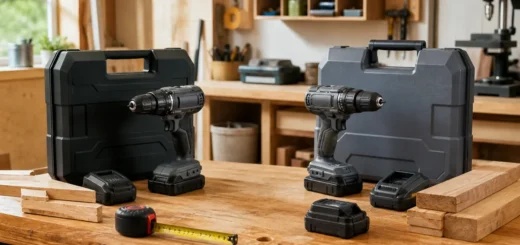
Then identify the minimum acceptable quality. A budget cordless drill can be perfectly adequate for assembling furniture or drilling occasional holes. It may be a poor choice for dozens of large holes, masonry work, or daily production, where battery capacity, chuck quality, and cooling matter more than the lowest purchase price.
Calculate the Full Rental Cost
Use this formula:
Total rental cost = base rate + extra days + delivery or travel + damage waiver + required accessories + consumables + cleaning or fuel + late fees
For example, suppose a floor sander costs $65 per day. You need it for two days, drive 40 miles in a vehicle that costs you an estimated $0.67 per mile to operate, buy $32 of sanding discs, and pay a $12 damage waiver. The real cost is:
($65 × 2) + ($0.67 × 40) + $32 + $12 = $201.80
If the rental shop requires a trailer or you need to buy a special blade, include those costs too. A refundable deposit is not normally a cost, but it can still matter if it ties up several hundred dollars on your credit card. Ask whether the quoted rate covers the accessory you actually need. A concrete breaker may be inexpensive until the required chisel, extension cord, or dust-control equipment is added.
Also price your time. A one-hour round trip to collect and return a tool is not free if it means missing work or paying for childcare. Even a modest personal time value of $20 per hour adds $40 to two rental trips.
Calculate the Full Buying Cost
Buying cost is not simply the shelf price. Use:
Net ownership cost = purchase price + accessories + maintenance + storage and financing costs − resale value
Consumables such as blades, bits, sandpaper, and fuel should be counted in either comparison. They are usually job costs, not ownership costs, unless the rental company charges a special package fee.
Consider a $240 random orbital sander. Add $30 for a better dust hose and $20 for replacement pads. If you expect to sell it for $100 after the project, your ownership cost is $190 before maintenance and storage. Compared with the $201.80 rental example, buying is only about $12 cheaper. That small difference may not justify storing another tool or dealing with a possible repair.
For cordless tools, include the battery and charger if you do not already own that platform. A bare tool priced at $120 can become a $220 purchase after adding a battery and charger. On the other hand, if you already use that battery system, the incremental cost may truly be $120.
Find the Break-Even Point
The basic break-even formula is:
Break-even uses = net buying cost ÷ cost per rental use
If a tool costs $300 after accessories and expected resale, and each realistic rental costs $85, buying breaks even at 3.53 uses. In practice, you should round up: buying makes financial sense at the fourth use, assuming the tool remains serviceable and you can resell it.
| Situation | Usually favors renting | Usually favors buying |
|---|---|---|
| Expected use | One or two jobs | Four or more comparable jobs |
| Tool type | Large, specialized, or rarely used | Compact, common, and useful around the house |
| Failure cost | Rental replacement or support is valuable | You can tolerate a repair or backup plan |
| Storage | No dry, secure space | Already have suitable storage |
| Learning curve | Rental staff can provide setup guidance | You will use the tool often enough to learn it |
Account for Risk and Downtime
The cheapest calculation can fail if the tool breaks at the wrong time. A rental company may replace a failed unit, but you lose the trip and possibly a day of labor. A low-priced consumer tool may save money for light use but overheat during a demanding job. Check the duty cycle, warranty terms, parts availability, and return policy before treating the purchase price as final.
Renting also reduces the risk of buying the wrong tool. This matters for unfamiliar equipment such as rotary hammer drills, drain augers, and floor sanders. A short rental lets you confirm the size, handling, and attachments before committing. Ask for a quick operating demonstration, especially for tools where incorrect setup can damage the work or create a safety hazard.
Use Timing to Improve the Buying Math
Seasonal pricing can change the result. Outdoor tools often receive discounts before or after the main spring and summer season, while snow equipment may be cheaper in late winter or spring. Watch for battery-tool bundles, but value the included battery only if it fits work you actually do. A free extra battery is not a saving if it leads you into an incompatible platform or sits unused.
Used tools can lower the break-even point, particularly for corded saws, sanders, clamps, and simple hand tools. Inspect cords, switches, bearings, guards, battery contacts, and damaged housings. For a used cordless tool, price a replacement battery separately; an old battery can turn a $75 bargain into a $180 purchase. Avoid used equipment with missing safety parts or no practical way to obtain replacements.
Make the Final Choice
Rent when the tool is specialized, bulky, expensive to store, or needed only once or twice. Buy when it is compact, likely to be used at least four times, easy to maintain, and valuable for future emergency work. A modest corded circular saw is often worth owning because it is inexpensive, versatile, and does not require a battery platform. A large tile saw or stump grinder is usually a better rental, even if the purchase break-even calculation looks close, because storage and maintenance add costs that are easy to overlook.
Before paying, write down both totals and add a 10 to 20 percent buffer to the rental estimate for delays or extras. If the difference is less than about 15 percent, choose based on convenience, storage, warranty support, and how likely you are to use the tool again. A small premium for the option that prevents a stalled project is often better value than the mathematically cheaper choice.