How to Decide Whether a Higher-Priced Tool Saves Money Through Longer Life
What's inside
As an Amazon Associate I earn from qualifying purchases. This post may contain affiliate links at no extra cost to you.
The real cost is cost per year
A tool that costs twice as much is not automatically a better value. It saves money only if its extra purchase price is outweighed by longer useful life, lower repair costs, or less downtime. The simplest comparison is purchase price divided by the number of years you realistically expect to use the tool.
For example, a $60 drill that lasts three years costs $20 per year. A $150 drill that lasts eight years costs about $19 per year, before batteries, repairs, or resale value. That is nearly a tie—not a clear win for the expensive drill. If the pricier one lasts only five years, it costs $30 per year.
Use your own expected workload, not a manufacturer’s best-case claim. “Years of life” depends heavily on how often you use a tool, whether you push it beyond its capacity, and whether replacement parts are available.
Estimate how hard you will use it
Start by counting jobs, not just calendar years. A homeowner who drills a few holes each month may put only a few dozen hours on a drill over five years. A contractor using one daily can reach that workload in months. The contractor is more likely to benefit from a tool designed for frequent use, while a homeowner may never recover the price difference.
Write down a rough annual estimate: hours used, typical material, and whether the work is occasional, repeated, or production-level. A tool used for 20 hours a year faces different wear from one used for 20 hours a week. For a saw, repeated cuts in dense lumber or abrasive sheet goods can also wear blades and components faster than light trim work.
Do not count a tool’s entire expected life as useful life if it will become too weak, inconvenient, or hard to repair for your work. Conversely, cosmetic wear does not mean a tool is worn out if it still works safely and accurately.
Compare the costs that change the answer
Use the same calculation for each option. Include likely consumables and repairs, but do not assume every tool will need a major failure. Batteries deserve special attention: on cordless tools, a battery replacement can erase much of the savings from a long-lasting bare tool.
| Cost or factor | What to check | Why it matters |
|---|---|---|
| Purchase price | Tool, required battery, charger, and case | A bare tool may look cheaper than a complete kit. |
| Expected life | Realistic years or hours for your workload | Use cases similar to yours, not the toughest advertised scenario. |
| Repairs and parts | Warranty terms, service access, replacement components | A repairable tool can outlast a cheaper sealed unit. |
| Consumables | Blades, bits, discs, filters, and other wear items | These can cost more over time than the tool itself. |
| Downtime | Cost of waiting, renting, or buying a replacement | Important for paid work; usually minor for occasional DIY. |
A useful formula is: (purchase price + expected repairs + consumables) ÷ expected years of service. Keep the assumptions visible. If the result changes dramatically when you add one uncertain repair, treat the comparison as uncertain rather than pretending the estimate is exact.
Look for evidence of longer life
A higher price can buy better bearings, stronger housings, more effective dust protection, or easier access to replacement parts—but price alone proves none of that. Check whether parts diagrams and service components are available, how long the warranty lasts, and whether local repair shops will work on the tool. A warranty covers specified defects, not normal wear, misuse, or every repair bill after coverage ends.
Look for repeated reports of the same failure, such as a switch failing early or a chuck loosening under ordinary use. One dramatic review is not a failure rate. Pay attention to reviews from people doing similar work, and separate complaints about dead batteries from complaints about the tool body.
For a frequently used corded tool, a repairable design may be valuable because there is no battery platform to replace. For cordless equipment, consider whether you already own compatible batteries. If not, compare the full kit cost and the likely cost of an extra battery, not only the tool’s advertised price.
When paying more makes sense
Pay more when failure would interrupt paid work, create a safety concern, or force an expensive emergency replacement. A contractor whose drill is used every day may reasonably choose a durable, serviceable tool and keep a spare battery. A homeowner borrowing a drill twice a year may get better value from a basic unit with a sensible warranty.
For repeated cutting or sanding, a better-built tool can also save time if it holds alignment, maintains speed under load, or has more effective dust collection. Put a value on that time only when it is real. Saving ten minutes on an occasional shelf project is not the same as saving ten minutes on every job in a working week.
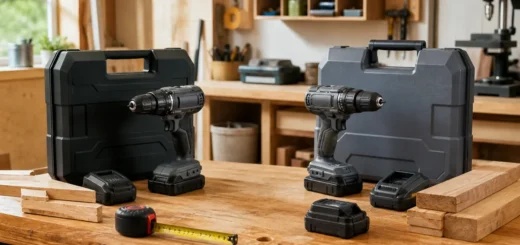
If your work is mainly light drilling and screw driving, compare a cordless drill-driver kit by complete kit price, battery availability, and warranty rather than by brand reputation alone. For occasional garage cleanup, a wet-dry shop vacuum does not need to be a commercial model if it will run only a few times a month.
When the cheaper tool is enough
The lower-priced choice is often sensible for intermittent home repairs, a one-time project, or work where precision and speed are not critical. It can also be the better buy when the premium tool’s extra features do not solve a problem you have. A larger motor, metal housing, or advanced settings are not valuable if your tasks never call on them.
For a single project, renting or borrowing may beat buying either option. If a tool costs $120 and rental is $25 per day, buying makes little sense for one short job unless you expect repeated use, need it on hand, or can resell it afterward. Check rental availability and the condition of included accessories before deciding.
Make the decision before shopping
Set a maximum price, estimate years or hours of use, and list the failures that would actually cost you money. Then compare two or three tools on total ownership cost, support, and fit for the work. Do not pay extra for a projected lifespan that has no credible evidence behind it.
Seasonal discounts can improve the math, especially when a kit includes batteries you would otherwise buy separately. Compare the sale price with the normal price of the same kit, and check whether the offer adds useful accessories or merely items you will not use. A higher-priced tool saves money through longer life only when the lifespan advantage is plausible, the added cost is covered by that advantage, and the tool’s capacity matches the work you will actually do.