Where to Actually Find Real Power Tool Deals (Not Fake Sales)
Our Top Picks
 DEWALT 20V MAX Cordless Drill and Impact DriverOne Size15.06 x 6.4 x 9.88 inches3.6 PoundsCheck on Amazon


What's inside
As an Amazon Associate I earn from qualifying purchases. This post may contain affiliate links at no extra cost to you.
Retailers are masters of the fake sale — mark it up, mark it “down,” call it a deal. After years of watching prices, here’s how we find genuine discounts and avoid getting played.
The trick works because almost nobody remembers what a tool cost last month. A listing shows a crossed-out reference price that few people ever paid, then a “sale” price sitting within a few dollars of what that model sells for on an ordinary Tuesday. Nothing was discounted. The only number worth anything is what that exact model has actually been selling for over the past few months, and the only way to know it is to watch the listing before you need it.
As an Amazon Associate we earn from qualifying purchases at no extra cost to you.





So the job breaks into three parts. Learn the windows where the discounts are real, learn to read what is actually in the box, and know what a good pick looks like at each price band so you can move quickly when the window opens. Everything outside that is marketing.

Time it to the calendar
The biggest genuine tool discounts cluster around a few predictable windows: spring for outdoor tools, and the big holiday sales in late November. Brands bundle free batteries then, which is where the real value hides.
Spring is the outdoor window because retailers are clearing floor space for the season and refreshing model years. Mowers, trimmers, blowers, pressure washers and the cordless outdoor kits get their honest cuts here, and again at the tail end of summer when whatever is left has to go. Buy a snow tool in autumn and you are paying the panic premium; buy it in spring clearance and you are paying what it is worth.
Late fall is the cordless window. From the Black Friday stretch through mid-December, combo kits, drill and impact pairs and battery bundles take the deepest legitimate cuts of the year, largely because brands compete on what they can throw into the box rather than on the sticker. Father’s Day, the July holiday weekends and early October are the smaller secondary windows worth a look. Outside all of them, most “sales” are the same price wearing a new badge.
The work happens before the window, not during it. Pick the two or three tools you actually intend to buy this year, find the specific models, and watch them for a few weeks so you know the ordinary price. When the promo lands you are comparing against a real number instead of a crossed-out one, and you can decide in a minute rather than talking yourself into something.
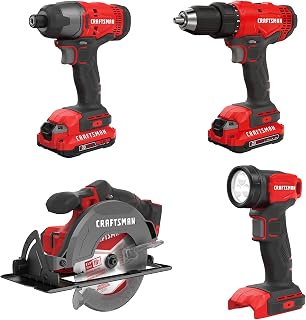
Combo Kit (Watch for Holiday Bundles)
Kits like this see their deepest, most genuine discounts during major holiday sales — often with a free extra battery thrown in. Track the price for a few weeks so you know a real deal when you see it.
Free-battery promos beat percent-off
A “buy a tool, get a free battery” promo is often a better deal than a straight discount, because batteries are the pricey part. Do the math on the battery’s standalone cost — it’s frequently the best value going.
Run the numbers the boring way. Look up what that pack sells for on its own, subtract it from the promo price, and compare the remainder against the bare tool’s usual price. A high-capacity pack thrown in for free routinely beats a headline percentage off the kit, and the value compounds: an extra battery means you keep working instead of standing at the charger, and it eventually migrates to the next tool you buy on the same platform.
The counterpart to this is the trick to watch for. When a kit looks unusually cheap during a promo, check the amp-hour rating on the included packs, because the cheapest configurations ship with the smallest compact batteries in the lineup, sometimes two of them instead of a compact plus a higher-capacity pack. The tool is identical. The runtime is not. The charger matters too: a standard charger and a rapid charger are a meaningful difference in a working afternoon, and swapping one for the other is an easy way to shave cost off a bundle without touching the headline.
How to tell a real discount from a fake one
Three checks, all of them fast, and they catch nearly everything.
Judge against the trailing street price
Ignore the “was” number entirely. Ask what this model has sold for over recent months and whether today’s price is meaningfully below that. If the answer is “about the same,” it is not a deal, no matter how large the percentage badge is. A modest cut on something you tracked is worth more than a dramatic cut on something you never priced.
Confirm the model number did not quietly change
Promotional versions of popular kits exist, with a slightly different suffix, one fewer accessory, a smaller battery or a soft bag instead of a hard case. That is not automatically bad, but it makes the price comparison invalid. Match the full model number against the one you tracked before you accept the number in front of you.
Read the box contents and the seller
Count what ships: tools, packs, charger, case, bits. Then check who is actually selling and shipping the item, because a third-party listing at a suspiciously good price can carry a different warranty path, or none. On a tool you plan to keep for a decade, warranty support is part of the price.
What a good pick looks like at each price band
Deal hunting only helps if you are hunting the right tool. Roughly, three bands, with the tradeoffs that matter in each.
Entry band
Brushed motors, one compact battery, basic charger, low two figures to the bottom of three for a kit. A good entry pick has a metal chuck, a clutch that actually works and a battery platform the brand still supports with new tools. A bad one is an off-brand kit with a proprietary battery nobody else uses, which strands you the moment the pack dies. This band suits occasional household work and people who genuinely do not know yet what they will use.
Middle band
Brushless motors, two packs with at least one higher-capacity, a better charger, low to mid three figures for a two-tool kit. This is where the free-battery promos do the most work and where most people should aim. A good pick here has a wide catalogue on the same battery, so the platform keeps paying off. Skip it only if you already own a platform, in which case buy the bare tool and use the packs you have.
Upper band
Larger combo kits, high-output packs, rapid chargers. The per-tool price looks great, which is exactly the trap: a five-tool kit is only a bargain if you will use four of the tools. Good for trades, remodels and anyone starting a shop from nothing. Bad for someone who needed a drill and got talked into a radio.
Mistakes that cost more than the discount saved
- Buying the platform twice. Chasing the best price on each individual tool leaves you with three chargers and no interchangeable batteries. Pick one platform and let deals come to you inside it.
- Shopping when the tool breaks. Urgency is full retail. Keep a shortlist so you are never buying angry.
- Valuing the percentage over the contents. A smaller cut on the better-configured kit usually wins.
- Ignoring consumables. Blades, bits, sanding discs and the right fasteners are a real line item, and a cheap tool with expensive proprietary accessories is not cheap.
- Waiting forever. A tool you did not buy has a productivity cost. If the price is fair and the project is real, buy it.
Who should chase deals, and who should just buy the tool
Deal timing pays best on high-ticket, battery-dependent purchases: your first cordless platform, a larger combo kit, outdoor power equipment, anything where the pack is a big share of the price. Those are worth planning around a window.
It pays almost nothing on cheap, high-use items. Tape measures, utility knives, hex keys, clamps and hand tools cost little and get used weekly; waiting three months to save a few dollars is a bad trade. Buy those whenever, and spend your patience on the expensive stuff.
- ✔ Holiday timing = real savings
- ✔ Free-battery promos win
- ✔ Price-tracking spots fakes
- ✘ Requires patience
- ✘ Best deals sell out fast
FAQ
How long should I track a price before I trust it?
A few weeks is enough to see the ordinary price and how often it moves. If a listing bounces between two numbers constantly, the higher one is the fiction and the lower one is the real price.
Is a free battery genuinely better than money off?
Usually, when the free pack is a higher-capacity one, because batteries carry a large share of the cost of cordless ownership. When the freebie is the smallest compact pack in the lineup, a straight discount can win. Price the pack on its own and compare.
What if the deal sells out before I decide?
Then it was a real deal, and another one is coming in the next window. Have your shortlist and your target price set in advance so the decision takes a minute, and accept that you will miss some. Missing a discount costs less than buying the wrong tool.
Should I size up to the bigger combo kit for the lower per-tool price?
Only if you can name the job for each tool in the box. Otherwise you are paying real money for tools that will live in the case, and the smaller kit plus one bare tool later is the cheaper route.
Bottom line
Track prices, buy in the right season, and favor free-battery bundles. Pair that with refurbished shopping and you’ll build a full shop for a fraction of retail.
None of it requires a spreadsheet or a deals feed. Decide what you need, learn its ordinary price, stay on one battery platform, and wait for a window you already know is coming. That is the whole method, and it is why the fake sale stops working on you.