Best Affordable Surge Protector for Power Tools and Battery Chargers
What's inside
As an Amazon Associate I earn from qualifying purchases. This post may contain affiliate links at no extra cost to you.
A good surge protector for power tools does not need to be expensive, but it does need to match the job. A $10 power strip designed for a desk is a poor choice for a 15-amp table saw, while a heavy-duty shop strip may be unnecessary for a drill charger drawing only a few watts.
For most home workshops, the best value is a UL-listed, 15-amp surge protector with a 1,000 to 2,000 joule rating, a resettable circuit breaker, spaced outlets, and a cord between 6 and 10 feet long. If you use a generator, work in an older building, or connect expensive battery chargers, spend more on protection and build quality rather than simply buying the highest joule number.
As an Amazon Associate we earn from qualifying purchases at no extra cost to you.

What to Look For in a Surge Protector
Joule rating: This is the approximate amount of surge energy the protector can absorb before its protective components wear out. For chargers and light-duty tools, 1,000 joules is a reasonable minimum. Around 2,000 to 3,000 joules gives a better margin for a workshop power strip. A high joule rating does not make a protector immune to lightning or a major utility fault, and it does not indicate how much continuous load the strip can carry.
Clamping voltage: Lower is generally better. A protector rated around 400 volts will begin limiting voltage sooner than one rated at 600 volts. Do not judge a product by joules alone; clamping voltage and response specifications matter too.
Current rating: Most household workshop receptacles and heavy-duty strips are rated for 15 amps at 120 volts. That is a theoretical maximum of 1,800 watts, but motors can draw much more current briefly when starting. Do not run a table saw, shop vacuum, heater, and battery chargers from one strip just because the total running wattage appears acceptable.
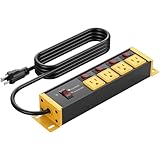
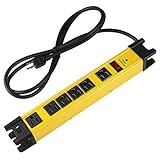
Construction: Look for a thick cord, a solid plug, recessed or covered power switches, and outlets that grip plugs firmly. Widely spaced outlets are useful because tool chargers often have large transformer blocks. A metal housing can survive shop abuse better than a thin plastic one, though it does not automatically provide better surge protection.
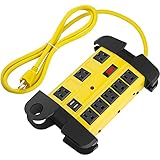
Start with a heavy-duty 15-amp surge protector if the strip will live on a workbench or serve multiple chargers.
Best Value by Use Case
| Use case | Good target | Typical value | Main trade-off |
|---|---|---|---|
| One or two battery chargers | 1,000–2,000 joules, 15 amps, six-foot cord | About $15–$30 | Usually plastic and less resistant to shop abuse |
| Workbench with several chargers | 2,000–3,000 joules, spaced outlets, breaker | About $25–$45 | More bulk; do not overload one circuit |
| Large tools and chargers | Heavy-duty strip or industrial power distribution unit | About $35–$70 | Costs more and still cannot replace a dedicated circuit |
| Outdoor or temporary work | Outdoor-rated GFCI protection and weather-resistant connections | About $25–$60 | Surge protection may be less convenient than indoor strips |
For a drill, impact driver, reciprocating saw, or lawn-tool battery charger, the cheaper category is usually fine. Chargers have switching electronics, but their actual power draw is modest. A typical charger may use tens to a few hundred watts, depending on battery size and charging stage. A reputable 1,000-joule protector with a breaker is generally adequate when the outlet and wiring are sound.
Choose a more robust workbench surge protector with widely spaced outlets when several chargers are plugged in permanently. The convenience is often worth more than another thousand joules, especially if oversized charger blocks would otherwise force you to use short extension cords.
Using Surge Protectors With Power Tools
Plug-in tools with motors are harder on a surge protector than chargers. Starting current can trip a breaker or damage a weak switch, particularly with shop vacuums, compressors, planers, and saws. A protector should not be used to hide an undersized extension cord or a circuit that already trips.
For a portable circular saw or drill used occasionally, plugging directly into a properly grounded wall outlet is often the better option. If you need extra reach, use a listed outdoor-rated extension cord of suitable gauge. A 12-gauge cord is a sensible choice for long runs or tools approaching 15 amps; thin 16-gauge cords can cause voltage drop and motor heating.
A surge strip is more useful for a bench where chargers, a radio, task lighting, and small electronics remain connected. Keep high-draw motor tools off that same strip unless the manufacturer specifically rates it for the load. Never plug one surge protector into another, and never use a power strip with a space heater.
Failure Modes Worth Avoiding
The most common failure is not a dramatic fire. It is a protector that has absorbed a surge and quietly lost its protective function. Many units have a “protected” light that turns off when the suppression components fail. Check that light occasionally, but do not treat it as proof that the strip is still healthy; the indicator itself can fail.
Replace a protector after a nearby lightning strike, a major power event, visible scorching, a melted plug, repeated breaker trips, or any burning smell. If its outlets become loose or the switch feels hot, retire it. Surge components can degrade without obvious exterior damage, so replacement after roughly three to five years is reasonable in a storm-prone area, sooner if the strip sees frequent electrical disturbances.
For garage outlets, confirm that the circuit has working grounding and GFCI protection where required. A surge protector cannot correct reversed wiring, an open ground, or an overloaded circuit. If chargers repeatedly stop working, have the receptacle and circuit tested instead of buying a larger strip.
When to Buy and Where to Save
Surge protectors are commonly discounted during spring tool promotions, major holiday sales, and back-to-school electronics events. The best bargains are usually on two- or three-packs, but only buy multiples if the specifications match your needs. A cheap six-outlet strip with a 180-joule rating is not a bargain for a busy workshop.
Look for a UL-listed 15-amp surge protector rated around 2,000 joules, and compare the price against cord length and outlet spacing. Paying $10 more for a better cord, resettable breaker, and usable layout is worthwhile. Paying extra solely for a huge joule number is not.
The Practical Choice
For a normal home workshop, buy one solid 15-amp protector around 2,000 joules for the bench, then use direct wall connections or correctly sized extension cords for high-draw tools. A basic reputable strip is enough for one or two chargers. If your shop has frequent outages, sensitive electronics, or questionable wiring, solve those electrical problems first; a surge protector is a last line of defense, not a substitute for safe power.