Best Affordable Shop Air Hose for Garage Compressors
What's inside
As an Amazon Associate I earn from qualifying purchases. This post may contain affiliate links at no extra cost to you.
A shop air hose is a small purchase that can quietly limit an entire garage compressor setup. The wrong hose kinks, leaks at the fittings, feels stiff in cold weather, or bursts when dragged across a sharp edge. The right one is usually inexpensive, but the best value depends on compressor size, tool demand, hose length, and how often you use it.
For most home garages, a 3/8-inch hose with a 1/4-inch industrial-style coupler is the sensible starting point. A 1/4-inch hose costs less and is easier to handle, but it can restrict airflow for impact wrenches, die grinders, and other high-consumption tools. A 1/2-inch hose delivers more air over longer runs, although it is heavier and often unnecessary for small compressors.
As an Amazon Associate we earn from qualifying purchases at no extra cost to you.



What to Look for in an Affordable Air Hose
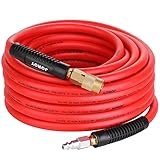
Check the hose’s inside diameter, working-pressure rating, temperature range, construction, and fittings before comparing prices. The pressure rating must exceed your compressor’s maximum pressure, not just the pressure you normally use. A hose rated for 200 PSI or more gives useful headroom for typical portable and stationary compressors.
Size matters more than many buyers expect. A 25-foot, 3/8-inch hose is a good general-purpose choice for nailers, blow guns, tire inflators, and occasional impact-wrench use. A 50-foot hose is convenient around a vehicle, but the added length increases pressure drop and makes storage harder. If you run a high-demand tool continuously, a short 1/2-inch hose can outperform a long, cheap 3/8-inch hose.
| Hose type | Best use | Advantages | Trade-offs |
|---|---|---|---|
| 1/4-inch PVC | Nailers, inflation, light blow-off | Lowest cost and light weight | Stiff, easy to kink, limited airflow |
| 3/8-inch hybrid | General garage use | Flexible, durable, good airflow | Costs more than basic PVC |
| 3/8-inch rubber | Frequent tool use and cold garages | Flexible and abrasion-resistant | Heavier and may leave black marks |
| 1/2-inch rubber or hybrid | High-airflow tools and long runs | Lowest pressure loss | Bulky, heavy, and often excessive for small compressors |
Best Budget Choice for Light-Duty Work
A basic 1/4-inch PVC hose is fine when your compressor mainly runs a brad nailer, stapler, tire chuck, or blow gun for short periods. It is commonly the cheapest option, and there is no meaningful reason to pay for a heavy rubber hose if the hose stays on a workbench and sees occasional use.
The failure mode is stiffness. PVC becomes especially unpleasant in an unheated garage, where it resists coiling and develops sharp bends. Those bends can restrict airflow and eventually damage the outer jacket. Avoid dragging inexpensive PVC over concrete, welding debris, or vehicle edges. For this use, compare 1/4-inch PVC air hoses in 25-foot lengths rather than buying extra length you will not use.
Best Value: 3/8-Inch Hybrid Hose
For most garage owners, a 3/8-inch hybrid hose is the best balance of price, flexibility, and airflow. Hybrid hoses typically combine rubber and thermoplastic materials. They coil more easily than PVC, remain reasonably flexible in cool weather, and weigh less than traditional rubber.
Choose a 25-foot hose for a workbench or compressor mounted near the vehicle. Choose 50 feet only when you regularly need to walk around a car or reach multiple work areas. Longer is not automatically better: every extra foot adds storage hassle, and a loosely coiled 50-foot hose is easier to run over or snag.
Look for factory-installed bend protectors at both ends and quality crimped fittings. A hose can have a high pressure rating and still fail at the fitting if the strain relief is poor. Search for 3/8-inch hybrid hoses with industrial couplers when comparing complete, ready-to-use sets.
When Rubber Is Worth the Extra Cost
Rubber is the better choice for frequent use, cold conditions, and rough floors. It stays flexible when temperatures fall, tolerates dragging better, and generally feels less springy while operating a tool. That matters when using an impact wrench or grinder, where a stiff hose can pull against your wrist.
The disadvantages are real. Rubber hoses are heavier, can leave dark marks on light concrete, and often cost noticeably more. If you use air tools once a month, the premium may not pay back. If you work every weekend or keep the hose permanently connected to a reel, rubber’s durability and flexibility can justify the added cost.
Fittings, Couplers, and Airflow
Do not judge a hose only by its outside diameter. The couplers and plugs can restrict flow, especially inexpensive high-flow tools paired with small automotive-style fittings. For general garage use, 1/4-inch industrial interchange fittings are widely available and easy to replace. Match every plug and coupler to the same standard; fittings that look similar are not always interchangeable.
Thread sealant belongs on tapered pipe threads, not on the hose end itself. Use thread tape carefully so loose strands cannot enter the air passage. After assembly, pressurize the system and brush soapy water over the fittings. Growing bubbles indicate a leak that will make the compressor cycle more often and reduce tool performance.
When to Buy and How to Save
Air hoses are often cheapest during spring garage-cleanup promotions, Father’s Day tool sales, and Black Friday events. Seasonal discounts are most useful on 50-foot rubber or hybrid hoses, where the dollar savings are larger. Basic PVC hoses are inexpensive year-round, so waiting for a small percentage discount rarely matters.
Compare the delivered price, not just the listed price. A hose with included couplers may cost less than a bare hose plus separate plugs, especially if you need two ends immediately. Avoid buying a cheap hose bundle with fittings you cannot use; replacing all the couplers can erase the savings.
The Practical Buying Decision
Buy a 25-foot, 3/8-inch hybrid hose for a mixed-use garage. Choose 1/4-inch PVC if your work is limited to nailers and inflation. Move to 3/8-inch rubber when the hose will see frequent dragging, cold temperatures, or daily tool use. Consider 1/2 inch only for long runs or tools that genuinely need sustained airflow; a larger hose cannot make a small compressor produce more air.
If your compressor struggles to keep up, the problem may be its cubic-feet-per-minute rating rather than the hose. A better hose reduces restriction, but it will not turn a 4-CFM compressor into a continuous grinder supply. Spend first on the diameter and length that match your work, then pay extra for rubber construction only where its durability solves a real problem.