Best Value Shop Air Filtration Unit for a One-Car Garage
What's inside
As an Amazon Associate I earn from qualifying purchases. This post may contain affiliate links at no extra cost to you.
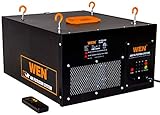
For a one-car garage, the best value air filtration unit is usually a compact ceiling-mounted or suspended shop air cleaner rated around 800 to 1,200 CFM. That is enough airflow to cycle the air in a typical 400- to 600-square-foot garage several times per hour without paying for a large commercial unit you do not need.
Air filtration is not the same as dust collection. A shop vacuum or dust collector should capture chips and dust at the tool. An overhead air cleaner handles the fine particles that escape, especially when sanding, routing, or cutting MDF. It is a second line of defense, not a substitute for connecting a dust hose to the tool.
As an Amazon Associate we earn from qualifying purchases at no extra cost to you.


What to Look For in a One-Car Garage
Start with airflow, but do not judge a unit by its highest advertised CFM alone. Manufacturers often quote free-air performance, while the real airflow drops when filters become dirty. A practical target is about 10 to 15 air changes per hour.
For example, a 20-by-20-foot garage with an 8-foot ceiling contains 3,200 cubic feet of air. A unit moving 800 CFM theoretically changes that air 15 times per hour. In actual use, reduced airflow, blocked intake space, and leaks lower the result. That is why an honest 800-CFM unit is often more useful than a claimed 1,200-CFM unit with weak filters and a small fan.
Look for a two-stage filter arrangement: a washable or replaceable coarse pre-filter followed by a pleated fine filter. The pre-filter catches larger dust and protects the expensive inner filter. A pleated filter with a rating around MERV 11 to MERV 13 is a sensible range for garage woodworking. Higher filtration can capture more fine dust, but it also increases resistance and may reduce airflow if the fan is not designed for it.
A timer or remote control is worth paying for. Running the unit for 30 to 60 minutes after sanding is more useful than leaving it running all day. Three speeds are preferable to a single-speed fan because you can use a quieter setting during cleanup or a higher setting after a dusty operation.
The Best-Value Configuration
For most one-car garages, buy a basic 800 CFM shop air filtration unit with a remote, timer, and replaceable pleated filter. This category usually offers the best balance of price, airflow, and operating cost. A unit in the roughly $150 to $250 range is generally more sensible than a premium machine costing twice as much.
Choose a larger 1,000- to 1,200-CFM unit if you regularly use a table saw, router table, thickness planer, or drum sander. Those tools produce more airborne fines, and the extra airflow helps in a larger or poorly sealed garage. The trade-off is more noise, higher filter costs, and less flexibility when the garage doubles as a workspace or storage area.
| Type | Typical airflow | Best use | Main compromise |
|---|---|---|---|
| Compact single-speed cleaner | 500-800 CFM | Occasional sanding and light DIY work | Less control and often louder at the only speed |
| Two- or three-speed unit | 800-1,200 CFM | Regular woodworking in a one-car garage | Costs more and needs periodic filter replacement |
| High-capacity shop unit | 1,200 CFM or more | Frequent heavy sanding or a larger shop | Higher purchase price, noise, and running cost |
| DIY box-fan filter | Varies widely | Very occasional work or temporary use | Usually less durable and less safe overhead |
Brand and Price Value
Established woodworking brands tend to offer better filter availability, clearer airflow specifications, and sturdier housings. That matters because the fan motor may last for years, while filters are consumables. A cheap unit becomes a poor bargain if replacement filters are difficult to find or cost nearly as much as the machine.
Budget brands can still be a good choice for occasional users. If you sand a few projects each year, a basic unit with a real pleated filter, a timer, and a readily available replacement filter may be all you need. Do not pay extra for digital controls or elaborate remotes if the unit will run only during weekend projects.
Before ordering, check the price of a replacement shop air filter. Expect to replace the inner filter roughly once or twice a year for regular hobby use, sooner if you work with MDF or drywall compound. A visibly gray filter, reduced airflow, or a dusty exhaust side means it is overdue. Do not wash a pleated paper filter unless the manufacturer specifically says it is washable.
Installation and Operating Mistakes
Mount the cleaner high, but leave clearance around the intake and exhaust. A common mistake is placing it directly against a wall, shelf, or garage door, which restricts airflow. Hanging it from the ceiling keeps it out of the way, but use properly rated hardware and safety cables. If you rent or cannot safely suspend it, place it on a stable shelf or workbench where it cannot vibrate off.
Position the unit so air circulates across the room rather than blowing directly at a pile of sawdust. In a rectangular garage, placing it near one end and aiming the exhaust along the long dimension often creates better circulation than putting it in a corner. Keep the main dust-producing tool several feet away from the intake so chips do not overload the pre-filter immediately.
Run the cleaner while working and for at least 30 minutes afterward. For heavy sanding, 60 minutes is more realistic. Keep the garage door partly open only when outdoor conditions and security allow; ventilation removes fumes and airborne dust, but it also reduces the effectiveness of recirculating filtration. Never rely on an air cleaner for solvent vapors, carbon monoxide, or combustible-gas hazards.
When to Buy
Prices are often strongest around major holiday sales, especially late November and during spring home-improvement promotions. Compare the complete cost, including the first replacement filter and shipping. A $20 discount disappears quickly if the unit has unusually expensive filters.
Winter can be a good buying season for garage woodworkers because indoor projects increase and retailers discount leftover inventory. In summer, watch for bundle promotions that include an extra filter. That is useful value only if the filter fits the exact unit and is not an obscure replacement.
If your budget is tight, buy the basic compact shop air filtration system with a remote and timer rather than the cheapest fan-only product. The cheaper option is fine for occasional hand sanding, but regular machine work justifies better filtration, multiple speeds, and dependable replacement parts.