Best Affordable Masonry Tool Set for Homeowners
What's inside
As an Amazon Associate I earn from qualifying purchases. This post may contain affiliate links at no extra cost to you.
For most homeowners, a masonry tool set does not need to be large or professional-grade. A practical kit for repairing mortar joints, setting a few bricks, patching concrete, or installing a small paver project usually costs less than $100. The key is buying the right hand tools, not a case full of duplicates that will sit unused.
As an Amazon Associate we earn from qualifying purchases at no extra cost to you.


What You Actually Need
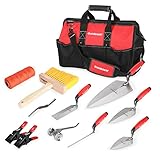
A useful starter setup includes a brick trowel, pointing trowel, margin trowel, masonry jointer, cold chisel, small club hammer, stiff brush, mixing tub, and basic safety gear. Add a mortar hawk if you will be repointing walls or working overhead. A 10- to 14-inch mixing hoe is helpful for larger batches, but a margin trowel or garden hoe can handle small repairs.
For a simple repair, start with a masonry hand tool set that includes the trowels and jointers, then buy a chisel, hammer, and tub separately if the included versions look thin or poorly finished. Sets are convenient, but the cheapest kits often save money by using narrow blades, weak handles, and jointers with inconsistent profiles.
Best-Value Tool Combinations
| Homeowner job | Tools to buy | Typical budget | Where to save |
|---|---|---|---|
| Small crack or loose brick repair | Pointing trowel, margin trowel, jointer, brush, bucket | $25–$50 | Use an existing bucket and buy individual tools |
| Repointing several square feet of wall | Pointing trowels, jointers, hawk, chisel, club hammer, brush | $50–$100 | Buy a basic hawk and skip oversized sets |
| Small brick or block project | Brick trowel, level, line, jointers, mixing tub, hoe, gloves | $75–$150 | Use a household level and rent a mixer if needed |
| Concrete or paver preparation | Chisel, club hammer, masonry brush, screed, rubber mallet | $40–$90 | Buy specialty tools only after measuring the project |
Prices vary by brand and season, but these ranges are realistic for basic homeowner tools. A $30 set can be perfectly adequate for one afternoon of work. It is less likely to remain comfortable or accurate after repeated use.
Where Quality Matters Most
The brick trowel is the tool most likely to expose poor quality. Look for a blade that is reasonably stiff, securely attached to the shank, and smooth along the edges. A blade that flexes when you scoop mortar makes it harder to spread an even bed. For occasional work, a carbon-steel blade is fine. Stainless steel resists rust and cleans more easily, but it usually costs more and is not automatically stronger.
A pointing trowel should have a straight, narrow blade with a comfortable handle. Blades around 5 to 6 inches are versatile for mortar joints. Very narrow 3-inch tools can work in tight joints but are slow for general repairs. A margin trowel is useful for scraping mortar from a bucket and packing deep gaps, so it is often more valuable than a second brick trowel.
Jointing tools deserve more attention than they usually receive. The correct profile controls the finished mortar surface. A concave jointer generally sheds water well and is forgiving for beginners. Buy a set with several widths if your wall has mixed joints, but do not assume every size is necessary. A 3/8-inch and 1/2-inch jointer cover many residential brick repairs.
For breaking out damaged mortar, choose a masonry cold chisel and club hammer rather than a claw hammer. A 1- to 2-pound club hammer gives better control than a full-size sledgehammer. Heavy blows can crack brick faces, chip concrete edges, or loosen sound mortar around the repair.
When Cheap Tools Are Fine
The cheaper option is usually fine for a single mailbox repair, a few damaged joints, or setting a handful of pavers. A basic steel trowel may last years if it is washed immediately, dried, and stored indoors. Spending $20 more will not make a badly mixed mortar repair succeed.
Upgrade when you are repointing an entire wall, working for several hours, or expect to use the tools every season. Better handles reduce hand fatigue, and a more rigid blade makes it easier to maintain consistent mortar thickness. The difference becomes noticeable after 30 to 60 minutes, not necessarily during the first five.
Avoid the very lowest-priced kits when the handles are loose, the blades have sharp unfinished edges, or the jointers are visibly bent. These are failure points, not cosmetic flaws. A loose handle can separate while loading mortar, and a rough blade can drag aggregate across a finished joint.
Safety and Jobsite Extras
Mortar dust is alkaline and can irritate skin, eyes, and lungs. At minimum, wear safety glasses, waterproof gloves, long sleeves, and a properly rated dust mask when mixing dry materials. A cheap plastic mixing tub is often safer and easier to clean than a household bucket because it gives the mortar more room and reduces splashing.
Add a masonry mixing pan and mortar hoe if you will mix more than one or two small batches. Mixing on a board or in a shallow box can work, but it leaves dry pockets and makes cleanup difficult. For batches over roughly 60 pounds, renting a mixer may be cheaper than buying a tool you will not use again.
Keep a stiff nylon brush and a sponge nearby. Clean mortar from tools before it hardens; once cured, it can take 10 to 20 minutes of scraping per tool and may damage plated surfaces. Do not wash large amounts of mortar into a drain. Let waste harden, then dispose of it according to local rules.
When to Buy and What to Watch For
Tool sets and masonry accessories are commonly discounted during spring home-improvement promotions, Memorial Day, Labor Day, and late-fall clearance events. Spring has the widest selection, while late fall can offer better prices on seasonal project kits. Compare the contents rather than the claimed discount: a $40 set with two redundant trowels is not a bargain if it lacks a usable jointer and chisel.
Before ordering, check blade dimensions, handle reviews, and whether the set includes a case that will actually fit the tools. Search for masonry jointer and brick trowel sets when you already own a hammer and bucket. That targeted purchase is often the best value for homeowners because it avoids paying for low-quality extras.
Finally, match the kit to the material. Soft historic brick needs controlled hand work and a light touch; a bargain chisel and heavy hammer can cause permanent damage. For modern block, concrete, and small paver jobs, an inexpensive hand-tool set is usually enough, provided the blades are straight, the handles are secure, and you take time to mix and clean properly.