Miter Box and Saw Sets: How to Choose for Clean, Square Cuts
What's inside
As an Amazon Associate I earn from qualifying purchases. This post may contain affiliate links at no extra cost to you.
For most buyers, the right miter box and saw set is a fixed-slot clamping box in the $15–$35 range paired with a 12–14 TPI backsaw; if you cut angles beyond 45° and 90° or work in hardwoods regularly, an adjustable pivot box in the $90–$200 range earns its price in accuracy. The decision comes down to three things listings rarely spell out: how many angles you actually need, how fine the teeth must be for your material, and — the big one — whether the box’s real capacity at 45° fits your widest molding.
As an Amazon Associate we earn from qualifying purchases at no extra cost to you.

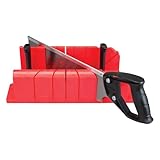

Fixed-Slot vs. Adjustable Miter Boxes: The Real Trade-Off
Fixed-slot boxes — the familiar molded-plastic units such as the Stanley 20-600 and the contractor-grade 20-800, plus older sheet-metal designs — guide the blade through slots cut at preset angles, usually 45° left, 90°, and 45° right, with some adding 22.5°. There’s nothing to calibrate: drop the saw in the slot and cut. Adjustable boxes like the Nobex Proman 110, Nobex Champion 180, and Ulmia’s metal mitre boxes swing the saw on a degree scale with detents, so any angle up to about 45° each way is available, and the blade rides in cam-adjustable guides rather than fixed slots.
| Fixed-slot box | Adjustable pivot box | |
|---|---|---|
| Angles | 45° and 90° (some add 22.5°) | Continuous, ~0–45° each way with detents |
| Typical capacity at 90° (flat) | ~3-1/2–4-1/2 in. | ~4-5/16–7-1/16 in. (110–180 mm) |
| Capacity at 45° (flat) | Same as 90° rating | ~70% of the 90° rating |
| Depth of cut | ~3-1/4–3-1/2 in. | ~3-7/16–4-15/16 in. |
| Cut accuracy | ±0.5–1° new; worsens as slots wear | ±0.25–0.5°; guides are user-adjustable |
| Included saw | 12–14 TPI push backsaw | Finer; some accept thin pull saws |
| Saw replaceable/sharpenable | Rarely | Yes — blades sold separately |
| Weight / mounting | ~1–2 lb, bench or sawhorse | ~5–15 lb, often bench-mounted |
| Typical price | $15–$35 | $90–$200+ |
The accuracy gap widens with use. A molded slot is precise on day one, but every stroke scrubs the slot shoulders, and after a few hundred cuts the slop can let the blade wander a degree or more — enough to open a visible gap in a casing joint. An adjustable box’s metal guides can be tightened or re-shimmed, and a dull blade is a $20–$40 replacement rather than a new set. On a fixed-slot kit, the bundled saw is usually induction-hardened and effectively disposable.
Saw Tooth Count: Match TPI to the Material
Teeth per inch controls speed and surface quality. The 12–14 TPI backsaw bundled with most miter box and saw sets is a deliberate compromise — fast enough for 1x stock, clean enough for painted pine. Go finer and cuts get slower but cleaner; go coarser and softwoods fuzz and hardwood faces tear.
| Material / job | TPI | If you choose wrong |
|---|---|---|
| Framing lumber, rough 1x/2x softwood, PVC pipe | 9–11 | Finer teeth clog and stall; cut is slow but still rough-edged |
| Baseboard, casing, lattice, laminate trim | 12–15 | This is the bundled saw’s territory — the safe default |
| Hardwood trim, veneered plywood, dowels | 16–20 | Coarse teeth tear veneer and chip oak faces |
| Hobby stock, brass tube, miniatures | 24–32 | Needs a razor saw (Zona-style) and a mini box, not a full-size set |
Push Saw or Pull Saw?
Most fixed-slot boxes are molded for Western push saws with plates around 0.025–0.035 in. thick. Japanese pull saws (Gyokucho-style) run kerfs of roughly 0.016–0.024 in. and wobble badly in a loose molded slot — which is exactly what ruins a miter. Several adjustable boxes accept thin pull saws because their guides clamp the plate on both sides. If you want pull-saw smoothness, buy the box style that supports it rather than hoping a thin blade will behave in a fixed slot.
Capacity: How Wide a Molding Each Box Really Holds
Listings quote one number — “4 in.” or “110 mm” — but that’s almost always the 90° rating. When a board lies flat and you cut a 45° miter, the kerf travels diagonally across the board face: a distance of board width × 1.41. On a fixed-slot box that doesn’t matter, because the molded slots span the whole channel. On a pivot-style box the blade sweeps the same physical width at every angle, so usable flat capacity at 45° drops to roughly the 90° rating ÷ 1.41 — about 30% less. For stock standing on edge (baseboard nested vertically, small crown), the limit is the saw’s depth of cut, not channel width at all.
| Box size / class | 90° flat width | 45° flat width | Depth of cut (on edge) | Moldings it fits |
|---|---|---|---|---|
| Mini hobby box (razor-saw sets) | ~1-3/4 in. | ~1-3/4 in. | ~1-1/8 in. | Quarter-round, dowels, scale trim |
| Standard fixed-slot plastic (Stanley 20-600 class) | ~3-1/2 in. | ~3-1/2 in. | ~3-1/4 in. | 1×4, 2-1/4 in. casing, 3-1/4 in. base flat |
| Contractor fixed-slot (Stanley 20-800 class) | ~4-1/2 in. | ~4-1/2 in. | ~3-1/2 in. | 4-1/4 in. base flat, wide casing |
| Compact pivot (Nobex Proman 110) | 110 mm ≈ 4-5/16 in. | ~78 mm ≈ 3-1/16 in. | ~88 mm ≈ 3-7/16 in. | Casing, shoe, base up to ~3 in. flat |
| Large pivot (Nobex Champion 180 / Ulmia-class) | 180 mm ≈ 7-1/16 in. | ~125 mm ≈ 4-15/16 in. | ~125 mm ≈ 4-15/16 in. | 4-1/4 in. base flat or on edge, 1×6, wide casing |
Worked example: 4-1/4 in. baseboard is the size that trips most buyers. Cut flat at 45°, it needs a full 4-1/4 in. of 45° capacity. A Proman 110 tops out around 3-1/16 in. at 45°, so the far corner stays attached and you finish by hand. The Champion 180 reaches roughly 4-15/16 in. at 45°, leaving about 3/4 in. of margin — and its ~4-15/16 in. depth of cut also means the same baseboard fits standing on edge. In a standard plastic box (3-1/2 in. channel, ~3-1/4 in. walls), a 4-1/4 in. baseboard fits in neither orientation; you need a contractor-size channel or a bigger box. Crown molding follows the same logic: nested crown needs depth of cut greater than the crown’s vertical rise, so anything over about 2 in. of crown gets awkward in a hand box and realistically belongs on a miter saw or gets coped.
Picking a Set for Your Situation
- One room of painted baseboard or casing, once or twice a year: fixed-slot plastic set, $15–$35. Cam-lock pins to hold the stock are worth paying a few dollars for.
- Bay windows, odd wall angles, hardwoods, repeat trim work: adjustable pivot box, $90–$200+. The 22.5° setting alone justifies it on older houses.
- Dowels, miniatures, hobby stock: mini box with a 24–32 TPI razor saw, roughly $10–$25.
- PVC pipe, lattice, rough stock: any fixed-slot box plus a coarse 9–11 TPI blade — tooth count matters more than the box here.
- Baseboard over 4 in., crown over 3 in., or daily volume: a miter box is the wrong tool; a compound miter saw is where the money should go.
Setting Up for Cuts That Actually Close
- Verify before you trust. Cut a scrap at 45°, flip one half 180°, and butt the miters together. A visible seam means the slot or fence is off — shim it, or exchange the box while you still can.
- Mark the show face with a knife line, not just pencil; a knife line severs surface fibers and gives the saw a track to start in.
- Clamp, don’t hold. Use the box’s cam pins or a C-clamp. Hand pressure lets stock creep 1/32 in. or more mid-cut — enough to spoil a joint.
- Score the kerf with three or four short strokes at the waste side before taking full strokes.
- Let the teeth cut. Forcing the saw tears the exit face and scrubs slot walls faster — the two most common ways these sets die young.
- Protect the exit face: cut face-up, tape or knife-score where the blade exits, or leave a hair of waste for a final light pass.
What Wears Out First — and How to Slow It
In order of failure: the slot shoulders on plastic boxes (they widen until the saw chatters), the tooth set on bundled saws (induction-hardened teeth aren’t worth resharpening), and the cam-lock pins (which bend if you crank them). Waxing the slots with paraffin and keeping strokes straight roughly doubles slot life. On metal pivot boxes, wax the turntable and oil the saw plate against rust. The flip test above doubles as a wear gauge — once a persistent gap can’t be shimmed out, the box is done, even if it looks fine. That serviceability is the quiet argument for adjustable boxes: on Nobex and Ulmia units, blades and guide parts are consumables you replace, not reasons to buy a whole new tool.
FAQ
Can a miter box cut crown molding?
Small crown, yes — nest it upside down against the fence the way you would on a miter saw, and make sure the box’s depth of cut exceeds the crown’s rise. For crown over about 2–3 in., a power miter saw or a coped joint is the practical answer.
Why do my 45° cuts leave a gap?
Three usual causes, in order: worn or sloppy slots letting the blade wander, stock creeping because it wasn’t clamped, and a box that was never square to begin with. Run the flip test on a scrap to isolate which one you have.
Do I need a different saw for PVC trim or pipe?
No new box — just tooth count. A coarse 9–11 TPI blade cuts PVC fast without clogging; the fine saw bundled with the set will gum up and chatter.
Can a miter box cut metal?
Only soft metals — brass, aluminum rod, picture-frame stock — and only with a fine 24–32 TPI razor saw in a mini or hobby box. Steel fasteners, conduit, or anything hard will strip the teeth in one pass.